
Heavenly Hosts
Biblical Encounters
Where angels meet the faithful in the pages of Scripture.
Again and again in the Scriptures a single angel steps into one moment of the story — unnamed, yet unmistakably sent. An angel wrestles with Jacob at the ford of the Jabbok; an angel stirs the waters of the pool of Bethesda; an angel breaks Peter’s chains in the night and leads him past the guards; an angel sits in the empty tomb and proclaims the Resurrection. Each of these is remembered here by the encounterrather than by a personal name, with the event, its Scripture, and the way the Church has read it.
The Old Testament
The Angel and AbrahamThe angelic intervention at the Binding of Isaac (Genesis 22, the Akedah). When Abraham, obedient to God’s command, raises the knife to offer his son Isaac upon Mount Moriah, the Angel of the Lord calls from heaven — “Abraham, Abraham! Do not lay your hand on the lad” — halting the sacrifice, providing a ram in Isaac’s place, and renewing the covenant promise. The Church reads Isaac bearing the wood as a type of Christ, the ram as His sacrifice, and Moriah as a foreshadowing of Golgotha; the figure is again the Angel of the Lord, understood either as a created messenger or, by some Fathers, as the pre-incarnate Word.The Angel and BalaamThe confrontation of Numbers 22:22–35, in which the Angel of the Lord stands in the road with a drawn sword to bar the way of the prophet-diviner Balaam, hired by Balak of Moab to curse Israel. The angel is seen first only by Balaam’s donkey, which turns aside three times and is beaten for it, until God gives the animal speech and opens Balaam’s eyes to the sword-bearing angel before him. The encounter shows that even a prophet may be spiritually blind, that humility perceives what pride cannot, and that God’s protection of His covenant people cannot be overturned — Balaam can utter only the blessing God permits.The Angel and HagarThe two wilderness episodes in which the Angel of the Lord comes to the aid of Hagar, the Egyptian servant of Sarah. In Genesis 16 the Angel finds her fleeing beside a spring, sends her back, and announces the birth of Ishmael; in Genesis 21 the Angel of God calls to her from heaven as her child lies dying of thirst and opens her eyes to a well. Hagar names the Lord “the God who sees” — one of Scripture’s most striking scenes of divine care for a vulnerable outsider. The figure is an appearance of the Angel of the Lord, whom the Church reads either as a created messenger speaking in God’s name or, in the great theophanies, as the pre-incarnate Word.The Burning BushThe theophany of Exodus 3–4 at Mount Horeb, where Moses, tending Jethro’s flock, sees a bush aflame yet not consumed. The Angel of the Lord appears in the flame and God speaks from the midst of the bush — bidding Moses remove his sandals on holy ground, revealing the divine Name (“I AM WHO I AM”), and commissioning him to lead Israel out of Egypt. The Church reads the bush that bore divine fire unconsumed as the great type of the Theotokos, who bore God incarnate without being consumed — an image at the very heart of Orthodox Marian hymnography and of the “Unburnt Bush” icon.The Destruction of Sennacherib’s ArmyThe angelic judgment of 2 Kings 19:35–37 (with Isaiah 37 and 2 Chronicles 32), in which the Angel of the Lord goes out in the night and strikes the camp of Sennacherib, king of Assyria, besieging Jerusalem in the days of King Hezekiah — 185,000 soldiers fall, and Sennacherib withdraws to Nineveh, where his own sons later kill him. The angel speaks no word; his deed itself is the message. It is among Scripture’s clearest signs of an angel as the instrument of divine judgment and protection — delivering Jerusalem in answer to Hezekiah’s prayer and Isaiah’s prophecy, and preserving the city of David and the Temple.Cherubim Guarding EdenThe cherubim whom God stationed east of the Garden of Eden after the Fall, with a flaming sword turning every way, to guard the way to the Tree of Life (Genesis 3:24). They are Scripture’s first angelic guardians of sacred space — a sign at once of humanity’s exile from Paradise and, as the Church reads it, of the way to the Tree of Life that Christ reopens through His Cross and Resurrection. Orthodox tradition identifies them with the Cherubim, the second rank of the celestial hierarchy.Daniel’s Angelic VisionsThe sustained cycle of revelations in the Book of Daniel (chiefly chapters 7–12), which gives the Old Testament its most detailed unveiling of the angelic world. Here the Archangel Gabriel appears by name to interpret Daniel’s visions (Daniel 8–9), and the Archangel Michael is named as “one of the chief princes” and “the great prince who stands watch over your people” (Daniel 10; 12). Daniel also beholds the Ancient of Days enthroned amid myriads of heavenly attendants, the radiant messenger of Daniel 10, the “watchers” who announce God’s judgment, and the angelic “princes” set over the nations. The book named Michael and Gabriel long before their appearances in the Gospel and the Apocalypse, and became a wellspring of Orthodox angelology, iconography, and eschatology.Jacob’s LadderThe vision granted to the Patriarch Jacob at Bethel as he fled toward Haran (Genesis 28:10–22): a ladder set on the earth with its top reaching to heaven, the angels of God ascending and descending upon it, and the Lord standing above it to renew the covenant of Abraham and Isaac. The Church reads the ladder as a type of Christ, who unites heaven and earth (John 1:51), and of the Theotokos, through whom God descended to dwell among us.
The New Testament
Angel Strengthening Christ in GethsemaneOn the night before His Passion, as Christ prayed in the Garden of Gethsemane — “Father, if it is Your will, take this cup away from Me; nevertheless not My will, but Yours, be done” — “an angel appeared to Him from heaven, strengthening Him” (Luke 22:43). The moment is recorded only by Luke, and the Church reads it as a witness to the true humanity of the incarnate Son: the angel strengthens Him not because His divinity lacks power but because He freely accepts angelic ministry according to the human nature He assumed, even as He remains the Lord whom the angels worship. Scripture names neither the angel nor his rank, and does not call him “the angel of the Lord”; the liturgical tradition keeps that silence. The scene pairs with the angels who ministered after the temptation (HH-0034) — the two Gospel moments where unnamed angels serve Christ directly, framing His ministry between His first victory over Satan and His voluntary Passion.Joseph's DreamsThe first and best-known of the four dreams by which “an angel of the Lord” guides Righteous Joseph the Betrothed through Christ’s infancy (Matthew 1–2). When Joseph, a just man of the house of David, resolves to divorce the pregnant Virgin quietly, the angel appears in a dream: he must not fear to take Mary as his wife, for the child is “of the Holy Spirit,” and he is to name Him Jesus, “for He will save His people from their sins” — fulfilling Isaiah’s word that the virgin shall bear Emmanuel. Three further dreams send Joseph to flee into Egypt, to return, and to settle in Galilee. Matthew names the messenger only as “an angel of the Lord” (angelos Kyriou), and — unlike the Annunciations to Zechariah and the Virgin — neither Scripture nor Orthodox liturgical tradition identifies him as Gabriel; the Church keeps the biblical wording. Understood as a created heavenly messenger (see the Angel of the Lord, HH-0019), the angel confirms the virginal conception, secures Christ’s legal descent from David, and inaugurates Joseph’s vocation as guardian of the Holy Family.The Annunciation to ZechariahThe opening event of Luke's Gospel (Luke 1:5–25): the Archangel Gabriel appears to the priest Zechariah at the altar of incense in the Jerusalem Temple and announces that his aged, barren wife Elizabeth will bear a son — John the Forerunner, who will go before the Lord “in the spirit and power of Elijah.” When Zechariah doubts, Gabriel — “who stands in the presence of God” (Luke 1:19) — declares him unable to speak until the child’s birth, and his silence itself becomes a sign to the people. Orthodox tradition reads Gabriel’s appearance as the renewal of prophecy after the silent centuries and the first announcement of the approaching Incarnation: the same archangel will soon appear to the Virgin. Unlike the Old-Testament theophanies of the Angel of the Lord, this is a named, created messenger, so no question of a divine manifestation arises.The Annunciation to the TheotokosThe Great Feast of the Incarnation (Luke 1:26–38): the Archangel Gabriel is sent to Nazareth to the Virgin Mary with the greeting “Rejoice, highly favored one, the Lord is with you,” and announces that she will conceive the Son of the Most High by the Holy Spirit. At her free assent — “Behold the servant of the Lord; let it be to me according to your word” (Luke 1:38) — the eternal Word takes flesh in her womb. Orthodox tradition keeps this as one of the Twelve Great Feasts on March 25, exactly nine months before the Nativity, and confesses it as the beginning of salvation, a manifestation of the Holy Trinity, and the fulfillment of the prophecy that a virgin shall conceive (Isaiah 7:14). Gabriel — the same named archangel who had appeared to Zechariah — is the created herald of the mystery, so, as at the earlier annunciation, no theophany question arises.Angels at Christ's TemptationAfter Christ’s forty-day fast and His victory over the devil’s three temptations in the wilderness, “angels came and ministered to Him” (Matthew 4:11; Mark 1:13). The angels do not intervene during the temptation itself: Christ confronts Satan alone, answering each assault from Scripture as the obedient New Adam and faithful Israel, where Adam and Israel had failed. Only after Satan departs do the angels appear — not to rescue Him but to honor the victory won, ministering to Him according to His human nature even as He remains their Creator and Lord. The Fathers compare their service to the angel who fed Elijah in the wilderness (1 Kings 19), and read it as heaven’s recognition of Christ’s triumph and as the promise that faithful endurance is followed by divine consolation. Scripture names neither the angels nor their rank, and does not call them “the angel of the Lord”; the Church keeps that silence.Angels at the AscensionThe two heavenly messengers who appeared to the Apostles immediately after Christ’s Ascension from the Mount of Olives (Acts 1:9–11). As the disciples gazed upward, where a cloud had received the Lord from their sight, “two men stood by them in white apparel” — universally understood as angels — and said, “Men of Galilee, why do you stand gazing up into heaven? This same Jesus, who was taken up from you into heaven, will so come in like manner as you saw Him go.” Unlike the angels at Bethlehem or the empty tomb, these angels announce no new event but interpret one already witnessed: they do not cause the Ascension or accompany Christ into heaven, but remain with the Apostles to explain His heavenly enthronement and proclaim the certainty of His return. Scripture names neither of them, and the Church keeps that silence. The two angels of the Ascension are the deliberate pair of the two angels at the empty tomb (HH-0036) — heaven’s witnesses at both the victory over death and the exaltation of human nature.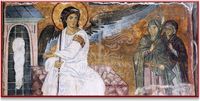 Angels at the ResurrectionThe heavenly messengers at the empty tomb on the morning of Christ’s Resurrection, recorded in all four Gospels (Matthew 28; Mark 16; Luke 24; John 20). Matthew tells of “an angel of the Lord” who descends, rolls back the stone, and sits upon it, his face like lightning and his garment white as snow; Mark of a “young man in a white robe”; Luke and John of “two men in dazzling garments” and “two angels in white” — accounts the Fathers harmonize as several angels present, each Evangelist telling what served his purpose. The angels do not raise Christ, who rises by His own divine power; nor is the stone rolled away to let Him out — the glorified Christ needed no opened tomb — but so that the women and the Apostles might see it empty. Their office is to proclaim: “He is not here; for He is risen, as He said,” and to send the Myrrh-bearing Women as the first heralds of the Resurrection. Scripture names none of them, and the Church keeps that silence, fixing the eye on the risen Lord.The Nativity and the Heavenly HostThe angelic proclamation at Christ’s birth (Luke 2:8–20): an unnamed “angel of the Lord” announces the Savior’s birth to shepherds keeping watch near Bethlehem, and suddenly “a multitude of the heavenly host” appears, glorifying God — “Glory to God in the highest, and on earth peace, goodwill among men” (Luke 2:14). Unlike the single messengers of the earlier infancy scenes, here a whole heavenly army (Greek stratia, an ordered host) is seen praising God, extending to earth the worship the angels offer unceasingly before His throne. Orthodox tradition reads the hymn as heaven’s celebration of the Incarnation and of the reconciliation of God and humanity, and has made its opening words the beginning of the Great Doxology, by which the Church joins the angels’ song. Luke names neither the first angel nor the host, and the Church keeps that silence — their ranks are not assigned.
Angels at the ResurrectionThe heavenly messengers at the empty tomb on the morning of Christ’s Resurrection, recorded in all four Gospels (Matthew 28; Mark 16; Luke 24; John 20). Matthew tells of “an angel of the Lord” who descends, rolls back the stone, and sits upon it, his face like lightning and his garment white as snow; Mark of a “young man in a white robe”; Luke and John of “two men in dazzling garments” and “two angels in white” — accounts the Fathers harmonize as several angels present, each Evangelist telling what served his purpose. The angels do not raise Christ, who rises by His own divine power; nor is the stone rolled away to let Him out — the glorified Christ needed no opened tomb — but so that the women and the Apostles might see it empty. Their office is to proclaim: “He is not here; for He is risen, as He said,” and to send the Myrrh-bearing Women as the first heralds of the Resurrection. Scripture names none of them, and the Church keeps that silence, fixing the eye on the risen Lord.The Nativity and the Heavenly HostThe angelic proclamation at Christ’s birth (Luke 2:8–20): an unnamed “angel of the Lord” announces the Savior’s birth to shepherds keeping watch near Bethlehem, and suddenly “a multitude of the heavenly host” appears, glorifying God — “Glory to God in the highest, and on earth peace, goodwill among men” (Luke 2:14). Unlike the single messengers of the earlier infancy scenes, here a whole heavenly army (Greek stratia, an ordered host) is seen praising God, extending to earth the worship the angels offer unceasingly before His throne. Orthodox tradition reads the hymn as heaven’s celebration of the Incarnation and of the reconciliation of God and humanity, and has made its opening words the beginning of the Great Doxology, by which the Church joins the angels’ song. Luke names neither the first angel nor the host, and the Church keeps that silence — their ranks are not assigned.The Book of Revelation
The Angel Flying in MidheavenThe angel whom John sees “flying in the midst of heaven, having the everlasting gospel to preach to those who dwell on the earth — to every nation, tribe, tongue, and people” (Revelation 14:6–7). With a loud voice he calls all humanity to “fear God and give glory to Him, for the hour of His judgment has come,” and to worship the Creator of heaven and earth. He is the first of three angels of Revelation 14; the two who follow announce the fall of Babylon and warn against worshiping the beast. Unlike most of the Apocalypse’s angels this one is not an agent of judgment but a herald — his message a last, universal invitation to repentance even as the judgment nears. The “eternal gospel” is no new revelation but the timeless proclamation of God’s kingdom and His claim upon every creature; Orthodox reading sees the angel reinforcing, not replacing, the Church’s own preaching of the Gospel to all nations. Flying at “midheaven,” the zenith of the sky, he proclaims to the whole world at once. Scripture gives him no name, and the tradition assigns him none.The Angel with the Golden Censer“Another angel” who stands at the heavenly altar with a golden censer, seen just before the Seven Trumpet Angels sound (Revelation 8:3–5). He is given much incense to offer with the prayers of all the saints upon the golden altar before the throne, and the smoke of the incense rises before God together with those prayers; then he fills the censer with fire from the altar and casts it upon the earth, and there follow thunder, lightning, voices, and an earthquake — the prelude to the trumpet judgments. The scene binds heaven’s worship to God’s justice: the prayers of the faithful are received into the heavenly liturgy, and from the same altar the judgments proceed. His ministry takes up the priestly incense-offering of the Temple (Exodus 30), and Orthodox worship still lifts incense as the sign of prayer ascending — “Let my prayer arise as incense before You” (Psalm 141:2). Scripture gives him no name; the tradition sees a faithful heavenly minister, not a named archangel, though his office of presenting the saints’ prayers is exactly that ascribed to the Archangel Raphael in the Book of Tobit.The Mighty Angel of Revelation 10“Another mighty angel” who comes down from heaven between the sixth and seventh trumpets (Revelation 10), clothed with a cloud, a rainbow over his head, his face like the sun and his feet like pillars of fire. Holding a little open scroll, he sets one foot upon the sea and the other upon the land, cries out with a great voice like a lion, and swears by the eternal Creator that there shall be “no more delay” before the mystery of God is finished. He gives John the scroll to eat — sweet as honey in the mouth, bitter in the stomach — recommissioning the seer to prophesy, in the joy of God’s revelation and the sorrow of the judgment it carries. His glory so resembles the descriptions of the risen Christ that some early writers read him as the Lord Himself, but the text calls him “another angel,” and the dominant Orthodox reading, following St. Andrew of Caesarea, holds him a created messenger who bears God’s authority without being divine by nature — leaving the figure, as Scripture does, without a name.Michael and the War in HeavenThe War in Heaven (Revelation 12:7–12): “Michael and his angels fought against the dragon; and the dragon and his angels fought, but they did not prevail.” The great dragon — “that serpent of old, called the Devil and Satan” — is cast down from heaven with his angels, losing his place as “the accuser of our brethren” before God’s throne. Orthodox tradition honors Michael here as the Archistrategos, the Commander of the heavenly hosts, whose defense of God’s kingdom continues the role Scripture gives him in Daniel and Jude. Yet the vision is careful that the victory is not the angels’ own: the saints “overcame him by the blood of the Lamb and by the word of their testimony” (12:11) — the dragon is defeated through Christ. The Church reads the battle not as a chronicle of cosmic history but as the revealing of a spiritual reality: Satan’s decisive defeat through Christ’s death, resurrection, and ascension, and the continuing struggle of the Church, whom the fallen dragon still assails on earth.The Four Angels at the EuphratesThe four angels “bound at the great river Euphrates,” released at the sounding of the sixth trumpet (Revelation 9:13–21). A voice from the golden altar before God commands the sixth trumpet-angel to loose them; once freed at the appointed “hour and day and month and year,” they lead an immense mounted army that kills a third of humanity — and still, the vision laments, the survivors do not repent of their idolatry and violence. Alone among Revelation’s angels these four are bound, and Scripture does not say why: whether they are holy angels held back for a set mission, or fallen powers whose destruction God restrains until His hour. The tradition, following St. Andrew of Caesarea, does not resolve the question — it leaves the text’s silence intact. What the passage does declare is God’s sovereignty: bound or loosed, holy or fallen, these angels act only at His command, at the moment He appoints, and within the limits He sets.The Four Angels of the Four Corners of the EarthThe four angels who stand “at the four corners of the earth,” holding back the four winds so that no wind blows upon earth, sea, or tree (Revelation 7:1–3). Their scene is a pause after the sixth seal: before any further judgment falls, another angel ascends from the east bearing the seal of the living God and commands the four not to harm creation “till we have sealed the servants of our God on their foreheads.” So the four angels restrain destruction — not to withhold judgment forever, but to hold it back until God’s faithful are marked and made safe. The “four corners” and “four winds” are the ancient biblical way of naming the whole world, not a map of its shape; the vision proclaims God’s authority over all creation and His mercy toward His own. Orthodox tradition sees in these four faithful ministers both God’s power over the forces of nature and His providential care: judgment is never arbitrary, and it waits upon the sealing of the saints. They are the mirror of the four bound angels of the Euphrates (Revelation 9) — one quartet loosing judgment, this one holding it back.The Seven Bowl AngelsThe seven angels who come out of the heavenly temple bearing the seven golden bowls of the wrath of God, “the seven last plagues” (Revelation 15–16). At the command “Go and pour out the bowls,” each empties one upon the world — festering sores, the sea and the rivers turned to blood, the scorching sun, the darkening of the beast’s kingdom, the drying of the Euphrates, and the final earthquake that topples Babylon the Great — completing God’s judgments, so that His wrath is “finished” (15:1). Orthodox tradition understands them, like the trumpet angels, as faithful ministers who execute God’s righteous judgment and hold no authority of their own. The bowls openly reprise the plagues of Egypt, and the golden vessels that once held the prayers of the saints (Revelation 5:8) now pour out the answer to those prayers. Yet the judgment turns toward mercy: one of the seven bowl angels becomes John’s guide, showing him first the fall of Babylon (17:1) and then the New Jerusalem, the Bride of the Lamb (21:9) — and when John falls to worship him, refuses: “Worship God” (22:9).The Seven Trumpet AngelsThe seven angels who stand before God and are given seven trumpets in the Apocalypse (Revelation 8–11). As each sounds his trumpet a judgment falls upon a portion of creation — earth, sea, rivers, the lights of heaven, then the demonic locusts of the abyss and the horsemen loosed at the Euphrates — until the seventh trumpet proclaims that “the kingdom of the world has become the kingdom of our Lord and of His Christ” (Revelation 11:15). Orthodox tradition understands them as faithful ministers who execute God’s righteous judgments, never as independent powers: the judgments are God’s, the angels His obedient heralds. Their trumpets gather up the trumpets of Scripture — Sinai, Jericho, the Day of the Lord — and Revelation 8:2’s “the seven angels who stand before God” echoes the seven holy angels of Tobit and 1 Enoch, whom the tradition connects to the archangels. Scripture never names them, and the Church — which receives Revelation as canonical yet does not appoint it for liturgical reading — commemorates them on no feast.