
Bright Friday
Also known as: Theotokos of the Life-Giving Spring, Life-Giving Fount, Zoodochos Pege
P+5· Movable · Paschal cycle
On the Friday of Bright Week the Church honors the Most Holy Theotokos under her title of the Life-Giving Spring, recalling the miraculous healing fountain near Constantinople associated with her intercession.
Overview
Bright Friday, also called the Friday of Renewal Week, falls within Bright Week, the joyous period that follows Pascha. On this day the Orthodox Church honors the Most Holy Theotokos under her title of the Life-Giving Spring (Greek: Zoodochos Pege), recalling the miraculous healing fountain that stood near the walls of Constantinople and was long associated with her intercession.
The observance is uniquely placed: it is the only feast day that may be celebrated during Bright Week, when the whole week is kept as one continuous paschal day. In the anchor's New (Revised Julian) calendar convention, it is reckoned as the Friday of Bright Week, five days after Pascha (P+5).
The commemoration is kept especially in the Greek tradition with festal joy proper to the paschal season. A special service to the Life-Giving Spring is sung, holy water is blessed, and the faithful are sprinkled, uniting the healing motif of the spring with the resurrection victory of Bright Week.
Timeline
457-474 — Foundation under Leo I
Nikephoros Kallistos attributes the shrine's foundation to Emperor Leo I, who is said to have discovered the healing spring near the Golden Gate and built a magnificent church there after becoming emperor.
536 — First historical confirmation
Zenon, hegumen of the house of the Virgin Mary at Pege, takes part in a patriarchal council, confirming the site's existence.
c. 559-560 — Justinian's monastery
Procopius records that Emperor Justinian built a monastery at the spring, using materials left over from the construction of Hagia Sophia.
9th century — The title enters hymnography
Joseph the Hymnographer first assigns the Mother of God the epithet 'Life-Giving Spring' in a hymnic composition.
1833-1835 — The present church
Patriarch Constantius I builds the present church at Baloukli with Ottoman permission; it is consecrated on Bright Friday of 1835.
1877 — Icon discovered at Larissa
A miraculous discovery of a Zoodochos Pege icon occurs at Larissa, a notable event in the veneration of this iconographic tradition.
History
The spring venerated on this day was situated at Valoukli (Baloukli, Pege), just west of the land walls of Constantinople near the Golden Gate. A shrine dedicated to the Theotokos likely existed at the site before the fifth or sixth century; its existence is historically confirmed for the year 536, when Zenon, hegumen of 'the house of the most holy and glorious Virgin Mary' at Pege, took part in a patriarchal council. The Turkish place name Balikli, 'a place with fish,' preserves the memory of the sacred pond associated with the spring.
Two founding accounts survive. Nikephoros Kallistos attributes the foundation to the Emperor Leo I (457-474): according to this tradition a soldier, later the emperor, heard a voice directing him to healing waters and cured a blind man with water and clay from the spring, then erected a magnificent church on the site after his accession. Procopius records instead that the Emperor Justinian (527-565), while hunting, envisioned a chapel at a spring and built a monastery there around 559-560, using materials left over from the construction of Hagia Sophia.
Through the Byzantine centuries the shrine passed through repeated destruction and restoration. The Byzantines protected the holy water source during the Avar invasion of 626; Empress Irene repaired earthquake damage in 790; Emperor Basil I the Macedonian restored the church after another earthquake in 869; Tsar Simeon burned it during a Bulgar campaign in 924, after which it was immediately rebuilt; and in 966 Emperor Nicephoros II Phocas attended an elaborate Ascension Day ceremony there with an imperial procession. Latins occupied the site from 1204 to 1261, and between 1328 and 1347 the young Emperor Andronicus III used it as an operational base, its waters said to have revived him.
Under Ottoman rule the church declined: at the siege of 1422 Murad II used it as his residence, and by 1547 Petrus Gyllius noted that the church no longer stood though pilgrims still visited the spring. In 1727 Metropolitan Nicodemus of Derkon built a small church and revived worship, and between 1833 and 1835 Patriarch Constantius I built the present church with Ottoman permission, consecrated on Bright Friday of 1835. Nicephoros Kallistos documented sixty-three miracles attributed to the spring's waters, fifteen of them in his own fourteenth-century era; a further miraculous discovery of a Zoodochos Pege icon occurred at Larissa in 1877.
The title 'Life-Giving Spring' was first assigned to the Mother of God in the ninth century by Joseph the Hymnographer, whose hymnic composition honored her role in salvation history. The epithet became extremely popular throughout the Orthodox world, and its icon type spread across miniatures, mosaics, woodcuts, and copperplates. In Russia, springs near churches were dedicated to the Holy Mother with corresponding icons painted for them.
Meaning
The Panagia receives the epithet 'Life-Giving Spring' because she gave birth to Life, who is Christ. The physical fountain and its healing waters become a sign of the deeper reality the feast proclaims: through the Theotokos, divine grace and healing flow to the world. The water imagery of the hymns is read as an image of sanctification and restoration, embracing both physical and spiritual healing.
The placement of the feast on the Friday of Bright Week binds the Theotokos's life-giving role directly to Christ's resurrection. Falling within the paschal octave, the commemoration presents her not in isolation but as sharing in the renewal that flows from the empty tomb; the healing spring motif connects physical and spiritual restoration to Pascha's victory over death.
The whole of Bright Week is kept as a single continuous day of resurrection joy, its royal doors left open to signify the empty tomb and the torn temple veil, and all fasting set aside. Set within this week, the feast of the Life-Giving Spring celebrates the Mother of God as both uniquely dignified and unfailingly present in her intercession, the source through whom the grace of the risen Christ is communicated to the faithful.
Iconography
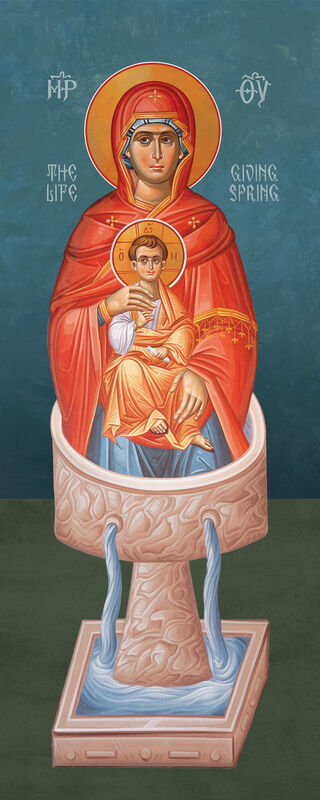
The festal icon of the Zoodochos Pege depicts the Theotokos within a marble fountain from which water flows abundantly outward. She holds the Christ Child above the basins, and Christ makes a gesture of blessing; in some versions the water flows into a larger marble basin below, shaped like a cross. Two hovering angels attend her, bearing a scroll with an acclamation greeting her as the throne of the King.
Around the central fountain the composition shows the emperor and afflicted people receiving the sprinkling of holy water, together with figures depicting 'the place of fish,' a reference to Baloukli and the sacred pond outside Constantinople. The icon type became an epithet for the Mother of God in its own right and grew extremely popular across the Orthodox regions.
Hymnography
The title 'Life-Giving Spring' entered the Church's hymnography through Joseph the Hymnographer in the ninth century, and Orthodox hymnody frequently compares the Theotokos with a holy fountain. The Apolytikion of the feast, in the Third Tone, addresses the Virgin as a life-giving fount who conceived the transcendent divine dew and provides eternal joy through waters flowing toward everlasting life. The Kontakion, in the Plagal Fourth Tone, supplicates the Mother of God for grace flowing beyond reason from her perpetual spring, seeking refreshment for the faithful. These hymns present her as the source of divine healing and grace, using the imagery of living water throughout.
Fasting in Practice
Bright Friday falls within Bright Week, during which fasting is entirely set aside; the ordinary Wednesday and Friday fast does not apply, since the whole week is kept as a continuous paschal celebration. Practice varies by tradition, and the faithful are encouraged to consult their priest.
Customs & Traditions
In the Greek tradition a special service to the Life-Giving Spring is sung, holy water is blessed, and the faithful are sprinkled.
A Lesser Blessing of Waters is often performed after the Divine Liturgy on Bright Friday.
Numerous monasteries in Greece (including on Poros, Paros, Rhodes, and in Cyprus) keep synaxis celebrations dedicated to manifestations of the feast.
In Russia, springs near churches have been dedicated to the Holy Mother with corresponding icons painted for them.
Fasting is described here at the season-summary level and differs by jurisdiction and person — please consult your parish priest about how to keep the fasts.