
Thomas Sunday
Also known as: Antipascha, New Sunday, Sunday of Antipascha, Sunday of the Apostle Thomas
P+7· Movable · Paschal cycle
The first Sunday after Pascha, when the Church recalls the risen Christ appearing to the Apostle Thomas, who passed from doubt to the confession "My Lord and my God" (John 20:19-31). It is called Antipascha ("in place of Pascha") because it renews the paschal joy on the eighth day.
Depictions & Icons
How the Church has written this feast — festal icons across the centuries.
Overview
Thomas Sunday is the first Sunday after Pascha, falling seven days after the Feast of the Resurrection. In the Orthodox calendar it lands between March 29 and May 2, depending on the date of Pascha. On this day the Church recalls the appearance of the risen Christ to the Apostle Thomas, who had been absent when the Lord first appeared to the assembled disciples and who moved from doubt to the confession "My Lord and my God" (John 20:19-31).
The day is also called Antipascha, a name meaning "in place of Pascha," because it renews the paschal joy on the eighth day after the Resurrection. Other traditional names for the observance are New Sunday and Renewal Sunday. It marks the official end of Bright Week and the beginning of Thomas Week, after which the Pentecostarion continues the fifty-day paschal season toward Pentecost.
Liturgically, Thomas Sunday functions as a transitional day within the Pentecostarion. Because Pascha's own unique services displaced the liturgical elements normally proper to a Great Feast of the Lord, those elements are restored and chanted on this day. From Thomas Sunday onward the Divine Liturgy and daily offices gradually return toward their normal formats, even as paschal themes continue throughout the season to Pentecost.
Timeline
Antiquity — The eighth day emerges as Antipascha
The eighth day after Pascha develops as a special celebration renewing Pascha itself, arising from an ancient custom of periodic commemorations for major events; it comes to mark the beginning of the annual cycle of Sundays and weeks (per Sergei V. Bulgakov).
4th century — St. Gregory the Theologian distinguishes the day
St. Gregory the Theologian teaches that the paschal day differentiates the burial and resurrection, while this eighth day "is purely of the new birth," framing Antipascha as a feast of spiritual renewal.
History
The celebration of the eighth day after Pascha developed in ancient times as a renewal of Pascha itself. According to Sergei V. Bulgakov, this day became known as Antipascha, meaning "instead of Pascha," and marked the beginning of the annual cycle of Sundays and weeks. The feast arose from an older custom of periodic commemorations for major events, giving the Church a recurring occasion to renew the memory of the Resurrection.
The day drew on a Hebrew precedent that Bulgakov notes: the people of Israel "celebrated the Passover in Gilgal for the first time, renewing their memory of the passage through the Red Sea." St. Gregory the Theologian distinguished this commemoration from the original Resurrection, teaching that the paschal day itself "differentiates the burial and the resurrection," while this eighth day "is purely of the new birth" — a celebration of spiritual renewal rather than of the historical event.
The eighth day also carried a baptismal character. Those newly baptized at Pascha had received the sacraments in white garments, and this day served as the final commemoration of their baptism, when they solemnly wore those white garments for the last time. The Church's transition from the intensity of Bright Week into the ongoing paschal season was thus marked by both the renewal of joy and the completion of the paschal baptismal cycle.
Thomas Sunday marks the close of Bright Week, or Renewal Week, the first week following the Resurrection. Throughout Bright Week the Royal Doors remained fully open to symbolize Christ's empty tomb, fasting was entirely prohibited, and Canon 66 of the Council in Trullo prescribed that the faithful should continually repeat psalms, hymns, and spiritual songs. Services were sung rather than read, and outdoor processions took place daily with the Resurrection icon and the Artos, the blessed bread. With Thomas Sunday this week ends and Thomas Week begins.
The commemoration is grounded in the account of John 20:24-29. Thomas, absent at the first appearance, refused to believe the reports of the Resurrection, declaring that he would not believe "except I shall see on his hands the print of the nails, and put my finger into the print of the nails, and thrust my hand into his side." Eight days later Christ appeared again to the assembled disciples and invited Thomas to touch his wounds, and Thomas responded, "My Lord and my God!" This "eight days later" timeframe, confirmed in the tradition, anchors the placement of the feast on the eighth day after Pascha.
Meaning
The heart of the feast is Thomas's passage from doubt to faith. Having demanded physical proof of the Resurrection, Thomas met the risen Christ and made one of the New Testament's most explicit confessions of Christ's divinity: "My Lord and my God." The Church commemorates not his doubt but the faith into which his doubt was transformed, and his physical contact with the risen Lord.
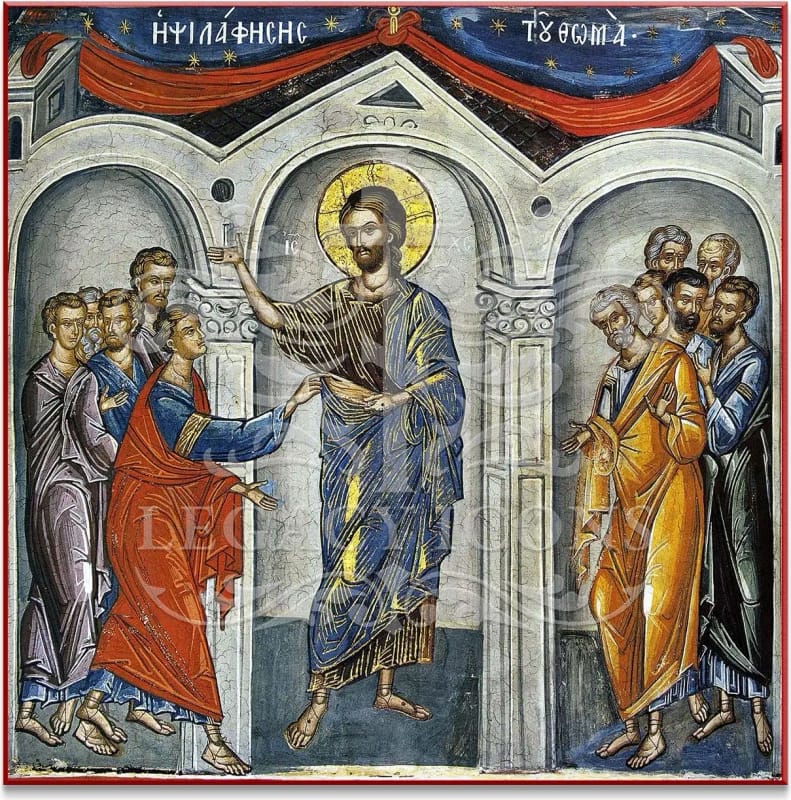
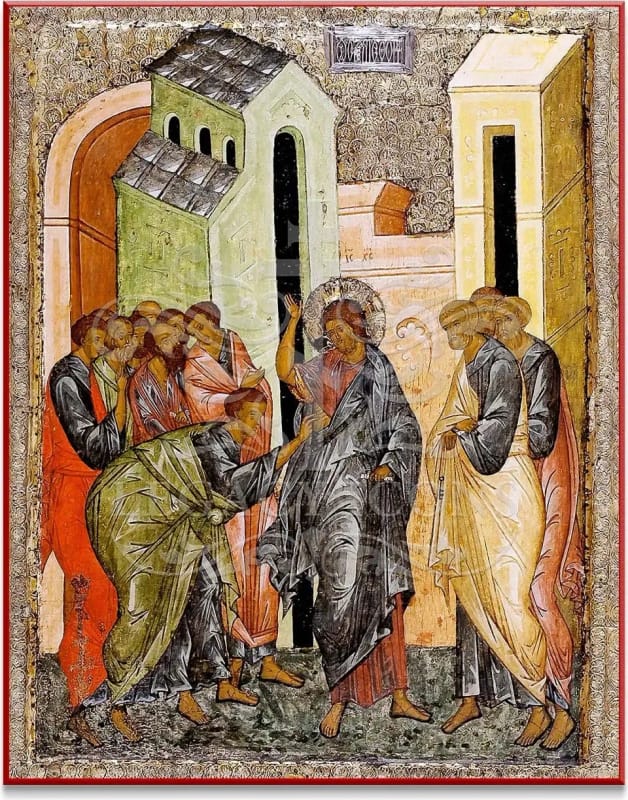
The Orthodox tradition is careful about how this is named. The OCA notes that although some icons of the event are inscribed "The Doubting Thomas," this is incorrect: in Greek the inscription reads "The Touching of Thomas," and in Slavonic "The Belief of Thomas." The focus of the feast is Thomas's faith and his touching of the life-giving side of the Lord, not his unbelief — the moment when contact with the wounded, risen body prompted his belief and confession.
The encounter carries a teaching for all believers. To Thomas the Lord said, "Thomas, because thou hast seen me, thou hast believed: blessed are they that have not seen, and yet have believed," commending faith that does not depend on direct sensory verification. Patristic reflection on the feast draws out the contrast between the faith of the mind and the faith of the heart, and treats the "touch of Thomas" as a kind of empirical theology by which the unbelief of one apostle became the strengthening of faith for all. This encounter became foundational to Christian theology concerning faith, doubt, and the nature of Christ's resurrection body.
As Antipascha and Renewal Sunday, the day also teaches spiritual renewal. St. Gregory the Theologian taught that the eighth day "is purely of the new birth" and calls believers to "put off ourselves the old man," to renew themselves, and to walk in newness of life. The renewal of the whole of creation proclaimed in the paschal greeting "Christ is risen" is thus carried forward and made personal on this day.
Iconography
The festal icon depicts the moment of Thomas's encounter with the risen Christ. The Orthodox tradition is precise about its title: although some icons are inscribed "The Doubting Thomas," the OCA notes this is incorrect. In Greek the inscription reads "The Touching of Thomas," and in Slavonic "The Belief of Thomas" — the composition centers on Thomas touching the life-giving side of the Lord and on the faith that follows, rather than on his prior doubt.
Hymnography
In the Orthodox services for Thomas Sunday the resurrectional texts of the Octoechos are set aside, and the day carries a Polyeleos and magnification, the Matins Gospel read from the Royal Doors, and the Great Prokimenon sung at Vespers. These elements, proper to a Great Feast of the Lord, are chanted on this day because Pascha's own unique services had displaced them.
The hymnography contemplates the paradoxes of the Resurrection appearance. One liturgical verse for the feast poses the mystery of Christ entering the locked room in imagery drawn from his birth and burial: if the sealed womb of the Virgin and the sealed tomb could not hinder him, neither could the sealed doors hinder his coming to the disciples.
Fasting in Practice
Thomas Sunday closes Bright Week, during which fasting is entirely prohibited. The day itself falls on a Sunday, and the paschal season continues without the disciplines of the preceding Great Lent; from Thomas Week the ordinary rhythm of the year gradually resumes as the Pentecostarion carries the faithful toward Pentecost.
Customs & Traditions
Throughout Bright Week, which Thomas Sunday closes, Orthodox Christians greet one another with "Christ is risen" and the response "Indeed He is risen," signifying the renewal of all creation.
The Royal Doors remain fully open during Bright Week services, symbolizing Christ's empty tomb; daily outdoor processions carry the Resurrection icon and the Artos, the blessed bread.
Antipascha traditionally served as an alternate celebration for those unable to attend the Paschal Vigil, providing a further occasion to keep the paschal feast.
Scripture
- John 20:19-31 — The Gospel of the feast: the risen Christ appears to the disciples and, eight days later, to Thomas, who confesses "My Lord and my God."
- John 20:24-29 — Thomas's demand for physical proof, his touching of Christ's wounds, and the Lord's blessing on those who believe without seeing.
Patristic commentary
Many Church Fathers wrote on this feast. St. John Chrysostom addressed Thomas's doubt in connection with countering Arian teaching; St. Cyril of Alexandria wrote a Gospel commentary on the passage; and St. Gregory Palamas treated the mysteries of the Sabbath and the Lord's Day in connection with this Sunday. Later homilies for the feast are attributed to St. Theophan the Recluse, St. John of Kronstadt, St. Luke of Simferopol, and St. Justin Popovich, developing the themes of doubt turned to firm faith, empirical theology through the touch of Thomas, and the contrast between the faith of the mind and the faith of the heart.
Fasting is described here at the season-summary level and differs by jurisdiction and person — please consult your parish priest about how to keep the fasts.