
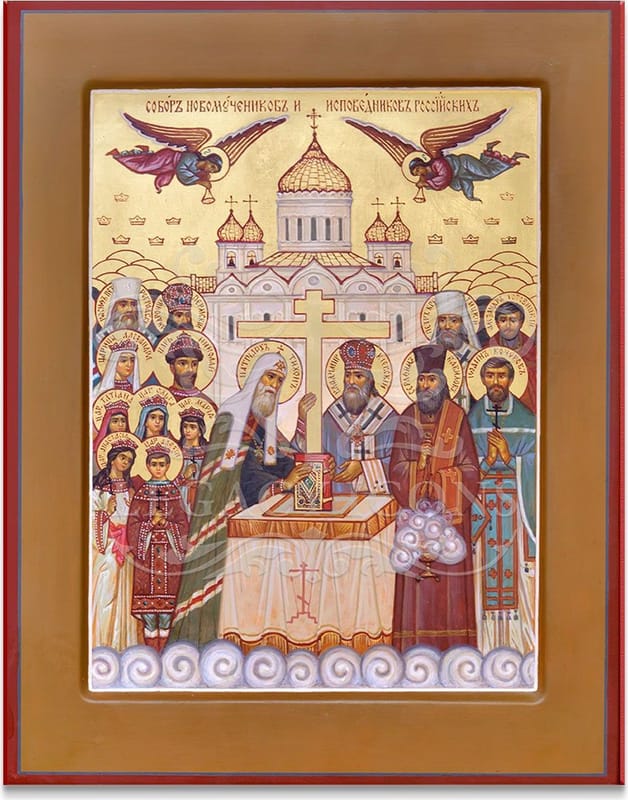
Synaxis of the New Martyrs and Confessors of Russia
Also known as: Sunday of the New Martyrs and Confessors of Russia, New Martyrs and Confessors of the Russian Church
Sun before Feb 8· Anchored to a weekday
Commemorates the great host of bishops, clergy, monastics, and laypeople of the Russian Church who suffered and died for Christ under the atheist persecution of the twentieth century, anchored to the martyrdom of Hieromartyr Vladimir, Metropolitan of Kiev, the first among them.
Overview
The Synaxis of the New Martyrs and Confessors of Russia is a collective commemoration of the bishops, clergy, monastics, and laypeople of the Russian Orthodox Church who suffered and died for Christ under the atheist persecution that followed the October Revolution of 1917. Rather than a single feast of the Lord or the Theotokos, it is an observance dedicated to the whole host of saints — hierarchs, monks, laypeople, and even children — drawn from every social stratum of the Russian Church.
The feast is kept on the Sunday nearest to January 25 (Old Style) / February 7 (New Style): on February 7 itself when that day is a Sunday, and otherwise on the nearer Sunday before or after. This date commemorates the martyrdom of Hieromartyr Vladimir, Metropolitan of Kiev, killed on January 25 / February 7, 1918, who is remembered as the first among the New Martyrs of the Bolshevik yoke and to whose death the whole commemoration is anchored.
In the calendar the observance falls at the end of January or the beginning of February. It gathers into one day the memory of a great multitude — many thousands of victims of the Soviet persecution — recognized in a special canon of saints, the New Martyrs and Confessors of Russia.
Timeline
January 25 / February 7, 1918 — Martyrdom of Metropolitan Vladimir of Kiev
Metropolitan Vladimir Bogoyavlensky is killed by Soviet forces during the Bolshevik seizure of Kiev, becoming the first bishop to suffer as a New Martyr under the Soviets; the feast is anchored to this date.
April 5 (18), 1918 — The All-Russian Local Council institutes the commemoration
The Council designates January 25 (Old Style) as an annual memorial day and sets the nearest Sunday for the yearly commemoration of all the New Martyrs and Confessors of Russia.
1981 — Glorification by the Russian Orthodox Church Outside of Russia
ROCOR canonizes the New Martyrs, while the Moscow Patriarchate remains unable to honor them publicly under Soviet rule.
1992 — First glorifications by the Moscow Patriarchate
Under Patriarch Alexis II the Russian Church canonizes, among others, Grand Duchess Elizabeth Fyodorovna, Metropolitan Vladimir of Kiev, and Metropolitan Benjamin of Petrograd.
2000 — Jubilee Council of Bishops
Tsar Nicholas II and his family are canonized alongside many other sufferers at the All-Russian Council.
History
The commemoration has its origin in the earliest days of the persecution itself. Shortly after the October Revolution, the All-Russian Local Council, meeting on April 5 (18), 1918, passed a resolution designating January 25 (Old Style) as an annual memorial day for those who suffered persecution. The Council decreed that the Sunday nearest to that date — the day of Metropolitan Vladimir of Kiev's martyrdom — would be set aside for the yearly commemoration of all the New Martyrs and Confessors of Russia.
The date is bound to the death of Vladimir Bogoyavlensky (1848–1918), Metropolitan of Kiev. Born on January 1, 1848, in Tambov province as Basil Nikephorovich Bogoyavlensky, he graduated from the Kiev Theological Academy in 1874. After the deaths of his wife and child in 1886 he entered monastic life, rising through the episcopate: bishop of Staraya Rus (1886), archbishop of Kartali and Kaheti (1892), Metropolitan of Moscow (1898–1912), and Metropolitan of Petrograd (1912–1915); he also served as chairman of the Most Holy Synod. Transferred to Kiev in 1915 after falling out of favor at court, he was killed by Soviet forces during the Bolshevik seizure of Kiev; his body was found pierced by two bullet wounds and three stab wounds. He is remembered as the first bishop to suffer as a New Martyr under the Soviets, and was glorified by the Russian Orthodox Church in 1992.
The persecution the feast remembers was systematic and vast. Reported casualty figures across the Soviet period include some 28 bishops and 1,215 priests executed between 1917 and 1921; approximately 130,000 Orthodox priests arrested and 95,000 put to death between 1917 and 1935; over 8,000 clergy reportedly killed in 1922 during the campaign to confiscate church valuables; and, in 1937–1938 alone, 168,300 clergy arrested, of whom 106,300 were shot. Between 1927 and 1940 the number of Orthodox churches in the Russian Republic fell from 29,584 to fewer than 500. In 1922 the Solovki camp was established as the first Soviet concentration camp within a former Orthodox monastery, and the League of the Militant Godless enforced the state's campaign of terror. Among the named martyrs are Metropolitan Veniamin of Petrograd, executed in 1922 for refusing to surrender church valuables; Archbishop Andronik, shot after being forced to dig his own grave; and Bishop Germogen of Tobolsk, strapped to a steamboat paddle wheel. Patriarch Tikhon excommunicated the Soviet leadership in January 1918.
The formal glorification of these saints came in stages, shaped by political circumstance. The Russian Orthodox Church Outside of Russia canonized the New Martyrs in 1981, while the Moscow Patriarchate was unable to honor them publicly until the collapse of the Soviet Union. After 1991 the Russian Church under Patriarch Alexis II began official glorifications: in 1992 it canonized, among others, Grand Duchess Elizabeth Fyodorovna, Metropolitan Vladimir of Kiev, and Metropolitan Benjamin (Veniamin) of Petrograd. At the Jubilee Council of Bishops in 2000, Tsar Nicholas II and his family were canonized alongside many other sufferers. The process remains ongoing: more names continue to be added to the list of New Martyrs as the Synodal Canonization Commission completes its investigation of each case.
Meaning
Through this observance the Church holds up the witness of martyrdom renewed in the modern age. The commemoration recognizes that suffering endured across every rank and condition of the Church — hierarchs and monks, laypeople and children — was not a scattering of private tragedies but a single, collective spiritual witness. Formal ecclesiastical recognition transformed individual suffering into a shared testimony to Christ, acknowledging the systematic nature of the persecution within the Church's understanding of holiness.
The feast's hymnody frames the martyrs as a spiritual harvest arising precisely out of affliction. The Troparion describes them as flowers of the spiritual meadow of Russia, blossoming forth wondrously in a time of grievous persecution and bearing good fruit for Christ. The Church thus teaches that the age of the martyrs did not end in antiquity: fidelity unto death, and the confession of faith under pressure to renounce it, remain the pattern of Christian sanctity, and the New Martyrs stand as intercessors for the Church that venerates them.
That the list of these saints is still being enlarged, case by case, expresses a further meaning: the Church continues to receive and name this witness rather than closing the account. The commemoration keeps the memory of the persecution from being lost, honoring both those already glorified and the great multitude whose suffering is remembered even where individual names are not yet known.
Hymnography
The services for the feast include a Troparion and a Kontakion proper to the commemoration, which emphasize the martyrs' steadfastness through persecution and their intercessory role for the Church. The Troparion depicts them as flowers of the spiritual meadow of Russia, blossoming wondrously in a time of grievous persecution and bearing good fruit for Christ — an image that gathers the whole host of sufferers into a single spiritual harvest.