
2 Enoch (The Book of the Secrets of Enoch)
A heavenly-ascent apocalypse attributed to Enoch and preserved for centuries by Slavic Christian scribes — the fullest ancient account of the ascent through the heavens, the silent Grigori, the rebel Satanail, and Enoch's transformation before the throne.
Named Angels and Heavenly Guides
The angels 2 Enoch names, and the guides who carry Enoch up.
Only two of them are angels the Orthodox Church names and honours — Michael and Gabriel, both securely biblical. The heavenly scribe of chapter 22 and the two unnamed guides of chapter 1 belong to this book alone, and are recorded here as figures of the text, not as archangels of the Church.
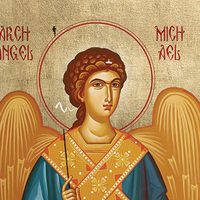 MichaelRemoves Enoch's earthly garments before the throne, clothes him in glory and anoints him with shining oil (ch. 22).
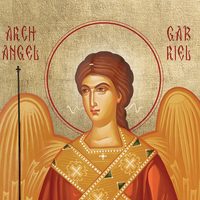 GabrielCarries Enoch up to the highest heaven, and at the end of the book rescues the infant Melchizedek from the Flood (chs. 21, 72).
Names in this book are unstable. Vretil appears as Vreveil, Vrevoil and Pravuil across manuscripts and translations, and similar variation affects other figures. A name found in one edition of 2 Enoch should never be added to a list of recognised archangels on the strength of that edition alone.
The Celestial Orders of the Ascent
The ranks and companies Enoch sees, in this book's own vocabulary.
Several of these names are biblical and are honoured in Orthodox tradition; others belong to the wider Jewish visionary vocabulary. The overlap with the nine orders the Church received is a matter of shared words, not of a shared system — 2 Enoch has no Dionysian hierarchy, and its groups should not be sorted into one.
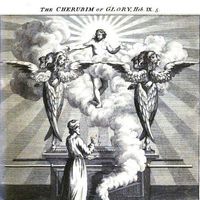 CherubimNamed among the orders about the throne in the seventh heaven (ch. 20).
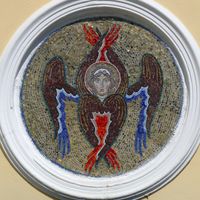 SeraphimNamed with the cherubim in the seventh heaven, in unceasing worship (ch. 20).
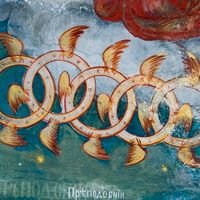 ThronesListed among the ranks Enoch sees before the divine presence (ch. 20).
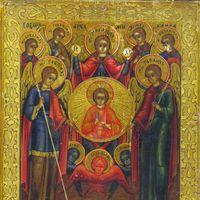 ArchangelsThe fiery armies of great archangels standing in the highest heaven (ch. 20).
The Heavens of the Ascent
Where each stage of the journey leads, and what stands there.
Seven heavens in the principal narrative, with the throne in the seventh in the short recension. The long recension carries Enoch on through three further heavens — Muzaloth, Kuchavim and Aravoth — and places the vision of God's face in the tenth. A reference to "the seven heavens of 2 Enoch" is describing one recension and should say so.
| Heaven | Name | What stands there | Chapters |
|---|---|---|---|
| First | — | Storehouses of snow, dew and cloud, with the angels who keep them; the rulers of the stellar orders | 3–6 |
| Second | — | Darkness, and apostate angels held under guard awaiting the measureless judgment | 7 |
| Third | Paradise, and a place of torment | The garden of the righteous and the tree of life — and, elsewhere in the same heaven, a place of terrible punishment | 8–10 |
| Fourth | — | The courses of the sun and moon, their gates and attendants, and the phoenixes and chalkydri | 11–17 |
| Fifth | — | The Grigori, standing silent and dejected without liturgy | 18 |
| Sixth | — | Seven bands of angels ordering creation and recording the deeds of men | 19 |
| Seventh | — | Fiery armies, archangels, dominions, cherubim, seraphim, thrones and many-eyed ones; the throne, in the short recension | 20–21 |
| Eighth | Muzaloth | The changer of the seasons — long recension only | 21 |
| Ninth | Kuchavim | The houses of the twelve signs — long recension only | 21 |
| Tenth | Aravoth | The face of the Lord, and the transformation of Enoch — long recension only | 22 |
The Grigori and the Imprisoned Angels
The rebellious powers Enoch meets on the way up — silent in one heaven, imprisoned in another.
2 Enoch inherits the Watcher tradition from the older Enochic literature and reworks it. Two distinct groups appear at two different stages of the ascent, and the book does not fully harmonise them.
Catalogued for study, never venerated (§9).
The GrigoriSlavonic Grigori, from Greek egrēgoroi — the wakeful ones, the watchers
2 Enoch 18 · Genesis 6.1–4 · Jude 6 · 2 Peter 2.4
In the fifth heaven Enoch sees a vast company of beings of enormous stature, humanlike in form, their faces dejected and their mouths silent. This heaven has no liturgy — the one stage of the ascent where the praise that sounds everywhere else has stopped. Enoch speaks to them and urges them to resume the service of God.
The narrative ties their rebellion to the older Watcher tradition: in the long recension they are connected with the heavenly rebels who descended upon Mount Hermon, took human wives and corrupted the earth, and with Satanail their prince.
Orlov argues that 2 Enoch creatively fuses two streams that were originally somewhat distinct — the Watchers who descended and sinned with women, and an Adamic tradition of a heavenly rebel who opposes God's purpose for humanity. That fusion is why Satanail comes to be associated with the Watcher rebellion here in a way he is not in 1 Enoch.
Genesis 6.1–4 speaks of the sons of God and the Nephilim without supplying the full narrative; Jude 6 speaks of angels who abandoned their proper habitation and are kept in bonds for judgment; 2 Peter 2.4 of angels who sinned and were cast into confinement. These passages resonate strongly with the tradition. They do not canonise the details of this book's version of it.
Fate. Left standing in the fifth heaven in grief and silence, their companions imprisoned below, awaiting the judgment.
- The Watcher tradition itself has genuine scriptural footholds in Genesis 6, Jude and 2 Peter
- The detailed narrative of their descent and teaching is extra-biblical
- The Grigori are not an order of the Church's angelic hierarchy and must not be listed as one
The apostate angels of the second heaven
2 Enoch 7 · Jude 6 · 2 Peter 2.4
Far lower in the ascent, in a darkness that Enoch describes as greater than any earthly darkness, he sees angels held under guard — prisoners hanging and awaiting the measureless judgment. They ask Enoch to pray for them, and he answers that he is a mortal man and cannot.
The scene is brief and stands apart from the Grigori of the fifth heaven, though both belong to the same broad tradition of angelic rebellion. It is the closest thing in 2 Enoch to the imagery that Jude and 2 Peter use of angels kept in bonds for judgment.
- The motif of imprisoned angels awaiting judgment is scripturally attested
- This particular scene, and Enoch's exchange with them, is extra-biblical narrative
Neither group is venerated, and neither is catalogued here for any purpose but study. Where this book's account goes beyond what Scripture says, the page says so rather than smoothing the difference away.
Satanail and the Rebellion
The rebel prince of the long recension — and why his name should be handled with care.
Satanail is among the most quoted features of 2 Enoch and among the most easily misrepresented. Everything below belongs to long-recension material, and the name is a literary form of particular textual traditions rather than Orthodox nomenclature.
SatanailThe ending -el marks his angelic standing before the fall; after it, the text calls him Satan
2 Enoch 29.4–5 (long recension) · 2 Enoch 31.3–6 (long recension) · Isaiah 14.12–15 · Luke 10.18
In the long recension Satanail is one of the archangelic order who conceives the impossible thought of setting his throne higher than the clouds, that he might be equal in rank to God. He is cast out of the height together with the angels under him, and thereafter flies about in the air over the abyss.
In chapter 31 the same figure enters Paradise and deceives Eve, so that the fall of the angels and the fall of humanity are drawn into a single continuous story. This is the point at which 2 Enoch differs most from 1 Enoch, where the Watcher rebellion is not tied to Eden in this way.
Fr Stephen De Young has emphasised that ancient Jewish literature often collapses several biblical adversarial figures into one principal adversary rather than treating each name as a separate devil, and that 2 Enoch participates in that broader habit. That is what is happening here: Satan, the adversary of Eden, the Watcher traditions and related demonic figures are being synthesised into a single career.
The theophoric -el ending is a literary device marking what he was before the fall. It is not evidence of an Orthodox name for the devil, and Satanail should not be catalogued as a distinct being whose existence the Church attests.
Fate. Cast out of the height with the angels under him; in the long recension, thereafter the deceiver in Eden.
- The fall of the devil is Orthodox teaching, grounded in Scripture and the Fathers
- The name Satanail is a literary form of particular extra-biblical textual traditions, not Orthodox nomenclature
- This book's continuous narrative — rebellion, expulsion, then the deception of Eve — is its own synthesis and is not established doctrine
- Nothing here is a biography of Satan, and the Church has never received one
Recorded, never venerated. Where the recensions differ, this page follows the long recension and says so; where the Fathers have not spoken, it asserts nothing.
The Human Figures of the Narrative
The patriarchs through whom the book traces its priestly line.
Several are commemorated by the Church among the Holy Forefathers and have their own pages here; two appear in this book alone. In every case what Scripture says and what 2 Enoch adds are different things, and the link goes to the saint the Church actually honours.
About the bookReadHide
2 Enoch, traditionally called Slavonic Enoch or the Book of the Secrets of Enoch, is an ancient pseudepigraphal apocalypse attributed to the patriarch Enoch. It takes the single verse in which Genesis says that Enoch "walked with God; and he was not, for God took him" (Genesis 5.24) and expands it into a full narrative — Enoch's ascent through the heavens, his meeting with the angelic orders and with rebellious powers, his transformation before the divine throne, the revelations of creation and judgment given to him there, his return to instruct his sons, and his final departure from the world.
The number in the title is modern scholarly shorthand and not a claim that the book continues 1 Enoch. Scholars use 1, 2 and 3 Enoch to distinguish separate works gathered around the same patriarch — 1 Enoch surviving chiefly in Ethiopic, 2 Enoch chiefly in Church Slavonic, and 3 Enoch a later Hebrew mystical text. 2 Enoch belongs to the same broad Enochic tradition and shares its interest in the Watchers, the heavenly court and the judgment, but it is a distinct composition, organised far more tightly around a single ascent and a single transformation.
For this catalogue its interest is angelological. Enoch meets angels who administer the visible order of the cosmos, apostate angels imprisoned and awaiting judgment, the Grigori standing in silence and grief, the heavenly armies, and the cherubim, seraphim and many-eyed ones nearest the throne. The book also carries a developed account of the rebel Satanail, traditions concerning Adam and Paradise, and, in its closing chapters, the extraordinary birth and rescue of Melchizedek.
Its place in Orthodox history is unusual and easily misread. The complete text survived because Eastern Christian — and specifically Slavic — scribes went on copying it for centuries; more than twenty Slavonic witnesses are known, in several independent lines. That is real evidence of sustained reading and preservation. It is not evidence of canonicity. 2 Enoch is not part of the Scriptures of the Orthodox Church, no council received it, and the doctrines and angel names peculiar to it carry no doctrinal authority. It is catalogued here as an ancient witness to the religious world from which the Church emerged, and to what Orthodox manuscript culture chose to keep — for study, never for veneration.
The book in depth15ShowHide
Authorship & Date
The patriarch Enoch did not write this book. The attribution is pseudepigraphy — the ordinary ancient practice of writing in the name and person of an authoritative figure of the past — and nothing in the work's value depends on pretending otherwise.
Dating it is exceptionally hard, because the complete text survives only in manuscripts many centuries younger than any plausible composition. Older scholarship ranged across nearly a thousand years. J. T. Milik proposed a ninth- or tenth-century Byzantine origin; Andrei Orlov and others have argued strongly against so late a date, and a substantial body of scholarship now places important portions of the work in the late Second Temple or early Roman period, potentially the first century AD. Other reconstructions still propose later composition or heavy later redaction.
The honest summary is that the question is genuinely open. Late surviving manuscripts, multiple recensions, centuries of Christian transmission and probable interpolation together make certainty impossible, and this page does not display a composition year.
Language and Transmission
Most scholars have taken the Slavonic text to derive from a Greek intermediary. Several passages make far better sense against a Greek background — the best-known being the derivation of the name Adam from four Greek words for the cardinal directions (2 Enoch 30.13), which works in Greek and not in Slavonic.
Behind the Greek there may lie Semitic composition or Semitic source material. Semitic terms and a marked interest in priestly and temple matters have led some researchers to propose Hebrew or Aramaic antecedents; Fr Stephen De Young argues for an Aramaic original on the basis of transliterated vocabulary. That is his position rather than a settled conclusion.
The defensible summary is a chain rather than a single origin — possible Semitic composition or sources, then Greek, then Slavonic, with an independently surviving Coptic witness. The exact linguistic history is not settled.
The Manuscript Tradition
Orlov catalogues more than twenty Slavonic manuscripts and fragments, principally from the fourteenth to the eighteenth centuries. Some carry most of the work; others preserve portions embedded in larger compilations. The oldest known Slavonic witness stands in the fourteenth-century Merilo Pravednoe, The Just Balance — but that is rearranged and edited material, not a pristine copy of the whole.
The traditional title Slavonic Enoch reflects the long-standing position that the text was known in that language alone. That changed when Joost Hagen identified four Coptic manuscript fragments from Qasr Ibrim in Nubia as portions of chapters 36–42. They appear to correspond closely to the short recension and are dated broadly to the eighth to tenth centuries. The identification has been questioned, and defended — most recently in a 2022 reassessment by Liudmila Navtanovich, which argues that Hagen's identification is sound.
Whatever the outcome of that particular debate, the evidence establishes at minimum that the literary history of 2 Enoch cannot be reduced to a late medieval Slavonic composition. The traditional title remains standard; it is no longer literally accurate.
Long and Short — the Recension Problem
Scholarship normally distinguishes a long and a short recension, and some researchers subdivide further into very long, long, short and very short forms. Earlier work tended to ask which recension preserved the original, with short-recension priority the influential answer, associated particularly with Vaillant.
Modern work is more cautious, and the caution matters for anyone citing the book. Material in the long recension may well include later expansion — but shorter manuscripts may equally represent abbreviation, so shorter does not automatically mean older. Grant Macaskill has emphasised that individual readings must be weighed one at a time rather than a recension adopted wholesale.
This is not a technicality. Several of the passages most often quoted from 2 Enoch — the fall of Satanail, his part in the deception of Eve, and the heavens beyond the seventh — belong to long-recension material. A citation of this book that does not say which recension it is drawing on has left out the most important part of the reference.
Structure of the Book
The work opens with the aged Enoch receiving a supernatural summons. Two beings of extraordinary appearance, their faces like the shining sun, announce that God has commanded his ascent. Enoch entrusts instructions to his children and is carried upward.
Orlov divides the work roughly into three movements — the ascent and the revelations given at the throne (chapters 1–38); Enoch's return to earth, his testament to his sons and his second and final ascent (39–67); and the priestly succession culminating in the birth of Melchizedek (68–73).
The middle movement changes register completely. Having seen the heavens, Enoch teaches: moral instruction, the treatment of the poor, the conduct of sacrifice, the duty of righteous speech. This is why Orlov describes the book as combining the characteristics of an apocalypse and a testament — it is a vision that ends in ethics.
The Ascent through the Heavens
The ascent is the book's organising structure, and the single feature most often misreported. The principal narrative moves through seven heavens, each disclosing a different aspect of cosmic order, angelic service, punishment, Paradise or celestial worship. In the short recension the seventh is the climax and the throne stands there.
The long recension does not stop at the seventh. It carries Enoch on to an eighth heaven called Muzaloth, a ninth called Kuchavim, and a tenth called Aravoth, where he beholds the face of the Lord and is transformed. Descriptions of "the seven heavens of 2 Enoch" are therefore describing one recension. The table below sets out both.
Two features deserve particular notice. The third heaven contains Paradise and, in another region of the same heaven, a terrible place of punishment — an arrangement that does not map onto later popular language about heaven and hell. And the fifth heaven is silent: the Grigori stand in it without liturgy, and Enoch urges them to resume the praise that sounds everywhere else in the ascent.
| Heaven | Name in the text | What Enoch sees | Chapters |
|---|---|---|---|
| First | — | The storehouses of snow, dew and cloud, and the angels who keep them; the rulers of the stellar orders | 3–6 |
| Second | — | Darkness, and apostate angels held under guard, awaiting the measureless judgment | 7 |
| Third | Paradise, and a place of torment | The garden prepared for the righteous and the tree of life — and, in another region of the same heaven, a place of terrible punishment | 8–10 |
| Fourth | — | The courses of the sun and moon, their gates and attendants, and the strange creatures called phoenixes and chalkydri | 11–17 |
| Fifth | — | The Grigori — Watchers of immense stature standing silent and dejected, whom Enoch urges to resume the liturgy | 18 |
| Sixth | — | Seven bands of angels who order the stars, the seasons and every living thing, and who record the deeds of men | 19 |
| Seventh | — | The fiery armies, archangels, bodiless powers, dominions, cherubim, seraphim, thrones and many-eyed ones; in the short recension, the throne itself | 20–21 |
| Eighth | Muzaloth | The changer of the seasons — long recension only | 21 |
| Ninth | Kuchavim | The houses of the twelve signs — long recension only | 21 |
| Tenth | Aravoth | The face of the Lord, and Enoch's transformation — long recension only | 22 |
Angelology in 2 Enoch
The book knows a densely populated heaven: angels and archangels, cherubim, seraphim, thrones, many-eyed ones, dominions and governments, cosmic administrators, and heavenly armies without number. Much of this vocabulary overlaps with terms found in Scripture, and some of it with terms later used in Christian theology.
That overlap should not be read backwards. 2 Enoch does not present the ninefold hierarchy associated with the Dionysian corpus — the arrangement in three triads that Orthodox tradition received, and which this site sets out on the Nine Orders page. That systematic arrangement belongs to a later Christian theological synthesis. What 2 Enoch preserves is evidence of an earlier and somewhat different angelological landscape, in which the same words are used with less system behind them.
The practical rule for a reader: do not sort the groups named in 2 Enoch into the nine orders, and do not add the angel names peculiar to it to any list of the archangels the Church names. Michael and Gabriel are securely biblical and liturgically honoured; the heavenly scribe of chapter 22 is not.
The Transformation of Enoch
The climax of the ascent comes in chapter 22. Standing before the divine throne, Enoch is transformed: Michael removes his earthly garments, clothes him in garments of glory and anoints him with shining oil, and Enoch reports that his own appearance becomes like that of the glorious ones around him. He is then set to receive the revelations of creation, dictated to him by a heavenly scribe.
Orlov reads this episode as an important stage in the development of traditions that culminate much later in the Enoch-Metatron literature of 3 Enoch — a human being progressively exalted among the heavenly beings.
There are obvious conceptual resonances with Scripture: the shining face of Moses after the mountain, the Transfiguration of Christ, the glorification of the righteous, the transformed body of the resurrection. There is also an evident resemblance to the Orthodox understanding of theosis, in which a human being comes to participate in the divine glory without becoming God by nature. That resemblance is worth noticing and easy to overstate. 2 Enoch is not a patristic treatise, and the Orthodox doctrine of deification is drawn from Scripture, the Fathers and the Church's own prayer — not from this book.
Priesthood and the Birth of Melchizedek
The closing chapters carry one of the strangest traditions in all the Enochic literature. The priestly line runs Enoch, Methuselah, Nir, Melchizedek. Nir is presented as the son of Lamech and the brother of Noah — a genealogy Scripture does not give.
Nir's elderly wife Sothonim (Sopanim in some witnesses) is found to be pregnant, though Nir insists he has not been with her. She dies, and the child is born from her body already fully formed. The newborn speaks, blesses God, bears the seal of priesthood on his breast, is clothed in priestly garments and fed the holy bread. Then God commands Gabriel to take him from the coming destruction, and the archangel carries him into Paradise so that the priestly line may survive the Flood.
Earlier scholars often treated this section as a late appendix. Orlov notes that later manuscript work complicated that judgment: the tradition appears across several textual families, and some scholars regard it as integral to the architecture of the work.
It bears almost no resemblance to the Melchizedek of Genesis 14, and none at all to the argument of Hebrews. It must never be presented as the Orthodox account of Melchizedek, who is commemorated among the Holy Forefathers on his own terms.
Canonicity & Orthodox Reception
Four questions have to be kept apart, because collapsing them is where nearly every error about this book begins.
Was it preserved by Orthodox Christians? Yes. The Slavonic manuscript history establishes prolonged transmission within Eastern Christian culture, in several independent lines rather than by a single accident of survival.
Was it read? Evidently so, at least in some circles. Sustained copying and incorporation into larger compilations imply readers.
Was it canonical? No. Nothing supports its inclusion in the biblical canon of the Eastern Orthodox Church, and no council received it.
Is its content doctrinally authoritative? No. Ancient Christians did not work with only two categories — Scripture on one side and forbidden books on the other. Noncanonical writings could be copied, studied and preserved without becoming Scripture, and 2 Enoch is one of the clearest examples of that middle condition. Orthodox scribes also copied chronicles, homilies, legends and classical literature; preservation records interest, not endorsement.
Modern Orthodox Discussion
Among contemporary Orthodox writers, 2 Enoch is discussed most often by V. Rev. Dr Stephen De Young, whose 2018 essay "Extra-Biblical Literature in the Orthodox Church" uses it as a principal example of ancient noncanonical literature preserved within Orthodox culture, and who returns to it across several episodes of The Lord of Spirits podcast.
Three of his positions are worth recording as his, and not as consensus. He favours an early date, giving approximately AD 70–80. He argues that the linguistic history points to an Aramaic original behind the Greek and Slavonic transmission. And he emphasises that ancient Jewish literature frequently collapses several biblical adversarial figures into a single principal adversary rather than imagining a separate devil behind each name — a point he applies directly to the way Satanail, Azazel and the Watcher traditions merge in this book.
His most useful contribution for a catalogue like this one is not a claim about the text at all but a distinction about categories: that noncanonical ancient literature can matter for Orthodox biblical interpretation without being Scripture. That is the frame this page uses.
Reception by the Fathers — What Cannot Be Claimed
This section exists to say what is not known. There are many resemblances between 2 Enoch and ideas current among early Christian writers, and resemblance is not dependence.
Early Christian writers certainly knew Enochic traditions in the broad sense, and some knew 1 Enoch or material closely associated with it. But to identify a Father as drawing specifically on 2 Enoch requires textual demonstration, and for the most part that demonstration has not been made. Statements of the form "St Basil taught from 2 Enoch", "St John Chrysostom used it", or "St Dionysius derived the angelic hierarchy from it" should not be repeated without much stronger evidence than currently exists.
The same caution applies to the Church's services and to her icons. The parallels with Orthodox liturgical language about the cherubim, the seraphim, celestial worship, light, Paradise and judgment are real and strong — but their canonical roots in Isaiah, Ezekiel, Daniel, Hebrews and Revelation are sufficient and demonstrable on their own. A Last Judgment icon containing angels and Paradise does not establish dependence on this book. The defensible category throughout is thematic similarity and shared ancient tradition; direct dependence is unproven.
Relationship to the New Testament
The right category for most of these comparisons is a shared religious world rather than literary borrowing. The apostolic writings and this book draw on overlapping ancient Jewish traditions about the heavens, the adversary and the judgment; that is a matter of background, and each proposed case of direct dependence would have to be argued on its own.
| Theme | New Testament | Best assessment |
|---|---|---|
| Multiple heavens | 2 Corinthians 12.2 | Shared ancient cosmology |
| Paradise | 2 Corinthians 12.4; Luke 23.43 | Broad conceptual parallel |
| Angels imprisoned, awaiting judgment | 2 Peter 2.4; Jude 6 | Strong shared tradition, most likely through the wider Enochic stream |
| Worship before the heavenly throne | Revelation 4–5 | Shared Jewish apocalyptic world |
| The divine court | Revelation | Broad apocalyptic background |
| Transformation into glory | 1 Corinthians 15; 2 Corinthians 3.18 | Conceptual parallel only |
| Melchizedek without genealogy | Hebrews 5–7 | Shared interest in the figure; radically different narrative |
| The adversary bound | Revelation 20 | Related adversary traditions; an interpretive comparison, not a source |
Relationship to Other Extra-Biblical Works
2 Enoch stands at an unusually busy intersection — Enochic literature, Adamic traditions, the heavenly-ascent apocalypse, and priestly and Melchizedek speculation all meet in it. Orlov's work in particular has traced how the Adamic and Enochic streams converge here, which is why the rebellion of Satanail is bound up with the creation of Adam rather than standing on its own.
| Theme | In 2 Enoch | Closely related literature |
|---|---|---|
| Enochic ascent | The organising narrative | 1 Enoch; later 3 Enoch |
| The Watchers | The Grigori of the fifth heaven | 1 Enoch; Jubilees |
| The rebel prince | Satanail, in long-recension material | Life of Adam and Eve; 3 Baruch |
| Multiple heavens | Seven, extended to ten in the long recension | Ascension of Isaiah; 3 Baruch |
| A human being transformed | Enoch clothed in glory and anointed | 1 Enoch 71; 3 Enoch |
| Adam's exalted place | Significant, especially in the long recension | Life of Adam and Eve |
| Paradise located in a heaven | The third heaven | Testament of Abraham; 2 Corinthians 12 |
| Azazel traditions | Textually complicated and merged with Satanail | 1 Enoch; Apocalypse of Abraham |
| Melchizedek's birth | Extraordinary, and developed as nowhere else | Otherwise unparalleled |
What 2 Enoch Can and Cannot Establish
It can help a reader understand a great deal: ancient Jewish ideas about the heavenly world; the development of the Enochic traditions; the traditions surrounding the Watchers and the fallen angels; the conceptual world in which the apostles preached; ancient beliefs about heavenly worship; the growth of multiple-heaven cosmologies; the convergence of Adamic and angelic traditions; early Melchizedek speculation; the road from Enoch to the later Jewish mystical literature; and the habits of the Eastern Christian manuscript cultures that kept such books alive.
It cannot establish any of the following by itself: Orthodox dogma; an official map of the heavens; additional recognised names of archangels; an authoritative biography of Satan or of any fallen angel; binding teaching about Paradise or punishment; the canonical history of Melchizedek; an angelic hierarchy competing with the one the Church received; the truth of every detail of Second Temple angelology; or the apostolicity of a tradition merely because an Orthodox monk copied it.
The distinction between those two lists is the whole editorial method of this section, and the table below applies it to the claims most often repeated about this book.
| Commonly said | Status | What can be said |
|---|---|---|
| 2 Enoch was written in AD 70 | Too certain | An early date is well argued, and Fr Stephen De Young favours c. AD 70–80, but the question is genuinely disputed |
| 2 Enoch survives only in Slavonic | Outdated | Coptic fragments from Qasr Ibrim have been identified with chapters 36–42 |
| The short recension is the original | Too simple | Both forms may preserve early material; readings have to be weighed one at a time |
| Orthodox monks preserved it, so it is Orthodox Tradition | Does not follow | Preservation is not canonisation. Orthodox scribes also copied chronicles, legends and classical literature |
| Satanail is the Orthodox name for Satan | Misleading | It is a literary form belonging to particular textual traditions, not Orthodox nomenclature |
| The Grigori are another order of angels | Incorrect | They belong to the Watcher traditions of heavenly rebellion, not to the received hierarchy |
| 2 Enoch teaches the nine orders of angels | Incorrect | Its vocabulary overlaps with later Christian terms; the Dionysian system is not there |
| 2 Enoch proves seven literal levels of heaven | Incorrect | It witnesses to one ancient cosmology and establishes no Orthodox cosmography |
| The Orthodox Church rejected 2 Enoch | Too simple | The Church did not receive it as Scripture, while Orthodox scribes went on preserving it — which is the more interesting fact |
SourcesShowHide
- W. R. Morfill, trans.; R. H. Charles, ed., The Book of the Secrets of Enoch (Oxford — Clarendon Press, 1896) — public domain; the translation cited on this page
- F. I. Andersen, "2 (Slavonic Apocalypse of) Enoch", in James H. Charlesworth, ed., The Old Testament Pseudepigrapha, vol. 1 (Doubleday, 1983) — the standard modern English translation; cited for scholarship, not reproduced
- A. Vaillant, Le livre des secrets d'Hénoch — texte slave et traduction française (Paris, 1952)
- Andrei A. Orlov, The Enoch-Metatron Tradition (Mohr Siebeck, 2005) and From Apocalypticism to Merkabah Mysticism — Studies in the Slavonic Pseudepigrapha (Brill, 2007)
- Andrei A. Orlov and Gabriele Boccaccini, eds., New Perspectives on 2 Enoch — No Longer Slavonic Only (Brill, 2012), including Joost L. Hagen on the Coptic fragments and Grant Macaskill on recensions and original language
- Liudmila Navtanovich, "Is There Indeed a Coptic 2 Enoch?", Scrinium 18 (2022)
- J. T. Milik, The Books of Enoch — Aramaic Fragments of Qumrân Cave 4 (Oxford, 1976), for the late-dating position since widely challenged
- Genesis 5.21–24; Genesis 6.1–4; 2 Peter 2.4; Jude 6 (Holy Scripture)
- V. Rev. Dr Stephen De Young, "Extra-Biblical Literature in the Orthodox Church", The Whole Counsel of God (Ancient Faith, 2018), and The Lord of Spirits podcast — episodes "The Priest Shall Make Atonement" and "Baptism by Fire"
- Catalogued for study; requires clergy/source review before any devotional use