
Archangels
The eighth of the nine angelic orders and the chief messengers of God — the “ruling angels” who bear His greatest tidings to humanity. Orthodox tradition names Michael, Gabriel, Raphael, Uriel, Selaphiel, Jegudiel, and Barachiel (and sometimes Jeremiel) among them: Michael leads the heavenly hosts, Gabriel announced the Incarnation to the Theotokos, and Raphael, in Tobit, brought healing and guidance. Only Michael is directly called “the archangel” in Scripture (Jude 1:9).
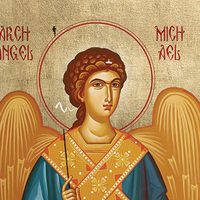 MichaelThe chief of the archangels and commander (archistrategos) of the heavenly hosts, whose name means “Who is like God?” He is the great defender against evil and protector of God’s people, who cast down the dragon (Revelation 12) and is the only being directly called “the archangel” in Scripture (Jude 1:9).
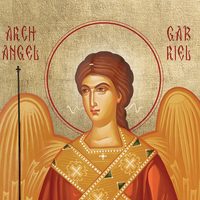 GabrielThe archangel of divine announcements, whose name means “God is my strength.” He interpreted the visions of Daniel, foretold the birth of John the Forerunner, and above all announced the Incarnation to the Most Holy Theotokos (Luke 1).
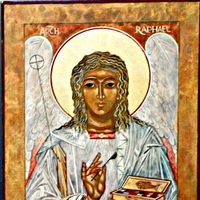 RaphaelThe archangel of healing, whose name means “God heals.” In the deuterocanonical book of Tobit he accompanies and guides Tobias, heals the blindness of Tobit, and reveals himself as one of the seven holy angels who stand before God.
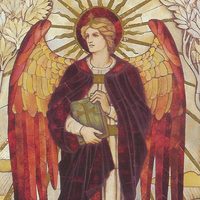 UrielOne of the archangels received in Orthodox tradition, whose name means “Fire of God” or “Light of God.” He is associated with divine light, wisdom, and the illumination of the mind.
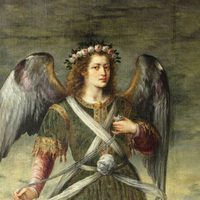 SelaphielThe archangel of prayer, whose name means “Prayer of God.” He is depicted with hands folded upon his breast in supplication and is invoked as a helper and teacher of prayer.
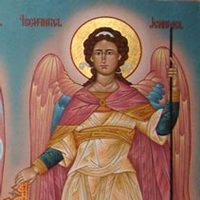 JegudielThe archangel who encourages and rewards those who labor for the glory of God, whose name means “Glorifier of God.” He is shown bearing a golden crown and a whip — reward for the diligent, admonition for the slothful.
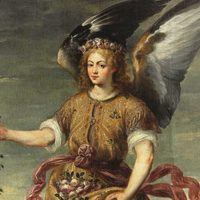 BarachielThe archangel of God’s blessings, whose name means “Blessing of God.” He is the bestower of heaven’s benedictions upon the faithful, often depicted scattering rose petals from his garments.
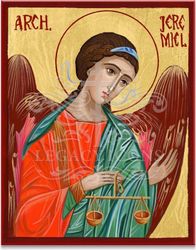 JeremielAn archangel sometimes numbered among the eight, whose name means “Exaltation of God” (or “God’s mercy,” as Jerahmeel). Named in 2 Esdras, he is associated with the raising up of hope and with divine visions.
Creation
The Fall
Old Testament History
The Incarnation
Christ’s Ministry
The Resurrection
The Ascension
The Last Judgment
The teaching in fullReadHide
The Archangels are one of the traditional orders of the bodiless heavenly powers in Orthodox Christian angelology. In the received hierarchy of the Nine Orders of Angels they are placed eighth overall, below the Principalities and above the Angels, belonging to the lowest triad (Principalities, Archangels, Angels). This ordering is preserved in Orthodox liturgical and synaxarial tradition, especially in the feast of the Synaxis of the Archangel Michael and the Other Bodiless Powers on November 8.
In Holy Scripture the word “archangel” appears explicitly only in the New Testament: Michael is directly called “the archangel” in Jude 1:9, and 1 Thessalonians 4:16 refers to “the voice of an archangel.” Gabriel is never explicitly called an archangel in the canonical New Testament but appears as a named heavenly messenger in Daniel and Luke; Raphael is named in the deuterocanonical book of Tobit as “one of the seven holy angels” who stand before God. Orthodox tradition commonly receives Michael, Gabriel, Raphael, Uriel, Selaphiel, Jegudiel, Barachiel, and sometimes Jeremiel among the archangels commemorated with the bodiless powers.
Orthodox Christianity understands the archangels as created spiritual beings, not divine powers — rational, bodiless servants of God who act as messengers, protectors, and ministers within the divine providence. The title “archangel” means “chief angel” or “ruling messenger,” from the Greek archē (“chief,” “first”) and angelos (“messenger”). Their significance is never separate from Christ: all the angelic ranks, archangels included, are created through Christ and subject to Him (Colossians 1:16; Ephesians 1:21).
The archangels are especially significant because several are known by name and appear in salvation history. Michael is associated with protection, spiritual warfare, and leadership among the heavenly hosts; Gabriel with divine announcements, above all the Annunciation to the Theotokos; and Raphael, in Tobit, with healing, guidance, and the offering of prayer before God. The other archangelic names are known chiefly from Orthodox liturgical and later traditional sources rather than from universally received canonical Scripture.
The Orthodox Church venerates the archangels but does not worship them — a crucial distinction. The Council of Laodicea condemned the worship of angels as gods, while Orthodox tradition affirms their proper veneration as servants of God.
Go deeper6ShowHide
How it reached us
The Old Testament contains named angels only rarely: Michael and Gabriel appear in Daniel, and Raphael in Tobit (deuterocanonical Scripture in Orthodox usage). During the Second Temple period Jewish writings increasingly developed angelic hierarchies, named angels, and heavenly-court imagery; these traditions form part of the historical background for New Testament angelology, though not all the later angelic names carry the same authority as Scripture.
Early Christianity inherited the Jewish angelic language but interpreted it through Christ. The New Testament consistently presents angels as servants of God, not independent divine beings, and St. Paul’s language about thrones, dominions, principalities, and powers emphasizes that all invisible beings are created through Christ and subject to Him.
What the Fathers taught
St. Dionysius the Areopagite places the Archangels in the lowest triad, together with the Principalities and Angels, treating them as a rank especially involved in the transmission of divine messages to the human world.
St. Basil the Great speaks of the angels as part of the invisible creation, citing the Pauline language of thrones, dominions, principalities, and powers to show that God created both visible and invisible realities.
St. Gregory the Theologian speaks of the angels as rational heavenly beings who worship God and serve His will, without systematizing the nine ranks in the Dionysian manner.
St. John Chrysostom emphasizes that angels and archangels are subordinate to Christ, warning against any angel-veneration that would obscure Christ’s supremacy.
St. John of Damascus teaches that the angels are incorporeal, rational beings created by God — a theology that undergirds the Orthodox distinction between angelic nature, angelic ministry, and divine worship.
In the Church’s services
The principal Orthodox feast connected with the archangels is the Synaxis of the Archangel Michael and the Other Bodiless Powers on November 8, which commemorates Michael, Gabriel, Raphael, Uriel, Selaphiel, Jegudiel, Barachiel, and sometimes Jeremiel, together with all the heavenly hosts.
The Menaion for November 8 contains hymns honoring the archangels and bodiless powers collectively, and the Horologion frequently names angels and archangels in the daily prayers.
The Divine Liturgy joins earthly worship to the worship of the heavenly hosts, especially in the Cherubic Hymn and in the anaphoral references to the angels, archangels, cherubim, and seraphim.
How it is shown in icons
The archangels are usually depicted as winged, youthful figures, often vested as heavenly warriors, messengers, or court attendants. Michael commonly carries a sword, spear, or staff and may be shown as commander of the heavenly hosts; Gabriel often bears a staff or lily-like rod in Annunciation icons; and Raphael may be shown with Tobias, a fish, or healing imagery, in traditions shaped by Tobit.
Byzantine, Greek, Russian, Serbian, Romanian, Antiochian, and modern Orthodox icons generally follow these patterns. Icons of the Synaxis often show Christ enthroned or Emmanuel in a mandorla, surrounded by Michael, Gabriel, and the other archangels, with cherubim and seraphim nearby.
Its mark on Orthodox life
The archangels have had a major influence on Orthodox theology, liturgy, iconography, hymnography, and church architecture. Icons of Michael and Gabriel are often placed on the deacon doors of the iconostasis; Gabriel is central to Annunciation iconography, and Michael is prominent in icons of the Synaxis, the Last Judgment, and spiritual warfare.
The archangels also shaped monastic and devotional literature as examples of obedience, vigilance, and service to God.
The Named Archangels
Orthodox tradition commonly numbers seven or eight archangels. Three are named in Scripture: MICHAEL (“Who is like God?”), the commander of the heavenly hosts, defender against evil, and protector of God’s people (Daniel; Jude 1:9; Revelation 12); GABRIEL (“God is my strength”), the messenger of divine announcements, above all the Annunciation (Daniel; Luke 1); and RAPHAEL (“God heals”), the companion and healer of Tobit’s household (Tobit 5–12).
Four more are received from Orthodox liturgical and later tradition: URIEL (“Fire of God,” associated with divine light and wisdom), SELAPHIEL (the angel of prayer), JEGUDIEL (who encourages those who labor for God), and BARACHIEL (the bestower of God’s blessings). An eighth, JEREMIEL (or Jerahmeel), associated with the raising up of hope, is sometimes added. These four-to-five names are not drawn from universally received canonical Scripture but from the Church’s liturgical inheritance, and an Orthodox account distinguishes them accordingly.
Where this comes fromShowHide
The Scripture passages12
- Jude 1:9 — Michael is called “the archangel” — the only passage directly naming him so.
- 1 Thessalonians 4:16 — The Lord descends “with the voice of an archangel” — one of the two explicit New Testament uses of the word.
- Daniel 8:15–26; 9:20–27 — Gabriel interprets Daniel’s visions and explains the prophecy of the seventy weeks.
- Daniel 10:13, 21; 12:1 — Michael, “one of the chief princes” and “the great prince” who stands for God’s people — the Old Testament background for his archangelic role.
- Tobit 5–12 (Deuterocanonical) — Raphael guides Tobias, heals Tobit, and reveals his identity.
- Tobit 12:15 (Deuterocanonical) — Raphael is “one of the seven holy angels” who stand before God — a key source for the tradition of the seven archangels.
- Luke 1:11–20 — Gabriel announces the birth of John the Forerunner to Zechariah.
- Luke 1:26–38 — Gabriel announces the Incarnation to the Theotokos — the central New Testament appearance of Gabriel.
- Matthew 1:20–24; 2:13, 19–20 — An angel guides Joseph in dreams concerning Christ’s infancy.
- Matthew 28:2–7 — An angel at the tomb announces Christ’s Resurrection.
- Revelation 8:2 — The seven angels who stand before God — associated with the wider tradition of the seven archangels.
- Revelation 12:7–9 — Michael and his angels fight the dragon — Michael as leader in the heavenly conflict.
Read more
Primary Sources
- Daniel 8–12; Luke 1:11–38; Matthew 1–2; Matthew 28:2–7; 1 Thessalonians 4:16; Jude 1:9; Revelation 12:7–9 (Scripture)
- Tobit 5–12 (Deuterocanonical)
- Menaion (Nov 8); Horologion; Divine Liturgy of St. John Chrysostom (Liturgical texts)
- On the Celestial Hierarchy — Pseudo-Dionysius the Areopagite
- Hexaemeron — St. Basil the Great
- An Exact Exposition of the Orthodox Faith — St. John of Damascus
Orthodox Sources
- Synaxis of the Archangel Michael and the Other Bodiless Powers — Orthodox Church in America
- The Synaxis of the Archangel Michael and All the Bodiless Powers — Ukrainian Orthodox Church of the USA
Academic Sources
- Pseudo-Dionysius the Areopagite — Stanford Encyclopedia of Philosophy
- On the Celestial Hierarchy — English translation and critical editions
The word “archangel” (“chief messenger,” Greek archē + angelos) appears explicitly only in the New Testament (Jude 1:9, of Michael; 1 Thessalonians 4:16). Michael is named in canonical Scripture (Daniel, Jude, Revelation) and Gabriel in Daniel and Luke; Raphael is named in the deuterocanonical Tobit as one of the seven who stand before God. Uriel, Selaphiel, Jegudiel, Barachiel, and sometimes Jeremiel are known chiefly from later Orthodox liturgical tradition. The Church venerates the archangels but does not worship them (the Council of Laodicea condemned the worship of angels as gods). Commemorated Nov 8 (Julian; Nov 21 Gregorian) at the Synaxis of the Bodiless Powers (FF-0071).
Daniel 8–12; Tobit 5–12; Luke 1:11–38; Matthew 1–2; Matthew 28:2–7; 1 Thessalonians 4:16; Jude 1:9; Revelation 12:7–9; Pseudo-Dionysius, On the Celestial Hierarchy; St. Basil the Great, Hexaemeron; St. John Chrysostom, Homilies on the Pauline Epistles; St. John of Damascus, An Exact Exposition of the Orthodox Faith; Menaion (Nov 8 Synaxis); Orthodox Church in America; Ukrainian Orthodox Church of the USA