
The Life of Adam and Eve (Apocalypse of Moses)
Not one book but a family of them — where Eve retells the fall in her own words, Seth is sent to Paradise for the oil of mercy, angels bury Adam, and Satan explains that he fell because he would not bow to a creature made of clay.
The Versions, Side by Side
Which episode stands in which witness — the table this material cannot be read without.
"The Life of Adam and Eve says…" is usually unsafe. Anderson and Stone's Synopsis exists to put these columns side by side, and this is a summary of what it shows.
| Version | Common title | Distinctive material |
|---|---|---|
| Greek | Apocalypse of Moses | Eve's first-person account of the fall; Adam's death and Eve's vision of the chariots; the angelic burial with Abel. No refusal-to-bow episode and no penance in the rivers |
| Latin | Vita Adae et Evae | The penance in the rivers; Satan's deception of Eve as an angel of light; Satan's account of his own fall and refusal to honour Adam |
| Armenian | The Penitence of Adam | Close to the Latin in shape; carries the refusal episode; preserves material the Greek lacks |
| Georgian | The Book of Adam | Carries the refusal episode; an important independent witness to the non-Greek branch |
| Slavonic | Life of Adam and Eve | Carries the refusal episode; transmitted in Slavic Christian manuscript culture |
The row that matters most is the first. The story everyone quotes from this literature is not in the witness everyone names.
Satan's Refusal to Honour Adam
One of the most influential stories in the history of Christian demonology — and not in Genesis, and not in the Greek.
Latin, Armenian, Georgian and Slavonic. Anyone citing it should name the witness.
Catalogued for study, never venerated (§9).
Satanwho names his own fall, and dates his hatred from it
Vita Adae et Evae 12–16 (Latin) · Wisdom of Solomon 2.24 · Luke 10.18 · Revelation 12.9
Asked by Adam why he pursues them, Satan explains himself. When Adam was made in the image of God, Michael brought him and set him before the face of God, and God commanded the angels to worship the image of God. Michael worshipped first and called the rest to do the same.
Satan refused. He would not worship one lower and later than himself; he was prior in creation, and Adam ought rather to worship him. Angels under his authority refused with him. For this he was cast out of heaven onto the earth, and his hostility to humanity dates from that moment — he pursues Adam and Eve because it was through them that he lost his glory.
The motive here is not simply pride but envy, and that is the version with the strongest canonical relative: Wisdom of Solomon 2.24 says that through the envy of the devil death entered the world. Scripture gives a fall, an expulsion with his angels, an identification with the ancient serpent, and envy. It does not give this scene.
Genesis narrates no command to the angels concerning Adam, no refusal and no fall of Satan. Nor is the episode in the Greek Apocalypse of Moses. It belongs to the Latin, Armenian, Georgian and Slavonic branch.
- Holy Scripture — that Satan fell and was cast down with his angels, and that death entered by his envy
- This literature — the command, the refusal, the speech, and the dating of his hatred from it
- Not in Genesis, and not in the Greek witness
- Not the source of later Christian demonology on its own; that is a braid of several strands
Michael, who worshipped first
Vita Adae et Evae 14 (Latin) · Genesis 1.26–27 · Psalm 8 · Hebrews 2.5–9
Michael's part is easily missed and is the hinge of the scene. He brings Adam before God, worships first, and calls the other angels to follow — and when Satan refuses, it is Michael who warns him of God's anger.
He is the model of the obedience Satan withholds, which is the same characterisation Jude 9 gives him when he will not presume to judge the devil on his own authority. In this literature as in Scripture, Michael's greatness is his subordination.
The honour he renders is to the image of God in Adam — Genesis 1.26–27, humanity crowned with glory and honour in Psalm 8, and Hebrews 2 arguing that the world to come was subjected not to angels but to man. Those are the coordinates the story works within.
Worship, or homage?
adorare (Latin) · proskynein (Greek)
The verb decides what the scene means. Latin adorare and Greek proskynein both cover a wide range — falling down before, doing obeisance, paying homage, reverencing — and both are used for honour given to a king or superior as well as for the worship due to God alone. English "worship" once had the same range and no longer does, which is why the modern rendering misleads.
The angels are not asked to give Adam what belongs to God. They are asked to do homage before the image of God in him, and the text says exactly that: the command is to worship the image of God.
This distinction matters for the whole page. "Angels were commanded to worship Adam as God" is a mistranslation, and it is the form in which the story is most often repeated.
- That humanity is made in the image of God is Scripture and Orthodox teaching
- The distinction between veneration and the worship due to God alone is settled Orthodox doctrine, and it applies here
- The scene itself remains extra-biblical narrative
Catalogued for study. Where the versions differ, this page names the version rather than choosing one and calling it the tradition.
The Angels of the Adam Story
Who actually appears, and in which witness.
Fewer than popular accounts suggest. An angel named in this literature does not thereby become an archangel of the Church.
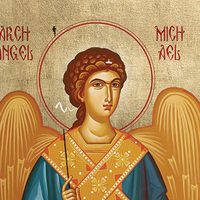 MichaelThroughout the family: he presents Adam before God and worships first (Latin); he refuses Seth the oil of mercy at the gate of Paradise; he intercedes at Adam's death, receives his soul, buries the body, and instructs Seth about the sign of the resurrection.
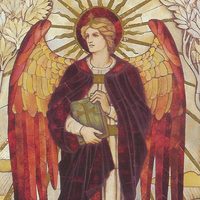 UrielNamed in the Greek with Michael as the archangel who carries and buries the bodies of Adam and Abel. His standing in Orthodox tradition rests on that tradition, not on this appearance.
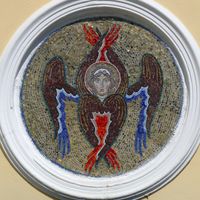 The seraphimAppear among the heavenly attendants in the death and burial scenes of some witnesses. The linked record is the Church's own; the scene here is this literature's.
Adam's Death and Burial
Genesis gives Adam's death one line. This literature spends its last third on it.
The first illness, the refused request, the opened heavens, and the first burial — attended by angels, with the first murdered man laid in the earth beside his father.
The oil of mercy
Apocalypse of Moses 9, 13 (Greek) · Vita Adae et Evae 40–42 (Latin) · Genesis 5.5
Adam falls ill and sends Eve and Seth back toward Paradise to beg oil from the tree of mercy, that he might be anointed and have relief. On the way, in several witnesses, a beast attacks Seth and Eve rebukes it — an episode about the dominion over the animals that humanity has lost.
Michael meets them at the gate and refuses. The oil cannot be given now. The promise attached is future: at the end of the times, when the appointed years are fulfilled, the mercy will come and the righteous will be anointed.
The Christian resonance is obvious and some witnesses sharpen it. Whether the promise as it stands is Jewish expectation or Christian shaping is exactly what the composition problem makes hard to settle, and connecting the oil to baptism or chrismation is a reading no witness on its own supports.
Seth returns with nothing. It is a remarkable thing for the literature to have done — the request that drives the last act is refused, and Adam accepts the refusal.
- Holy Scripture — Genesis 5.5, that Adam lived nine hundred and thirty years and died
- This literature — the illness, the journey, the tree of mercy, the refusal and the promise
- Not established — any sacramental identification of the oil
Eve's vision
Apocalypse of Moses 33–37 (Greek)
As Adam dies Eve looks up and sees the heavens opened — a chariot of light borne by four bright eagles, angels going before it, and the sun and moon making supplication for her husband. The chariot comes and stands over the body, and there is the smoke of incense between.
The angels fall down and cry to God to forgive him, for he is God's image and the work of God's hands. God does not answer at once; Michael and the angels intercede; and at length the soul is received.
In the Greek the soul is given into Michael's keeping until the day of dispensation, in the third heaven and in Paradise — held against a future restoration rather than simply arriving somewhere. This is the one genuinely visionary passage in the Greek text, and the nearest thing it has to the apocalypse its title promises.
Adam's death is the first human death and is treated as unique — the head of the race dying, and the whole creation reacting. Reading it as a description of what happens to every soul goes past what the narrative claims.
The burial, and the sign of the resurrection
Apocalypse of Moses 38–43 (Greek) · Genesis 4.8
God commands linen cloths of fine byssus, and the body is wrapped and prepared. Michael and Uriel carry it and bury it in the region of Paradise — and with Adam they bury Abel, whose body had lain unburied since Cain killed him. The first man and the first murdered man go into the earth together.
The whole scene is conducted as a service: incense, prostration, angelic prayer, procession, with God present.
Eve dies six days later, having prayed to be laid beside her husband. Michael instructs Seth that the dead are not to be mourned beyond six days, because the seventh day is the sign of the resurrection and the rest of the age to come. That is the last word of the story — a promise, not a lament.
The resemblance to the Church's burial of the dead is immediate and should be held as resemblance. Nothing here has been shown to have shaped the Orthodox funeral service. What the passage shows is that the picture of angels attending a burial, and of the seventh day as the sign of resurrection, is very old.
Adam's Family
The four who carry the story, all commemorated by the Church and all with their own pages here.
What Genesis says of each and what this literature adds are different things.
About the bookReadHide
The Life of Adam and Eve is not a book. It is a family of related books — Greek, Latin, Armenian, Georgian and Slavonic — telling overlapping but genuinely different versions of what happened to Adam and Eve after they were driven out of Paradise. Treating them as translations of one lost original is the commonest mistake made with this material, and it produces claims no surviving text actually supports.
The Greek witness is confusingly called the Apocalypse of Moses. The title comes from its manuscripts and from the edition that made it famous, not from its contents: there is no Moses in it, and it is not an apocalypse in the sense that 1 Enoch or the Apocalypse of Abraham are. It is a deathbed narrative about Adam, in which Eve retells the fall in her own words.
Across the family the story runs roughly like this. Expelled from Paradise, Adam and Eve are hungry and wretched, and undertake a penance standing in the rivers — during which Satan appears to Eve disguised as an angel of light and deceives her a second time. Adam falls ill, and sends Eve and Seth back toward Paradise to beg the oil of mercy from the tree; the archangel Michael refuses it and tells them the time has not come. Adam dies; Eve sees the heavens opened and the chariots of light; the angels bury him with his son Abel; and Eve dies and is buried beside him, with Michael instructing Seth about the days of mourning and the sign of the resurrection.
One episode in this family became one of the most influential stories in the history of Christian demonology — Satan explaining that he was cast down because he refused to bow before Adam. It is not in Genesis, and it is not in the Greek. It belongs to the Latin, Armenian, Georgian and Slavonic witnesses, and this page keeps that distinction visible throughout, because almost everything written about it online does not. None of this material is canonical Scripture in any Orthodox tradition. It is catalogued here for study.
The book in depth14ShowHide
Not One Book — the Textual Family
The single most important thing to understand about this material is that "the Life of Adam and Eve says…" is usually an unsafe sentence. The versions differ in what they contain, not merely in wording.
Scholars use Life of Adam and Eve as an umbrella term for the whole family, and Apocalypse of Moses for the Greek witness in particular. The Latin is the Vita Adae et Evae; the Armenian is often called the Penitence of Adam; the Georgian the Book of Adam; there is also a Slavonic tradition. They are related — they share episodes, sequences and phrasing — and they are not copies of one another.
Gary Anderson and Michael Stone's Synopsis of the Books of Adam and Eve exists precisely because of this: it sets the versions in parallel columns so a reader can see at a glance which episode stands in which witness. Any serious use of this material starts there.
The practical rule for this page, and for anything drawn from it: name the witness. Where an episode is common to the family, it is described as such. Where it belongs to one branch, the branch is named.
The Misleading Title
The Greek text is conventionally called the Apocalypse of Moses, and both halves of that title are misleading.
Moses does not appear in it. The name comes from the manuscript tradition and was fixed by the edition that first made the text widely known in the nineteenth century; it seems to reflect a scribal notion that the revelation of Adam's story was given to Moses, who wrote Genesis. Nothing in the narrative depends on him.
Nor is it an apocalypse in the sense the other works in this section are. There is no guided ascent through heavens, no angelic interpreter walking a seer through cosmic geography, no vision of the end of the age. It is a deathbed narrative with one visionary passage in it — Eve's sight of the heavens opened while Adam is dying.
The title is too entrenched to abandon and too misleading to leave unexplained, which is why this page carries both names.
Date, Origin and Authorship
Almost every question here has a range rather than an answer, and the honest presentation is a table of positions rather than a date.
The traditional view is of a Jewish work of roughly the first century AD, later transmitted and modified by Christians. That view has been substantially complicated. Johannes Tromp's critical work on the Greek text, and the broader turn associated with Marinus de Jonge, made it much harder to separate a clean Jewish original from Christian editing, and some scholars now place the Greek text as we have it considerably later than the first century. The Latin and the other versions have their own histories, and the relationship between them is itself disputed.
The original language is not settled either. Greek is the language of the earliest substantial witness and may represent an early compositional stage; a Semitic original has been hypothesised and has not been demonstrated. Geographic origin is likewise proposed rather than established.
| Question | Positions | Certainty |
|---|---|---|
| Date | A Jewish core around the 1st century AD is the traditional view; some place the Greek text as we have it considerably later | Disputed |
| Jewish or Christian | Probably Jewish traditions, certainly Christian transmission; separating the layers cleanly is now regarded as very difficult | Disputed |
| Original language | Greek is the earliest substantial witness and may be compositional; a Semitic original is hypothesised | Unknown |
| Geographic origin | Proposed rather than established | Unknown |
| Relation between versions | Related witnesses of a shared tradition, not translations of one recoverable original | Probable |
Eve's Account of the Fall
The heart of the Greek witness is a long passage in which Eve, as Adam lies dying, gathers her children and tells them what happened — Genesis 3 retold in the first person by the woman who was there.
The retelling adds a great deal. Paradise is divided, Adam keeping one part and Eve another, with angels set to guard them; the angels withdraw at the hour of worship, and it is then that the adversary comes. Satan does not simply use the serpent as a mouthpiece: he approaches the serpent first, persuades it, and speaks through it as a vessel. Eve is made to swear an oath before she is given the fruit, and she then gives it to Adam with the same words used on her.
The account is also emotionally particular in a way Genesis is not. Eve accuses herself, describes the moment she understood she was naked of the righteousness she had been clothed with, and cries out that she has sinned before God and before the angels.
None of this is Genesis, and the page does not present it as an expansion authorised by Genesis. It is an ancient Jewish and Christian meditation on Genesis 3, and it is the most sustained early one that survives.
The Penance in the Rivers
This episode belongs to the Latin, Armenian and Georgian witnesses, and is not in the Greek.
Driven out and starving, Adam and Eve find nothing to eat like the food of Paradise, and Adam proposes penance: he will stand in the Jordan for forty days and Eve in the Tigris for thirty-seven, silent, the water up to their necks, entreating God.
Satan interrupts it. He comes to Eve disguised as an angel of light — the disguise is the point — and tells her that God has heard and sent him to bring her out of the water. She believes him and leaves the river, and when Adam sees what has happened he cries out to her that she has been deceived a second time. Satan is then made to explain himself, which is where the next section begins.
Two things follow for a reader. First, the episode is a study in the discernment of spirits long before that phrase was current: the deception works precisely because it comes as consolation and as light. Second, it is narrative, and this page does not present the penance as a historical fact about Adam and Eve.
Satan's Refusal to Honour Adam
Asked why he pursues them, Satan gives an account of his own fall — and it is one of the most consequential passages in all extra-biblical literature.
In the Latin Vita he says that when Adam was made in the image of God, Michael brought him and set him before the face of God, and God commanded the angels to worship the image of God. Michael worshipped first and called the others to do the same. Satan refused, saying that he would not worship one lower and later than himself, that he was prior in creation, and that Adam ought rather to worship him. Angels under him followed his refusal. For this he and they were cast down out of heaven onto the earth, and his hostility to humanity dates from it — he pursues Adam and Eve because through them he lost his glory.
The episode appears in the Latin, Armenian, Georgian and Slavonic witnesses. It is not in the Greek Apocalypse of Moses, which has no such scene. That distribution is the fact most often got wrong, and it matters, because the same claim is routinely presented as what "the Life of Adam and Eve" says.
It is also, emphatically, not in Genesis. Genesis narrates no command to the angels concerning Adam, no refusal, and no fall of Satan. Anyone citing this story should say which witness they are citing and should not attribute it to Scripture.
| Detail | Greek | Latin | Armenian / Georgian / Slavonic |
|---|---|---|---|
| Satan explains his own fall | Absent | Present | Present |
| God commands the angels concerning Adam | Absent | Present | Present |
| Michael obeys first and summons the others | Absent | Present | Present |
| Satan's refusal — "prior in creation" | Absent | Present | Present |
| Angels who follow Satan | Absent | Present | Present |
| Expulsion from heaven to earth | Absent | Present | Present |
| Hostility to humanity as consequence | Implied elsewhere | Explicit | Explicit |
| Eve's first-person account of the fall | Present and central | Reduced | Varies |
| Penance in the rivers | Absent | Present | Present |
| Seth's journey for the oil of mercy | Present | Present | Present |
| Angelic burial of Adam | Present | Present | Present |
Worship, or Homage?
A translation question sits underneath the whole episode, and getting it wrong makes the story say something it does not.
The Latin verb is adorare, and the Greek equivalent in comparable texts is proskynein. Both cover a wide range — falling down before, doing obeisance, paying homage, reverencing — and both are used in Scripture and in ordinary ancient usage for honour rendered to a king or a superior as well as for the worship due to God alone. English "worship" once carried that same range and no longer does.
So the scene is not asking the angels to render Adam the worship owed to God. It is asking them to do homage before the image of God in him, and the text says as much: the command is to worship the image of God. Adam is honoured for what he bears, not treated as divine.
That reading also connects it to genuine biblical material — humanity made in God's image and likeness in Genesis 1.26–27, crowned with glory and honour and set over the works of God's hands in Psalm 8, and the argument of Hebrews 2 that the world to come was not subjected to angels but to man. Those are the scriptural coordinates the story is working within. The story itself is still not in Scripture.
What Scripture Says About Satan's Fall
Since this book is so often cited as the origin of Christian demonology, it is worth setting out what the canonical texts actually give.
Genesis 1–3 has a serpent, subtle above the beasts of the field, and does not identify it as Satan or narrate any angelic rebellion. Isaiah 14 and Ezekiel 28 are addressed in their immediate contexts to the king of Babylon and the prince of Tyre; Christian tradition has long read them as also disclosing the fall of the adversary, and that reading is interpretation rather than the plain sense, which is why this page does not present them as straightforward descriptions of Satan. Wisdom of Solomon 2.24 says that through the envy of the devil death entered the world — the closest canonical relative of the Adamic material, and the reason envy rather than pride is the motive most easily defended from Scripture. Luke 10.18 has Christ seeing Satan fall as lightning; John 8.44 calls him a murderer from the beginning and the father of lies; Revelation 12.9 identifies the great dragon with the ancient serpent, the devil and Satan, cast down to the earth with his angels.
So Scripture gives a fall, an expulsion with his angels, an identification with the serpent, and envy as a motive. What it does not give is the scene: no command to the angels concerning Adam, no refusal, no speech of self-justification.
The Life of Adam and Eve supplies the scene. Whether later Christian demonology took it from there, or both draw on older shared tradition, is not something a catalogue should assert — and no single source should be named as the origin of the whole later tradition of Lucifer's fall, which is a braid of Isaiah, Ezekiel, Wisdom, Luke, Revelation, patristic exegesis and this literature together.
Adam's Illness, Seth's Journey, and the Oil of Mercy
Adam falls ill — the first illness — and gathers his children. Genesis gives his death one line: he lived nine hundred and thirty years, and he died. This literature spends its final third on it.
He sends Eve and Seth back toward Paradise to beg the oil of mercy from the tree of mercy, that he might be anointed and have relief. On the way, in several witnesses, a beast attacks Seth, and Eve rebukes it; the episode turns on the loss of the dominion humanity had over the animals.
At the gate the archangel Michael meets them, and refuses. The oil cannot be given now. In the Greek he tells Seth not to labour to obtain it, since it cannot be his at present — and the promise attached is future: at the end of the times, when the appointed years are fulfilled, the mercy will come and the righteous will be anointed.
The Christian resonance of that promise is obvious, and some witnesses make it more explicit than others. This page notes it and stops there. Whether the promise as it now stands is Jewish expectation or Christian shaping is exactly the kind of question the composition problem makes hard, and connecting the oil to baptism or to chrismation is a reading no witness on its own supports.
Seth returns empty-handed, and Adam receives the answer without complaint. It is a striking thing for the literature to have done: the request that drives the last act of the story is refused.
Adam's Death, and Eve's Vision
As Adam dies, Eve looks up and sees the heavens opened, and this is the visionary passage that gives the Greek text whatever claim it has to be called an apocalypse.
She sees a chariot of light borne by four bright eagles, and angels going before it, and the sun and the moon making supplication for Adam — and the chariot comes and stands over her husband's body, and there is the smoke of incense between. The angels fall down and cry out to God to forgive him, for he is Your image and the work of Your hands.
God does not answer immediately. Michael and the angels intercede, and at length the body is given over and the soul received. In the Greek the soul is taken up and given into the care of Michael, who is told to keep it until the day of dispensation, in the third heaven and in Paradise — held, that is, against a future restoration rather than simply arriving at a destination.
Adam's is the first human death in these texts, and it is treated as unique — the head of the race dying and the whole creation reacting. Reading it as a general description of what happens to every soul goes beyond what the narrative claims for itself.
The Angelic Burial, and the Sign of the Resurrection
God commands the angels to bring linen cloths of fine byssus, and Adam's body is wrapped and prepared. Michael and Uriel are named in the Greek as the archangels who carry it and bury it — and with Adam they bury the body of Abel, which had lain unburied since Cain killed him, so that the first man and the first murdered man go into the earth together.
The burial is in the region of Paradise, and the whole scene is conducted as a service: incense, prostration, angelic prayer and procession, with God Himself present. It is the earliest full description in this literature of a funeral attended by the heavenly host.
Eve dies six days later, having prayed to be laid beside her husband, and is buried with him. Michael instructs Seth that the dead are not to be mourned beyond six days, because on the seventh day is the sign of the resurrection and the rest of the age to come — the story's last word, and a promise rather than a lament.
For an Orthodox reader the resemblance to the Church's own burial of the dead is immediate, and it should be held as resemblance. Nothing here has been shown to have shaped the Orthodox funeral service, whose sources are its own; what the passage shows is that the picture of angels attending a burial and of the seventh day as the sign of resurrection is very old.
Not the Cave of Treasures, and Not the Qur'an
Two neighbouring bodies of material are routinely merged with this one, and both mergers produce errors.
The Cave of Treasures is a later Syriac Christian work with its own concerns — a continuous sacred history from Adam to Christ, in which Adam's body is preserved in a cave, carried through the ark, and finally buried at Golgotha so that Christ's blood falls upon his skull. That Golgotha tradition is genuinely important in Eastern Christianity and it belongs to the Cave of Treasures, not to the Life of Adam and Eve, which buries Adam in the region of Paradise. Importing it here is the commonest contamination in popular accounts.
The Qur'anic account of Iblis refusing to prostrate before Adam is the other. The comparison is legitimate historically and the chronology should be stated plainly: the Jewish and Christian Adamic witnesses containing the refusal are earlier than the rise of Islam, so the direction of any influence cannot run from Islam into this literature. Whether it ran the other way, or whether both draw on shared late-antique Near Eastern tradition, is a scholarly question this page leaves open. It is raised here only for historical comparison.
Canonicity, the Fathers, and Orthodox Reception
No version of this literature is canonical Scripture in any Orthodox tradition, and no Orthodox council received it. Its transmission across Greek, Slavonic, Armenian and Georgian Christian manuscript cultures is nevertheless extensive, and the Armenian and Georgian traditions in particular preserved forms of the material that the Greek does not have.
Patristic use is hard to establish, and this page claims none. The Fathers certainly discuss Satan's envy of humanity — Wisdom 2.24 gave them the motif directly, and it appears in Irenaeus and elsewhere without requiring any knowledge of this literature. St Ephrem's Paradise material, the garments of glory, Adam's lost radiance and the restoration of Adam belong to a rich Syriac tradition with its own roots. Similarity of theme is not evidence of dependence, and the graded categories used elsewhere in this section apply: direct citation, probable dependence, shared tradition, thematic parallel, no evidence — with most of these cases falling in the last two.
The same caution governs the liturgical and iconographic questions. Adam lamenting outside Paradise on Cheesefare Sunday, Christ raising Adam in the Anastasis, Paradise reopened at Pascha — these are central Orthodox themes with abundant scriptural and patristic grounding, and no motif among them has been shown to derive from this literature. No surviving Orthodox image is known to illustrate these texts specifically.
A sourcing note, in the spirit of the rest of this section. This page was written from a research brief rather than a completed source dossier. The narrative substance, the version distribution — especially the absence of the refusal episode from the Greek — and the scriptural coordinates are reliable. Bibliographic particulars, chapter references and the precise attribution of some scholarly positions have not been checked against the primary editions, and should be verified before this profile is promoted.
What It Can and Cannot Establish
It can illuminate ancient interpretation of Genesis 2–3; the growth of Satan traditions and of the motive of envy; the developing portrait of Michael; Adam as the image of God and the honour due to that image; Paradise and the oil of mercy; repentance and the deception of the penitent; the first death and the first burial; angelic attendance at a funeral; the hope of resurrection; and the way Eastern Christian manuscript cultures preserved Adamic material.
It cannot establish historical events before or after the Fall; an Orthodox account of Satan's rebellion; a canonical command that angels bow to Adam; Orthodox teaching about death or the soul; an angelic hierarchy; the standing of any angel named only here; influence on Orthodox liturgy or iconography without separate evidence; or doctrine drawn from an isolated manuscript variant.
| Commonly said | Status | What can be said |
|---|---|---|
| The Life of Adam and Eve says Satan refused to bow to Adam | Names the wrong thing | The episode is in the Latin, Armenian, Georgian and Slavonic witnesses; it is not in the Greek Apocalypse of Moses |
| Genesis describes Satan's refusal to bow | False | Genesis narrates no command to the angels concerning Adam, no refusal, and no fall of Satan |
| The Greek and Latin texts are the same work in two languages | False | They are related witnesses of a family, differing in which episodes they contain |
| The Apocalypse of Moses is about Moses | No | Moses does not appear; the title is a manuscript and editorial convention |
| Angels were commanded to worship Adam as God | Mistranslation | The command is homage before the image of God in him; adorare and proskynein cover reverence as well as divine worship |
| Adam was buried at Golgotha | Different work | That is the Cave of Treasures, a later Syriac work; here Adam is buried in the region of Paradise |
| This is where the story of Lucifer's fall comes from | Too simple | Later tradition braids Isaiah 14, Ezekiel 28, Wisdom 2.24, Luke 10.18, Revelation 12, patristic exegesis and this literature |
| Islam took the story from this text | Not established | The Jewish and Christian witnesses are earlier than Islam, but direct borrowing has not been shown and should not be assumed |
| The text describes what happens to every soul after death | Overreaches | Adam's death is treated as unique — the head of the race, with the creation reacting |
| The Orthodox funeral service comes from this book | No evidence | The resemblance is real; the service has its own sources and no dependence has been demonstrated |
| Uriel is an archangel of the Church because he buries Adam here | Does not follow | Uriel's standing rests on Orthodox tradition, not on an appearance in this literature |
SourcesShowHide
- Gary A. Anderson and Michael E. Stone, A Synopsis of the Books of Adam and Eve (Society of Biblical Literature) — the synoptic edition that makes the versions comparable; the indispensable tool for this material
- Johannes Tromp, The Life of Adam and Eve in Greek — A Critical Edition (Brill, 2005)
- M. D. Johnson, "Life of Adam and Eve", in James H. Charlesworth, ed., The Old Testament Pseudepigrapha, vol. 2 (Doubleday, 1985) — standard English translation; cited for scholarship, not reproduced
- Gary A. Anderson, Michael E. Stone and Johannes Tromp, eds., Literature on Adam and Eve — Collected Essays (Brill, 2000)
- Michael E. Stone, on the Armenian and Georgian Adam literature
- Genesis 1.26–27; Genesis 2–3; Genesis 5.5; Psalm 8; Isaiah 14.12–15; Ezekiel 28.11–19; Wisdom of Solomon 2.24; Luke 10.18; John 8.44; Romans 5.12–21; 1 Corinthians 15; Hebrews 2.5–9; Revelation 12.9 (Holy Scripture)
- Catalogued for study; requires clergy/source review before any devotional use. This page was written from a research brief rather than a completed source dossier — see the sourcing note in Canonicity & Orthodox Reception