
Transfiguration of the Lord
Also known as: Transfiguration of Christ, Metamorphosis
Aug 6· Fixed date
Christ's transfiguration on the mountain before Peter, James, and John, His face and garments shining with uncreated light while Moses and Elijah appeared with Him and the Father's voice was heard.
Depictions & Icons
How the Church has written this feast — festal icons across the centuries.
Overview
The Transfiguration of the Lord is one of the Twelve Great Feasts of the Orthodox Church, celebrated on August 6. It commemorates the moment when Christ, having taken the apostles Peter, James, and John up a mountain, was changed before them: His face shone like the sun and His garments became white as light, while the prophets Moses and Elijah appeared speaking with Him and the Father's voice was heard from a bright cloud, declaring Him the beloved Son.
The feast is dedicated to the Lord and falls within the Dormition Fast (August 1–14). Because of the feast's importance the fast is relaxed on this day, and fish, wine, and oil are permitted. The celebration is preceded by a one-day Forefeast on August 5 and is followed by an Afterfeast of eight days, its Apodosis falling on August 13, the day before the Forefeast of the Dormition.
In Orthodox tradition the mountain of the Transfiguration is identified as Mount Tabor. The event is recorded in the Synoptic Gospels and referred to in the Second Epistle of Peter, and it stands as a revelation of Christ's divinity and a foreshadowing of His glory, given to strengthen the disciples before His voluntary Passion.
History
The origins of the feast are uncertain. It may derive from the dedication of three basilicas on Mount Tabor, and it existed in various forms by the ninth century. Some sources connect its early observance to the Jewish Festival of Booths, of which the Transfiguration came to be regarded as the New Testament fulfillment. The celebration was at one time associated with the season of Great Lent, but this placement may have been felt to be too joyous for that penitential period, and the feast came to be kept on August 6.
A theology of the Transfiguration drew the attention of the Church Fathers from the earliest times. Irenaeus in the second century wrote that the glory of God is a living human being. By the fourth century Gregory of Nyssa and Pseudo-Dionysius developed a theology of light that influenced later Byzantine mystical traditions. In the seventh century Maximus the Confessor taught that the apostles' senses were transfigured so that they might perceive Christ's true glory.
The feast became central to a major theological controversy in the fourteenth century between Gregory Palamas and Barlaam of Calabria. Barlaam held that the light shining from Christ on the mountain was a created light, while Gregory maintained that the disciples were given grace to perceive the uncreated light of God. Palamas conceived true knowledge of God as the transfiguration of humanity by the Spirit, and his defense of the uncreated light shaped the Orthodox understanding of the feast.
The Transfiguration ranks among the Twelve Great Feasts of the Byzantine and Orthodox calendars. It is celebrated with an All-Night Vigil, and Great Vespers is served on the eve. When the feast falls on a Sunday, its liturgy is not combined with the Sunday service but completely replaces it.
Meaning
The Transfiguration reveals the divinity of Christ. On the mountain the disciples beheld, as far as they were able, the glory that belonged to Him always, and the event demonstrated His divine nature even as He drew near to His voluntary Passion. The setting on the mountain is presented as the meeting point of human nature and God, the place where the temporal and the eternal come together.
Byzantine theology reads the feast as a revelation of the Holy Trinity: the Father spoke from heaven, the Son was transfigured, and the Holy Spirit appeared as a cloud. For this reason it is called the Small Epiphany, paralleling the Baptism of Christ, which is the Great Epiphany.
The appearance of Moses and Elijah, representing the Law and the Prophets, shows that Christ fulfills both, and the event is understood as the fulfillment of Old Testament messianic prophecy. Standing with Him, the two prophets bear witness that He is the one toward whom the Scriptures point.
Central to the meaning of the feast is the teaching on the uncreated light. Following Gregory Palamas, the Church confesses that although God cannot be known in His essence, He can be known in His energies, and that the light which shone on Tabor was the uncreated light of God Himself. In this the feast opens onto the hope of theosis: the Transfiguration shows the possibility of the deification of the human person, transfigured by the grace of the Spirit.
Iconography
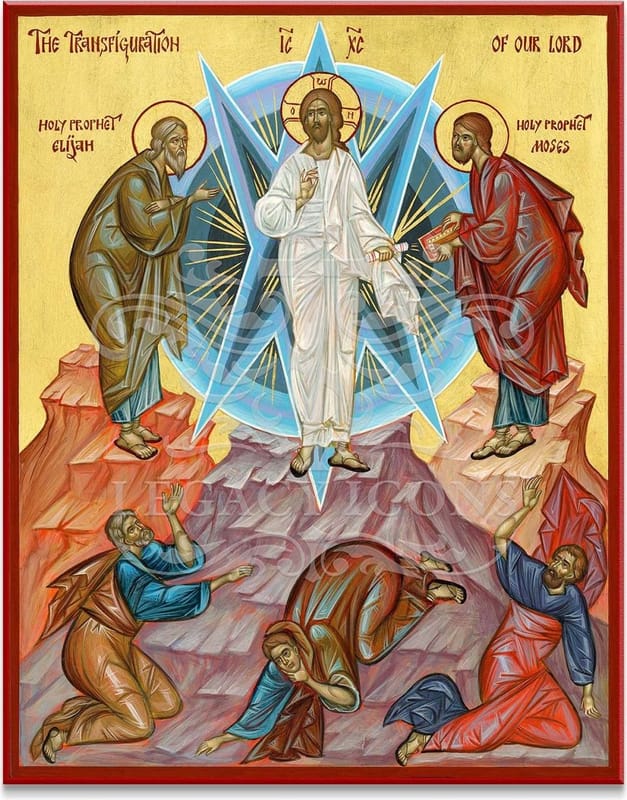
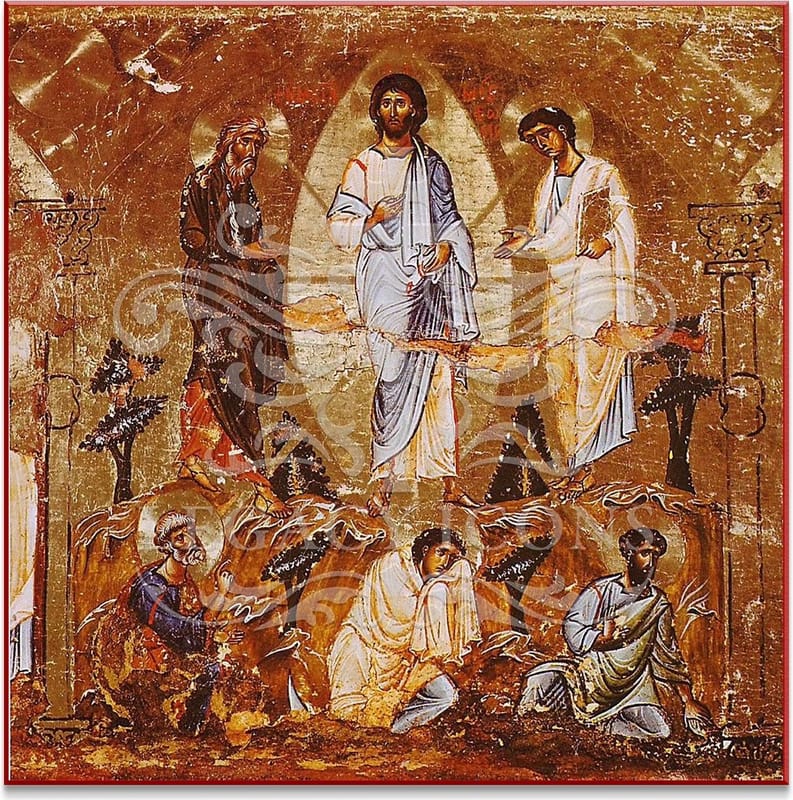
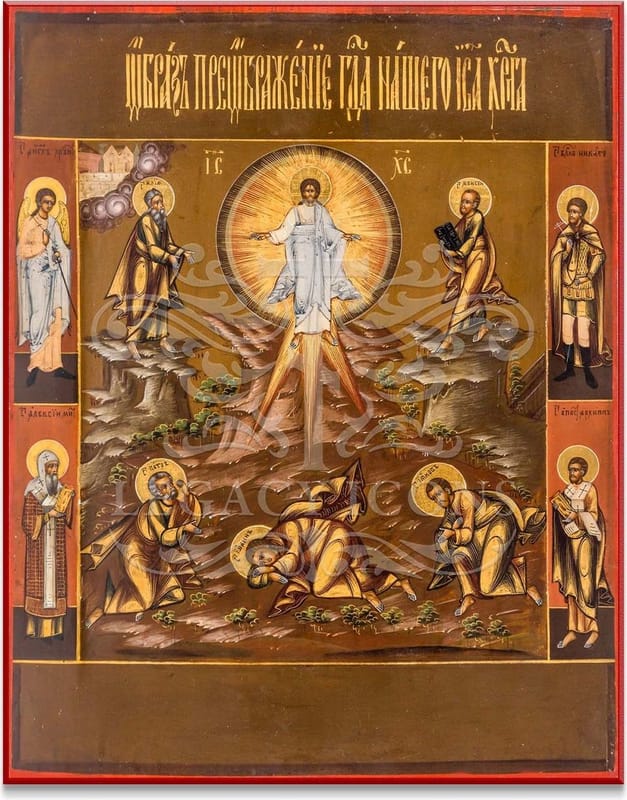
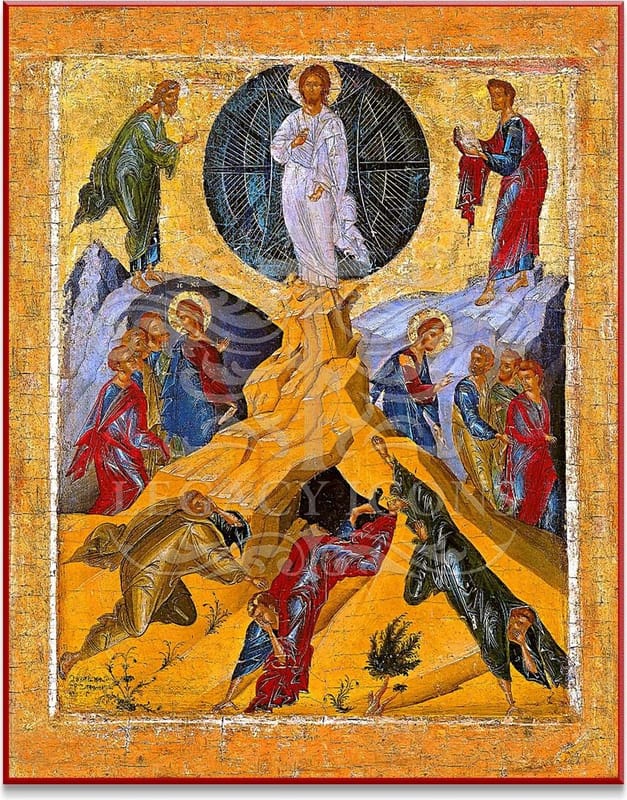
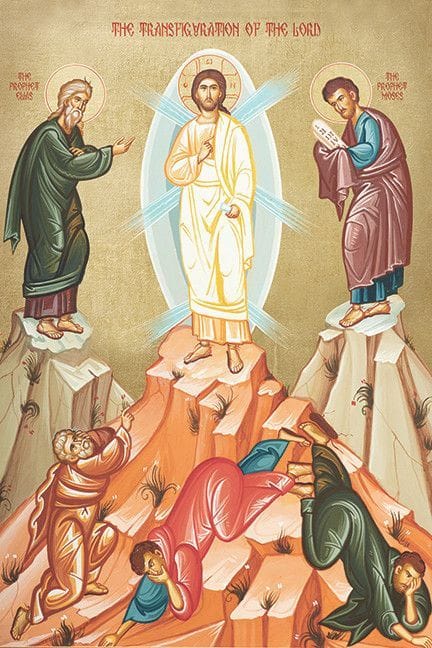
Depictions of the Transfiguration developed early; a sixth-century symbolic representation survives in the Basilica of Sant'Apollinare in Classe. The standard iconographic composition organizes the figures into two zones. Above, Christ and the prophets appear in stately, static, and calm dignity: Christ stands in bright radiance at the center, with Moses, shown with a long beard, on the left and Elijah on the right. Below, the three witnessing apostles — Peter, James, and John — are shown sprawling and writhing in sleep or in terror, responding with wonder or prostration.
The mandorla is the primary vehicle for representing the divine radiance. In many Eastern icons a blue-and-white mandorla depicts the uncreated light emanating during the event; this element also represents the luminous cloud and signifies the presence of the Holy Spirit on the mountain. The tradition stresses that the disciples beheld the light only as far as they were able, reflecting the varying spiritual development of the apostles.
In monastic tradition icon painters have often begun their practice by rendering the Transfiguration, on the understanding that this icon is painted not so much with colors as with the Taboric light.
Hymnography
The services of the feast are furnished with proper hymns that celebrate the manifestation of Christ's glory on the mountain and the revelation of His divinity to the disciples. Great Vespers is served on the eve, with Old Testament readings drawn from Exodus and First Kings; the Gospel of the Transfiguration from Luke is appointed at Matins, and the readings from Second Peter and Matthew at the Divine Liturgy of Saint John Chrysostom, which is traditionally preceded by Matins.
Fasting in Practice
The feast falls within the Dormition Fast (August 1–14). In recognition of the importance of the celebration the fast is relaxed on this day, and the Church's practice permits the consumption of fish, wine, and oil. Fasting disciplines vary by tradition and typikon; the faithful are directed to their priest for the observance proper to them.
Customs & Traditions
The blessing of the first fruits of the new harvest — especially grapes, and also apples and other produce — which are brought to the church to be sanctified after the Divine Liturgy on the feast, beginning the annual blessing of first fruits; where grapes are unavailable, other fruits may be substituted.
In Greece and Romania the harvest season traditionally began on the Transfiguration, and grapes in particular were not eaten before August 6; in some parishes the first grapes are brought to church for a blessing and then distributed to the faithful.
Ideas for Celebrating This Feast
Ways to keep the Transfiguration and its blessing of the first fruits at home.
- Take grapes and the season's first fruits to church to be blessed — the classic custom of the feast — then share them at home.
- Hike up a nearby hill or mountain and read the Gospel of the Transfiguration at the top, recalling Christ on Mount Tabor.
- Talk with children about the "uncreated light": light candles and describe how Peter, James, and John saw Christ shining with divine glory.
- Let children help pick, wash, and arrange fruit for the festal table, and give thanks for the gifts of creation.
- Make a simple summer dish featuring grapes or fresh produce — fish, wine, and oil are permitted on the feast though it falls in the Dormition Fast.
- Retell the stories of Moses and Elijah, who appeared with Christ, as the Law and the Prophets pointing to Jesus.
- Add the Transfiguration icon to the icon corner and sing the troparion of the feast.
Ideas gathered and adapted from Orthodox family resources — OCA. These are optional, inviting ideas, not liturgical requirements.
Scripture
- Matthew 17:1–8 — The Transfiguration account, read at the Divine Liturgy.
- Mark 9:2–13 — The Synoptic account of the event.
- Luke 9:28–36 — The Synoptic account; read at Matins.
- 2 Peter 1:16–19 — Peter's witness to the glory beheld on the holy mountain; read at the Liturgy.
Fasting is described here at the season-summary level and differs by jurisdiction and person — please consult your parish priest about how to keep the fasts.