
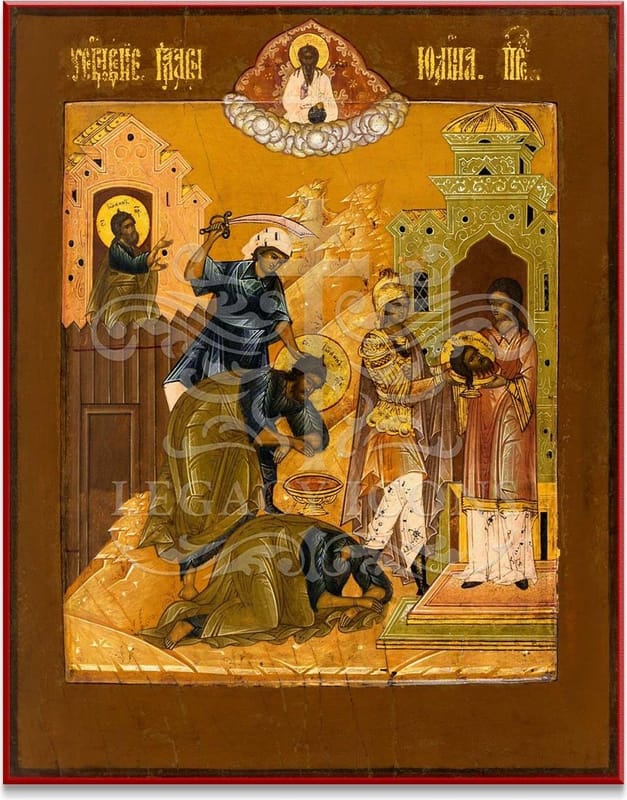
Beheading of St John the Baptist
Also known as: Beheading of the Forerunner, Beheading of the Honorable Head of John the Baptist, Decollation of the Forerunner
Aug 29· Fixed date
A feast that is at the same time a strict fast, commemorating the unjust beheading of St John the Baptist and Forerunner at the command of Herod.
Depictions & Icons
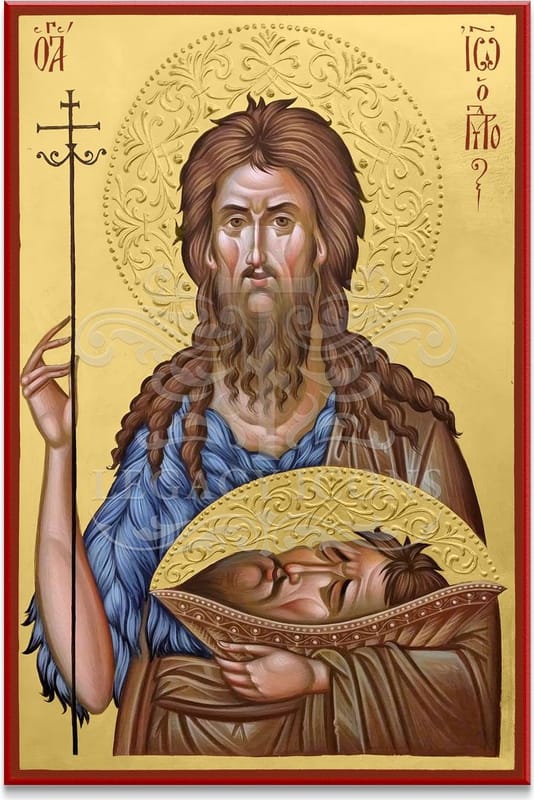
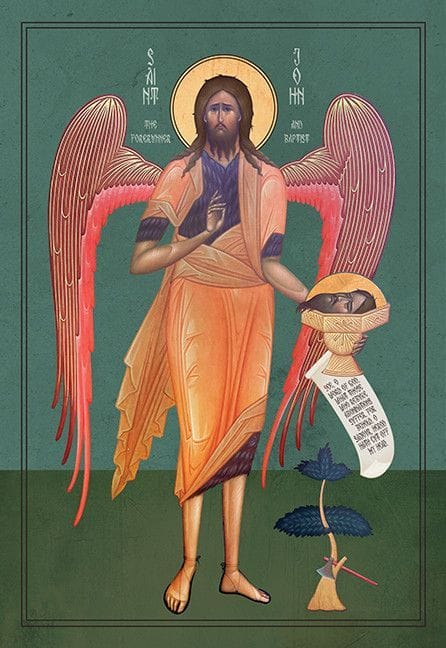
How the Church has written this feast — festal icons across the centuries.
Overview
The Beheading of St John the Baptist, commemorated on August 29, marks the martyrdom of St John the Forerunner and Baptist, who was executed by beheading at the command of Herod Antipas, the Roman-appointed ruler of Galilee. It is one of the Church's fixed observances in which a feast and a strict fast coincide: the day honors the great prophet who baptized Christ, yet it is kept in sober mourning for his unjust death.
The commemoration is one of six feast days that the Orthodox Church dedicates to St John throughout the liturgical year, and it stands among the oldest observances honoring a saint in both Eastern and Western liturgies. In the Latin calendar it is known as the Decollation of St John the Baptist.
Because the day recalls a martyrdom rather than a joyful mystery, the Church prescribes a strict fast even though August 29 is a feast, and a number of pious customs of abstinence surround it.
History
According to the New Testament, Herod Antipas had imprisoned John the Baptist because John publicly reproved him for divorcing his first wife and unlawfully taking Herodias, his brother's wife and his own sister-in-law, as his second wife. John was confined at the fortress of Machaerus, east of the Dead Sea, and the execution is generally placed around 28 to 29 AD.
The synoptic Gospels relate that at a banquet held for Herod's birthday, Herodias's daughter, identified by the Jewish historian Josephus as Salome, danced before the assembly. Her performance so pleased the intoxicated ruler that he swore to grant her any wish. Prompted by her mother Herodias, she asked for the head of John the Baptist on a platter. Though the Gospels describe Herod as saddened, he felt bound by his oath and ordered the beheading, which was carried out in the prison; the head was brought on a dish and given to the girl, who presented it to her mother. John's disciples buried his body and brought word of the tragedy to Jesus. The event is understood to have preceded Jesus' third Passover.
The historian Josephus offers corroborating testimony, noting that Herod feared John's influence over the people might incite rebellion. Many Jews afterward regarded Herod's military defeat by Aretas as divine punishment for the execution of John. Church tradition further holds that Salome later died when the ice broke beneath her as she crossed a frozen river and she was decapitated, an end seen as a form of divine retribution.
The liturgical commemoration of the Beheading is almost as ancient as that of John's Nativity on June 24, itself among the oldest feasts introduced into both the Greek and Latin liturgies in honor of a saint. Alongside these principal feasts, the calendar keeps additional commemorations of the discoveries of John's relics: the First and Second Finding of his Head on February 24, recalling its discovery on the Mount of Olives in the fourth century and its transfer to Emesa in 452, and the Third Finding on May 25, marking its location at Comana in the ninth century during the period of iconoclasm. From early on, the Eastern Orthodox and Byzantine Catholic churches have observed the Beheading with strict fasting.
Meaning
The feast holds together two realities that the Church does not separate: the greatness of the Forerunner and the horror of his unjust death. John is honored as the bridge between Old Testament prophecy and New Testament fulfillment, the prophet whom Jesus himself called 'a burning and a shining light.' His martyrdom is presented as the crown of a life wholly given to his divine calling, in which fidelity to God's truth was maintained even to the point of death.
John's death exemplifies the beatitude that blesses those persecuted for the sake of righteousness. He was killed not for any crime but for speaking the truth about an unlawful marriage, and his witness stands as a pattern of prophetic courage that does not yield to temporal power. His death demonstrates fidelity to the divine calling despite its earthly consequences.
Orthodox tradition holds that after his martyrdom John descended into Hades to proclaim there, as he had on earth, the coming of Christ, so that he remained the Forerunner even in death. The strict fast kept on the feast expresses the Church's mourning for the Forerunner and turns the remembrance of his death into an occasion of sober repentance rather than festal rejoicing.
Iconography
Traditional depictions of the event consistently show the severed head of St John the Baptist resting on a round silver platter or charger, often held by Salome or by Herod Antipas. Scenes of the beheading and of the banquet became an extremely common subject in the treatment of John in art, appearing at first most often in small predella scenes and later as the subject of larger independent works.
In Orthodox sacred art John is sometimes called the Angel of the Desert, and on account of this title he is at times depicted with wings, a symbol reflecting both his ascetic life in the wilderness and his prophetic, messenger-like role as the Forerunner.
Fasting in Practice
August 29 is kept as a strict fast day even though it is a feast, in mourning for the martyrdom of the Forerunner. The Church's practice is to abstain from meat, dairy, fish, wine, and oil in sober remembrance of his death.
Beyond the table itself, several customs of abstinence attach to the day. By long-standing pious custom the faithful will not eat food from a flat plate, use a knife, or eat round foods on this day — symbolic avoidances that recall the platter on which John's head was presented and the instrument of his decapitation. Such customs vary in observance, and the site's general disclaimer to consult one's own priest applies.
Customs & Traditions
A strict fast is kept out of mourning for the Forerunner, with abstinence from meat, dairy, fish, wine, and oil.
By pious custom the faithful refrain from eating food off a flat plate or platter, recalling the head brought on a charger.
By custom the faithful avoid cutting food with a knife on this day, in memory of the instrument of the beheading.
By custom round foods are not eaten, a symbolic avoidance referencing the severed head.
Ideas for Celebrating This Feast
Ways to keep the strict-fast day of the Beheading of St John the Baptist with children.
- Keep the strict fast as a household, adapting gently for young children so the day's solemnity is felt without imposing adult fasting.
- Serve simple bowl foods — soup, lentils, rice and beans — a plain fasting meal that helps children sense the day is set apart.
- Bake "locust and honey" crescent rolls with the kids, tied to St John's wilderness diet.
- Read the Gospel account (Mark 6) and tell children about St John beforehand, preparing them with the story.
- Color a St John the Forerunner page at the icon corner and talk about his courage and humility.
- Sing the troparion and pray to St John at the family icon corner.
Ideas gathered and adapted from Orthodox family resources — Ascetic Life of Motherhood, OCA. These are optional, inviting ideas, not liturgical requirements.
Fasting is described here at the season-summary level and differs by jurisdiction and person — please consult your parish priest about how to keep the fasts.