
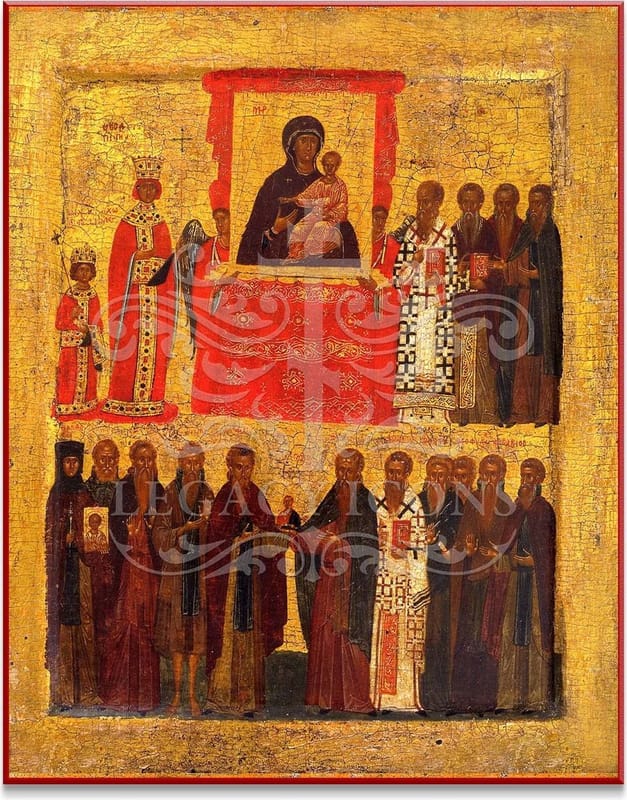
Sunday of Orthodoxy
Also known as: First Sunday of Great Lent, Triumph of Orthodoxy
P−42· Movable · Paschal cycle
The first Sunday of Great Lent, commemorating the restoration of the holy icons in 843 and the final triumph over iconoclasm, a celebration of the Church's confession of the true faith of the Ecumenical Councils.
Overview
The Sunday of Orthodoxy — also called the Feast of Orthodoxy or the Triumph of Orthodoxy — is observed on the first Sunday of Great Lent. It commemorates the restoration of the holy icons in 843 and the final defeat of iconoclasm, the heresy that had refused honor to sacred images.
More than a memorial of a single event, the observance became a celebration of the Church's confession of the true faith as defined by the Ecumenical Councils. On this day the Church remembers not only the vindication of the icons but its victory over all heterodoxy.
In older liturgical practice the first Sunday of Lent commemorated Old Testament prophets such as Moses, Aaron, and Samuel; after 843 the day came to commemorate the triumph of Orthodoxy over all heresy, and this remains its principal meaning.
Timeline
726 — Iconoclasm begins under Leo III
Emperor Leo III the Isaurian declares images idols forbidden by the commandment and orders their removal from the churches, opening the first period of iconoclasm.
754 — Council of Hieria
Constantine V summons a synod that condemns the veneration of images as a heresy.
787 — Second Council of Nicaea
Empress Irene, regent for Constantine VI, convenes the council, which reverses Hieria and decrees on October 13 that holy images are to receive veneration of honor. It is recognized as the last genuine Ecumenical Council.
814–843 — Second iconoclasm
Leo V the Armenian reinstitutes iconoclasm around 815; Michael II confirms the decrees in 824 and Theophilus continues the policy.
843 — Restoration of the icons
Empress Theodora, regent for Michael III, and Patriarch Methodius convene a synod at Constantinople; on the first Sunday of Great Lent a triumphal procession restores the icons, and the annual commemoration is decreed.
History
Byzantine iconoclasm unfolded in two phases. The first, roughly 726–787, began when Emperor Leo III the Isaurian ordered the removal of religious images, declaring in 726 that images were idols forbidden by the commandment against graven images. His successor Constantine V pressed the policy further, summoning the Council of Hieria in 754, which condemned the veneration of images as a heresy. The controversy was reversed under Empress Irene, regent for her young son Constantine VI, who convened the Second Council of Nicaea in 787.
The Second Council of Nicaea, recognized by the Orthodox Church as the last of the seven genuine Ecumenical Councils, met with roughly three hundred bishops and reversed the decrees of the iconoclast Council of Hieria. On October 13, 787, it decreed that venerable and holy images are to be set up in the churches of God and to receive veneration of honor, comparable to the honor given to the cross and the Gospels — distinguishing this veneration from the adoration due to God alone.
A second period of iconoclasm followed, from 814 to 843, beginning under Emperor Leo V the Armenian, who reinstituted the policy around 815, possibly prompted by military defeats. Michael II confirmed the iconoclast decrees in 824, and Theophilus continued them. Throughout both periods the defenders of images included Patriarch Germanus, Pope Gregory II, St. John of Damascus — who composed apologies against those who destroy the holy icons from his monastic sanctuary — and, in the second period, Patriarch Nicephorus I and St. Theodore the Studite, whose writings tied iconoclasm to Christological error.
Upon the death of Emperor Theophilus, his widow Empress Theodora, serving as regent for their minor son Michael III, reversed the iconoclast policies. In 843 she and Patriarch Methodius — who had endured imprisonment for defending the icons — convened a synod at Constantinople to resolve the controversy. The restoration was agreed on the condition that Theophilus not be condemned, a political compromise alongside the theological resolution.
The decisive moment came on the first Sunday of Great Lent in 843, when church leaders made a triumphal procession restoring the icons to the churches; sources place the event in the early months of that year (dates of March 11 and February 19 are variously reported). Theodora, her son the Emperor Michael, the clergy, and the people venerated the holy icons together. The synod decreed that this commemoration be kept each year on the first Sunday of Great Lent, and it has been observed annually ever since.
Meaning
The veneration of icons is held by the Orthodox to be a necessary consequence of the Christian faith in the Incarnation of the Word. Because Christ became visible in the flesh, the iconophiles argued, the Old Testament prohibition of images was superseded: the invisible God, now made man, could be depicted. The controversy therefore touched fundamental questions — the character of Christ's human nature, the Christian attitude toward matter, and the true meaning of redemption.
The iconoclasts argued that any depiction of Christ created a theological problem: a representation could show only his human nature, thereby either separating the divine and human natures (the Nestorian error) or confusing them into one (the Monophysite error), and they invoked the biblical prohibition of graven images. The defenders answered that the Incarnation itself made depiction possible and cited even the Old Testament's own commanded images, such as the cherubim God directed Moses to fashion.
Orthodox theology maintains a strict distinction: icons receive veneration (proskynesis), not worship (latria), which belongs to God alone. As the tradition summarizes Empress Theodora's own clarification, the faithful do not kiss the icons as a sign of worship, nor honor them as gods, but honor them as images of their prototypes; worship is offered only to the Triune God — Father, Son, and Holy Spirit — and to no saint or angel.
The icon possesses a sacramental character, making present to the believer the person or event it depicts. It also bears witness that man, created in the image and likeness of God, becomes holy and godlike through purifying himself as God's living image. In this way the feast confesses not merely the legitimacy of images but the whole doctrine of the Incarnation and of human sanctification, and by extension the Church's confession of the true faith against every heresy.
Hymnography
A Canon attributed to St. Theodore the Studite is sung during the procession with the icons. The proper hymns of the day celebrate the restoration of the images and the confession of the true faith, sounding the themes of the Incarnation that underlie the veneration of icons.
Customs & Traditions
A solemn procession is made with the holy icons after matins or the Divine Liturgy; the clergy and faithful process, often carrying icons of their patron or parish saints.
The Synodikon of Orthodoxy — the decree of the Synod of Constantinople — is proclaimed aloud, listing the saints who receive the threefold 'Eternal Memory' and the heretics (Arians, Nestorians, Monophysites, Monothelites, Iconoclasts, and others) who are met with the 'Anathema.'
In Greek usage the Creed is often recited by a lay member of the congregation who is a secular official.
Where several Orthodox jurisdictions are present, Pan-Orthodox Vespers are commonly celebrated in the evening.
In the former Russian Empire the service differed: the Emperor and his family were acclaimed, and the anathemas extended to those who denied the divine right of kings.
Ideas for Celebrating This Feast
Ways to keep the Sunday of Orthodoxy, the triumph of the holy icons, at home.
- Hold a mini icon procession at home — each child carries a family icon around the house or to church, echoing the parish procession that celebrates the restoration of the icons.
- Make an icon craft — a popsicle-stick or ribbon frame, or a small icon booklet the child keeps for prayer.
- Teach why Orthodox venerate icons, in kid-friendly terms — honoring an image versus worshipping God.
- Refresh the family icon corner together: dust and tidy it, light the lamp, and add a newly made or acquired icon to mark the day.
- Tell the story behind the feast — the restoration of the holy icons under the Empress Theodora in 843 — and narrate or act it out simply.
- Keep up Lenten almsgiving as a family — a weekly diaper drive, or sorting and donating outgrown clothes and toys.
Ideas gathered and adapted from Orthodox family resources — Orthodox Pebbles, Orthodox Motherhood. These are optional, inviting ideas, not liturgical requirements.
Scripture
- Exodus 20:4–5 — The prohibition of graven images invoked by the iconoclasts and answered by the defenders of the icons.
- Hebrews 11 — The appointed Epistle discusses faith in unfulfilled promises.
- The appointed Gospel — The Gospel lesson emphasizes the fulfillment of the divine promises through Christ's incarnation and the Church.
The Synodikon of Orthodoxy
The Synodikon read on this day names the defenders of the faith for whom 'Eternal Memory' is proclaimed three times, and pronounces 'Anathema' upon the condemned heresies. Though instituted for the restoration of the icons, the text came to embrace opposition to all heterodoxy, so that the day commemorates the triumph of Orthodoxy over every heresy and not the icons alone.