
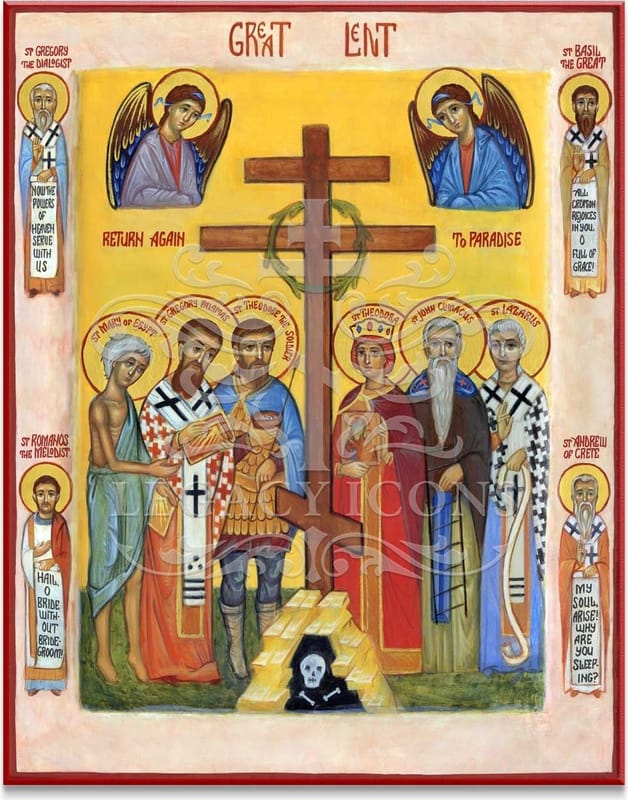
Great Lent
Also known as: Great Fast, The Forty Days, Holy Forty Days, Tessarakoste
P−48 → P−9· Movable · Paschal cycle
The chief penitential season of the Church year, a springtime of the soul preparing the faithful for Pascha through intensified prayer, almsgiving, and fasting in imitation of Christ's forty days in the wilderness.
Overview
Great Lent is the chief penitential season of the Eastern Orthodox year, the most demanding fast of the calendar and the Church's principal period of preparation for Pascha. It is often called a springtime of the soul, a spiritual workshop in which the faithful intensify prayer, almsgiving, and fasting in imitation of Christ's forty days in the wilderness.
The Forty Days proper begin on Clean Monday, the Monday following Forgiveness (Cheesefare) Sunday, and run continuously to the Friday before Lazarus Saturday. In the Eastern reckoning the Sundays are counted within the forty days, while Lazarus Saturday, Palm Sunday, and Holy Week fall outside the count and are kept as their own observances; fasting nonetheless continues through Holy Week to Pascha itself.
The season does not stand alone. It is opened by the pre-Lenten Sundays of the Triodion, which ease the faithful toward the fast, and it is structured internally by a series of themed Sundays and by distinctive weekday services found at no other time of the year.
Timeline
c. 190 — Diverse pre-paschal fasts
St Irenaeus records Christians keeping fasts of varying length before Easter, from a single day to a period of forty hours, with no fixed forty-day season.
325 — First mention of Tessarakoste
The fifth canon of the First Council of Nicaea uses the term Tessarakoste, the Forty Days, as an already-familiar observance.
331 and 339 — St Athanasius commends the forty days
Athanasius enjoins forty days of fasting before Holy Week and later urges the Alexandrians to keep it as universally practiced.
c. 360 — Synod of Laodicea
The synod imposes the obligation of fasting through the forty days before Easter.
End of the 4th century — General observance
The Great Fast, Tessarakoste to the Greeks and Quadragesima to the Latins, is kept generally throughout the Church.
History
The forty-day Lenten fast was not part of apostolic practice or the first three centuries. St Irenaeus, writing around 190, records that Christians before Easter kept fasts of widely differing lengths: some for a single day, some for two, some for several, and others reckoning a period of forty hours. Tertullian in the early third century likewise knew only a short paschal fast, not a period of forty days.
The Church's memory of the season's origin links it closely to the baptismal catechumenate. Having established Easter as the solemn day of Baptism, the early Church subjected candidates, the catechumens, to an intensive period of spiritual training and fasting in preparation for their illumination. Their sponsors, relatives, and friends gradually joined them in this discipline, so that a fast begun for those approaching the font came in time to involve the whole body of the faithful. Whereas the earlier fast was a brief paschal observance, the lengthening forty-day fast was bound up particularly with this final preparation of the catechumens for Baptism.
The first official mention of the term Tessarakoste, Greek for fortieth, appears in the fifth canon of the First Ecumenical Council at Nicaea in 325, where it is spoken of as something already familiar rather than a novelty introduced by the council. By 331 St Athanasius enjoined forty days of fasting before the stricter fast of Holy Week, and in 339, after travelling through Rome and Europe, he urged the Alexandrians to keep it as a practice observed everywhere. The Synod of Laodicea, about 360, imposed the obligation of fasting through the forty days before Easter. By the end of the fourth century the Great Fast, called Tessarakoste by the Greeks and Quadragesima by the Latins, was generally observed throughout the Church.
The precise way of counting the forty days varied from place to place. Some regions kept a six-week span and others an eight-week arrangement, as at Jerusalem, with localities exempting Saturdays or Sundays differently in order to arrive at exactly forty actual days of fasting. The Eastern practice that took hold counts the Sundays within the forty days and treats Holy Week as a distinct, more rigorous observance beyond them.
Meaning
Great Lent teaches that repentance is not a season of gloom but of purification and joy. The Orthodox tradition presents the fast as a return and a renewal rather than a mere ordeal, insisting that it is not a time of morbidity but a time of joyfulness in which the soul is cleansed and turned back toward God.
The Eastern understanding of the fast places its accent less exclusively on penance for sin than on the recovery of humanity's original state. Through the disciplines of the season the Christian is drawn to become, by grace, more godlike, participating more deeply in the life of Christ. Asceticism is offered to each of the faithful according to their own strength, so that the fast is a shared labor of the whole Church and not the work of monastics alone.
The season rests on three inseparable practices, prayer, fasting, and almsgiving, held together and oriented toward repentance and the renewal of love for God and neighbor. The forty days are patterned on the great fasts of Scripture, Moses receiving the commandments, Elijah journeying to Horeb, and above all Christ's forty days in the wilderness, so that the faithful walk with Christ toward His Passion and share, at its end, in the joy of His Resurrection.
Hymnography
The season's most distinctive hymnographic monument is the Great Canon of St Andrew of Crete, the longest canon of the church year, comprising nine odes woven densely from scriptural images of repentance. It is read in portions during the first week of the fast and in its entirety at Matins of the Fifth Week, an observance commonly called the Thursday of the Great Canon.
The hymnody of the Triodion, the service book proper to the season, governs both the pre-Lenten Sundays and the weeks of the fast, giving each Sunday and week its own penitential and preparatory themes.
Fasting in Practice
Great Lent is kept as the most demanding fast of the year, observed as a graded discipline rather than a single uniform rule. The fast sets aside meat, fish, eggs, and dairy, together with wine and oil, for the duration of the season.
Within that general shape the tradition allows customary relaxations: wine and oil are permitted on Saturdays and Sundays and on certain feasts, and fish is permitted on Palm Sunday and on the Annunciation when it falls within the fast. The exact keeping of the fast varies by day, by local typikon, and by pastoral counsel, and the faithful are directed to keep it according to their strength under the guidance of their priest.
Customs & Traditions
Forgiveness (Cheesefare) Vespers on the eve of Clean Monday opens the fast with the ceremony of mutual forgiveness, in which the faithful ask pardon of one another.
The Liturgy of the Presanctified Gifts is served on Lenten weekdays, especially Wednesdays and Fridays, since the full eucharistic Divine Liturgy is not celebrated on the weekdays of the fast; the faithful commune from Gifts consecrated the preceding Sunday.
The Saturdays of the Dead (Soul Saturdays) commemorate the departed, kept with kolyva.
Each Sunday of the fast carries its own commemoration: the Sunday of Orthodoxy, St Gregory Palamas, the Veneration of the Cross, St John Climacus, and St Mary of Egypt.
Ideas for Celebrating This Feast
Ways families keep the Great Fast at home with children.
- Make a 40-day countdown to Pascha — a paper chain, a wall calendar, or a "Lady Lent" figure whose seven feet are removed one a week.
- Agree together on a short, doable family Lenten rule — a little added prayer, simpler food, and giving — small enough to actually keep.
- Add the Prayer of St Ephraim to evening prayers and let the children make the accompanying bows and prostrations.
- Go to the Presanctified Liturgy and the Lenten services, giving young children a sticker sheet to mark each one attended.
- Refresh the icon corner for the season — a purple cloth, the lit vigil lamp — and gather there morning and evening.
- Keep an alms jar or a daily-kindness habit all Lent, and declutter and give away as a fast from "too much."
Ideas gathered and adapted from Orthodox family resources — Orthodox Motherhood, Ascetic Life of Motherhood. These are optional, inviting ideas, not liturgical requirements.
The Triodion and the pre-Lenten Sundays
Before the fast itself, the Church keeps a preparatory cycle drawn from the Triodion: the Sundays of the Publican and the Pharisee and of the Prodigal Son, followed by Meatfare and Cheesefare weeks, which gradually withdraw the faithful from rich foods and set the tone of humility and return that the fast will deepen.
Fasting is described here at the season-summary level and differs by jurisdiction and person — please consult your parish priest about how to keep the fasts.