
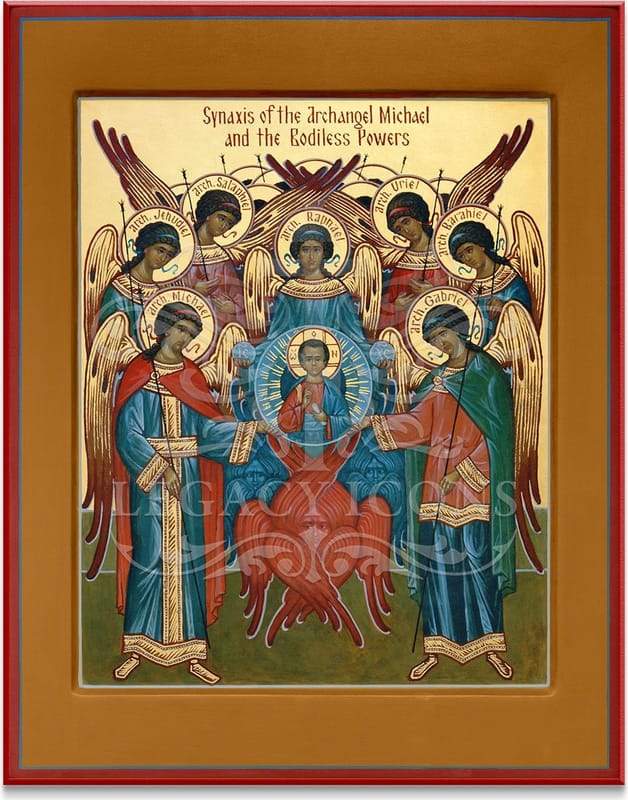
Synaxis of the Archangel Michael and the Other Bodiless Powers
Also known as: Synaxis of the Bodiless Powers, Feast of the Holy Angels, Archangels Michael and Gabriel
Nov 8· Fixed date
The principal feast of the holy angels, gathering the commemoration of the Archangel Michael, commander of the heavenly hosts, together with Gabriel and all nine ranks of the bodiless powers who stand before God and guard His people.
Depictions & Icons
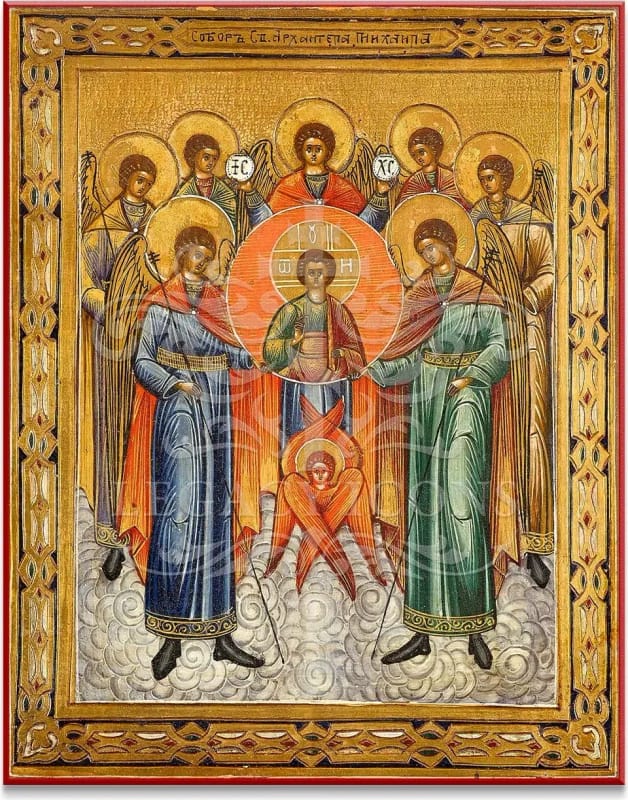
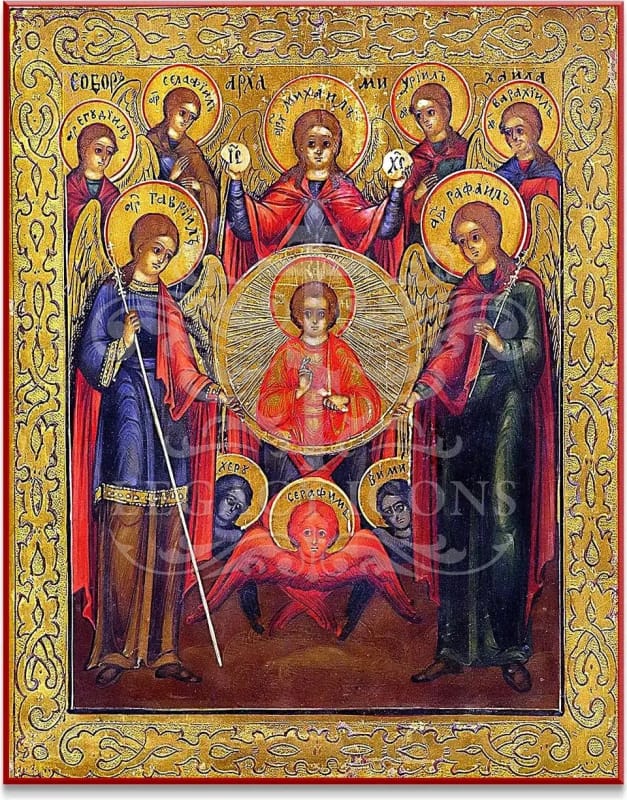
How the Church has written this feast — festal icons across the centuries.
Overview
The Synaxis of the Archangel Michael and the Other Bodiless Powers, kept on November 8, is the principal feast of the holy angels in the Orthodox Church. It gathers into a single commemoration the Archangel Michael, commander of the heavenly hosts, together with the Archangel Gabriel and all nine ranks of the angelic orders who stand before God and minister to His people.
A synaxis is an assembly for common commemoration, and here the whole company of the bodiless powers is honored under the leadership of Michael, whose name means "who is like unto God." Because the angels are venerated rather than worshipped as saints in the ordinary sense, this feast is carried among the feasts of the liturgical year rather than in the calendar of individual saints.
The celebration honors the Chief of the Heavenly Hosts, the Archangel Michael, together with the archangels Gabriel, Raphael, Uriel, Selaphiel, Jehudiel, Barachiel, and Jeremiel, and through them all the ranks of the angelic world.
Timeline
4th century — Council of Laodicea
Convening before the First Ecumenical Council, the council's thirty-fifth canon condemned the worship of angels as deities while affirming their proper veneration; tradition connects the establishment of the feast with this council.
4th–5th century — The Celestial Hierarchy
The writer known as pseudo-Dionysius the Areopagite systematized the ordering of the angels into nine ranks in three hierarchies, drawing on New Testament passages including Ephesians 6:12 and Colossians 1:16.
Early Byzantine period — Adoption at Constantinople
The Eastern Churches kept the feast on November 8 in connection with the thermal baths of the Emperor Arcadius at Constantinople, from where the observance spread across the Christian East.
History
Tradition traces the establishment of the feast to the early fourth century and the Council of Laodicea, which convened before the First Ecumenical Council. Its thirty-fifth canon condemned the heretical worship of angels as deities while affirming their proper veneration, and the feast gave that affirmation liturgical expression.
The dating of the feast is itself symbolic. November was chosen as the ninth month counting from March, when the year traditionally began, so that the month would correspond to the nine ranks of angels. The eighth day of the month was chosen because the holy Fathers call the Day of the Dread Last Judgment the Eighth Day, linking the assembly of the angelic hosts to their role at the end of the age.
In the East the observance became connected with Constantinople, and sources associate it with the thermal baths of the Emperor Arcadius in that city. From Constantinople the feast spread across the Christian East, taking root among Syrian, Armenian, and other Eastern communities, and it remains the principal feast of the holy angels in the Orthodox calendar.
Devotion to the angels, and to Michael and Gabriel above all, has been strong throughout Eastern Orthodox history. In Russia the faithful historically invoked Michael against invasion and civil conflict and dedicated many cathedrals to him across their lands.
The detailed ordering of the angels into nine ranks was systematized by the writer known as pseudo-Dionysius the Areopagite in his work The Celestial Hierarchy, dated to the fourth or fifth century, drawing on New Testament passages such as Ephesians 6:12 and Colossians 1:16. Pseudo-Dionysius is the sole historical source for this classification, and some later scholars have noted the possible influence of Neoplatonic philosophy on its three-triadic structure.
Meaning
The feast teaches the place of the bodiless powers within God's creation and their unceasing ministry to the human race. The word "angel" means "messenger," and the angels are also called the bodiless Powers of Heaven; their being is defined by service, standing before God and carrying out His will toward the world.
Through this commemoration the Church confesses the ordered structure of the angelic world. The nine ranks are arranged in three hierarchies. The highest comprises the Seraphim, six-winged beings closest to the Most Holy Trinity; the Cherubim, many-eyed and radiant with divine wisdom; and the Thrones, who bear God's presence and minister His justice. The middle hierarchy comprises the Dominions, who guide earthly rulers toward righteous governance; the Powers, who execute God's will through miracles; and the Authorities, who protect against demonic temptation. The lowest comprises the Principalities, who command the lower angels and oversee the nations; the Archangels, who announce great and wondrous tidings; and the Angels, who are nearest to humanity and guide it toward virtue.
Michael is honored as chief commander of the hosts, the Archistrategos or Supreme Commander of the Heavenly Hosts. Tradition holds that he cast down from Heaven the arrogantly proud Lucifer and the other fallen spirits, and it remembers his part in the events recorded of the Old Testament: leading Israel in the Exodus, revealing God's will to Joshua, destroying the army of Sennacherib, protecting the Three Holy Youths in the fiery furnace, and transporting the Prophet Habakkuk to aid Daniel. Christian tradition assigns him the roles of fighting against Satan, rescuing the faithful at death, championing God's people, and conducting souls to judgment.
The feast also expresses the nearness of the angels to every human life. The Church teaches that every person receives a guardian angel, that each nation has its own protective angel, and that consecrated churches are given guardian angels of their own. The framework of nine ranks reflects a further belief that the souls of those redeemed through the blood of the Lamb would complete a tenth order.
In all of this the feast holds a careful balance affirmed at Laodicea: the angels are not worshipped as gods but are properly venerated as the servants and ministers of God who intercede for humanity.
Iconography
The archangels are each depicted with distinguishing attributes. Michael tramples the devil with a spear and bears a white banner; he also appears as an angelic warrior, fully armed with helmet, sword, and shield, standing over a dragon and sometimes piercing it with a lance, and he is shown holding a pair of scales for weighing souls or carrying the book of life, signs of his part in the judgment. Gabriel holds a paradise branch or a lantern; Raphael guides Tobias and carries healing medicines; Uriel bears a naked sword and a fiery flame; Selaphiel stands in a prayerful posture with folded hands; Jehudiel holds a golden crown and a three-thonged whip; Barachiel displays a white rose; and Jeremiel carries balance scales. In many icons Christ is accompanied by a number of angels, with Michael a predominant figure among them.
Ideas for Celebrating This Feast
Ways to keep the feast of the holy angels with children.
- Make angel crafts — paper angels, a "nine ranks" mobile, or simple painted icons of Michael and Gabriel for the icon corner.
- Pray the guardian-angel prayer together at bedtime, and talk about the angel God gives each of us as protector and companion.
- Keep a name-day for anyone named Michael, Gabriel, Raphael, or Angela — their icon out, a candle, a small cake, and the Archangels' troparion sung.
- Learn the named archangels and their roles (Michael the commander, Gabriel the messenger, Raphael the healer) — a "who's who of the angels" for children.
- Talk about the "eighth day" the feast points to — a wonder-filled conversation about heaven and the age to come.
Scripture
- Ephesians 6:12 — Cited among the New Testament passages underlying the nine-rank ordering of the angelic powers.
- Colossians 1:16 — Cited alongside Ephesians as scriptural basis for the classification of the heavenly ranks.
Michael's rank among the angels
Tradition has not spoken with one voice on Michael's precise place within the angelic ranks. Some theologians positioned him above all the angels, and among them Saint Basil; some held him to be prince of the Seraphim, while others placed him as prince of the lowest choir. The feast honors him above all as the leader of the whole company of the bodiless powers under whose command the nine ranks are gathered.