
Ascension of the Lord
Also known as: Ascension of Christ, Holy Ascension
P+39· Movable · Paschal cycle
Forty days after Pascha, Christ's ascent into heaven from the Mount of Olives in the presence of the Apostles, taking up human nature to the right hand of the Father.
Depictions & Icons
How the Church has written this feast — festal icons across the centuries.
Overview
The Ascension of the Lord is one of the Twelve Great Feasts of the Orthodox Church, commemorating Christ's ascent into heaven forty days after Pascha. On the Mount of Olives, in the presence of the Apostles, the risen Lord blessed his disciples and was taken up, a cloud hiding him from their sight, and took up human nature to the right hand of the Father.
Because it is reckoned forty days after Pascha (by inclusive counting), the feast is moveable and always falls on a Thursday. In the Orthodox calendar its eve is the Leavetaking (Apodosis) of Pascha itself, so that the Paschal season concludes and the feast of the Ascension immediately opens. It has no forefeast for this reason.
The feast is followed by an eight-day afterfeast, with its own Apodosis on the Friday before Pentecost, the forty-seventh day after Pascha. The Sunday falling within the afterfeast commemorates the Holy Fathers of the First Ecumenical Council at Nicaea.
Timeline
4th century — Emergence as a distinct feast
Scholarly consensus dates the separate liturgical emergence of the Ascension to the late fourth century; Eusebius hints at its celebration, and by 384 it was venerated at the traditional site on the Mount of Olives.
c. 390 — The Eleona Basilica
A wealthy Roman woman named Poimenia financed construction of the Eleona Basilica at the Mount of Olives site, its name drawn from the Greek elaion, 'olive garden.'
early 5th century — Augustine attests wide observance
Augustine of Hippo held the feast to be of apostolic origin, indicating that it was already widely observed before his era.
614 — Destruction by the Persians
The Sassanid Persians destroyed the basilica at the Ascension site; it was rebuilt in the eighth century, destroyed again, and later rebuilt by the Crusaders.
1198 — Site passes to Waqf control
Saladin's emissaries acquired the Ascension site, placing it under Islamic Waqf control; only a small octagonal aedicule survives, said to bear the imprint of Christ's feet.
History
The Ascension appears in the New Testament in Luke and Acts, with further references across the epistles. Luke 24:51 recounts Jesus leading the eleven disciples toward Bethany on the Mount of Olives, blessing them, and being carried up into heaven. Acts 1:1-9 gives the fullest narrative: for forty days after the Resurrection Jesus appeared to the disciples, instructing them to await the Holy Spirit in Jerusalem, before being taken up from their sight with a cloud hiding him from view, after which two figures in white announced his future return in the same manner. Psalm 110:1 — 'Sit at my right hand until I make your enemies your footstool' — provided the interpretive framework by which early Christians understood the event.
As a distinct liturgical observance, the feast developed slowly. Saint Jerome attributed its observance to apostolic origins, and Augustine of Hippo, writing in the early fifth century, likewise held that it was of apostolic origin, indicating widespread observance before his time; scholarly consensus, however, dates its separate liturgical emergence to the late fourth century. Eusebius hints at its celebration in the fourth century, and John Chrysostom, Gregory of Nyssa, and the Apostolic Constitutions all mention the feast. The Pilgrimage of Aetheria attests to early liturgical observance at the holy sites of Jerusalem, describing how the feast was kept at the Church of the Nativity in Bethlehem — evidence that liturgical celebration predates the fifth century. It appears the feast may at first have been commemorated together with Pascha or Pentecost before becoming its own celebration only gradually from the late fourth century onward.
The traditional site of the Ascension was venerated on the Mount of Olives by 384. Around 390 a wealthy Roman woman named Poimenia financed the construction of the Eleona Basilica there — the name drawn from the Greek elaion, 'olive garden.' The Catholic tradition holds that Saint Helena erected the first memorial basilica at the site. It was destroyed by the Sassanid Persians in 614, rebuilt in the eighth century, destroyed again, and rebuilt by the Crusaders; Muslims later demolished the Crusader church. What remains is a small octagonal structure, an aedicule roughly twelve meters square, said to house the stone bearing the imprint of Christ's feet. Saladin's emissaries acquired the site in 1198, placing it under Islamic Waqf control, while the Russian Orthodox Church operates a convent at the summit of the Mount.
Meaning
Early Christian theology understood the Ascension as the divine vindication of Jesus following his crucifixion: taken into heaven and exalted to the right hand of God, he was recognized as the first of the dead and the head of the redeemed. The feast signifies Christ's glorification and his assumption of the mediatorial office — he now intercedes for believers before the Father — and establishes his heavenly session, his present reign, while promising his future return in the same manner in which he departed.
For the Orthodox tradition the feast carries a theanthropic dimension: in ascending, Christ takes up human nature itself to the Father. As V. Rev. George Florovsky expressed it, in the Ascension resides the meaning and fullness of Christ's Resurrection, and with Christ, man's nature ascends also — the Resurrection and the Ascension being inseparable stages of a single saving event. OrthodoxWiki describes the theological core of the feast as demonstrating the last stage in God's plan for mankind: total union with himself upon one's departure from the world.
The Ascension also legitimizes the mission of the disciples and anticipates the coming of the Holy Spirit at Pentecost, for the Lord instructed his followers to await in Jerusalem the power they would receive. Both Eastern and Western theology hold that the figurative language of Christ 'sitting at the right hand of God' is to be understood according to conventional usage rather than literal spatial position — a point of shared Catholic and Orthodox consensus.
Iconography
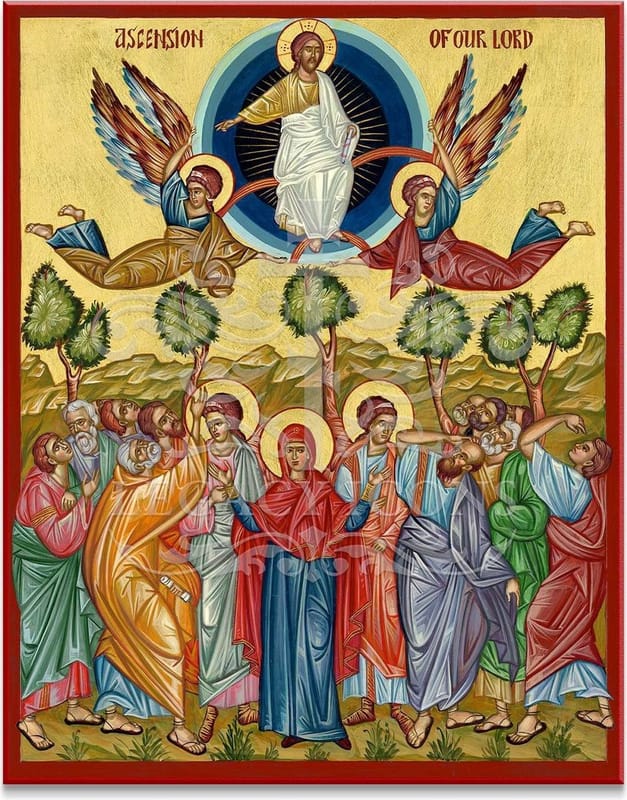
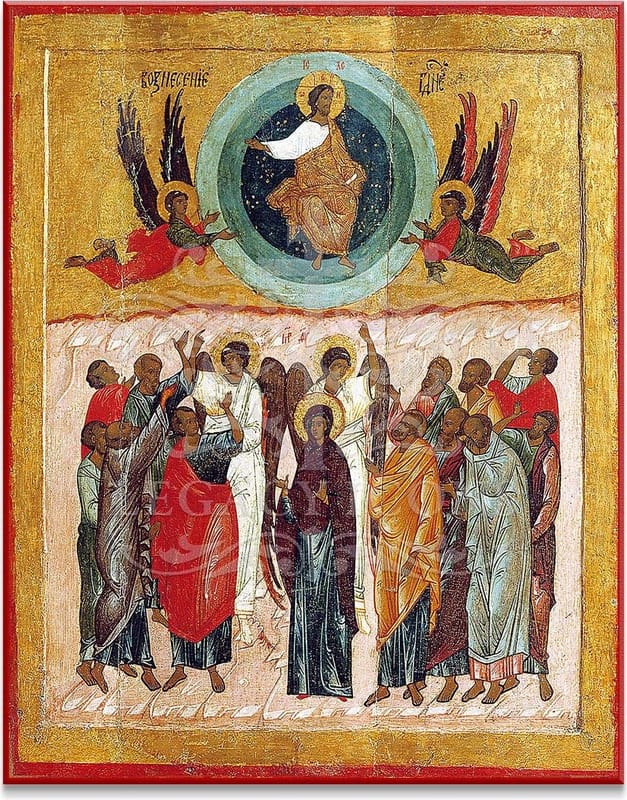
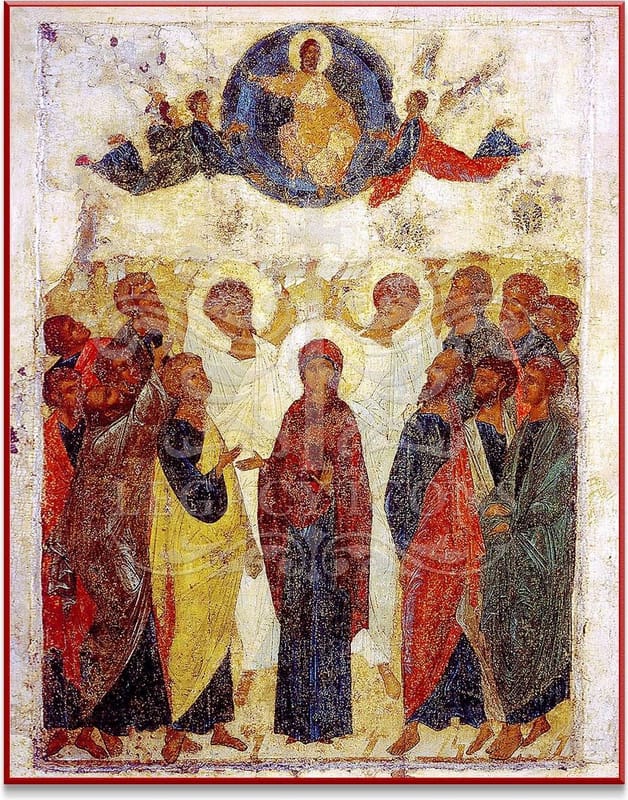
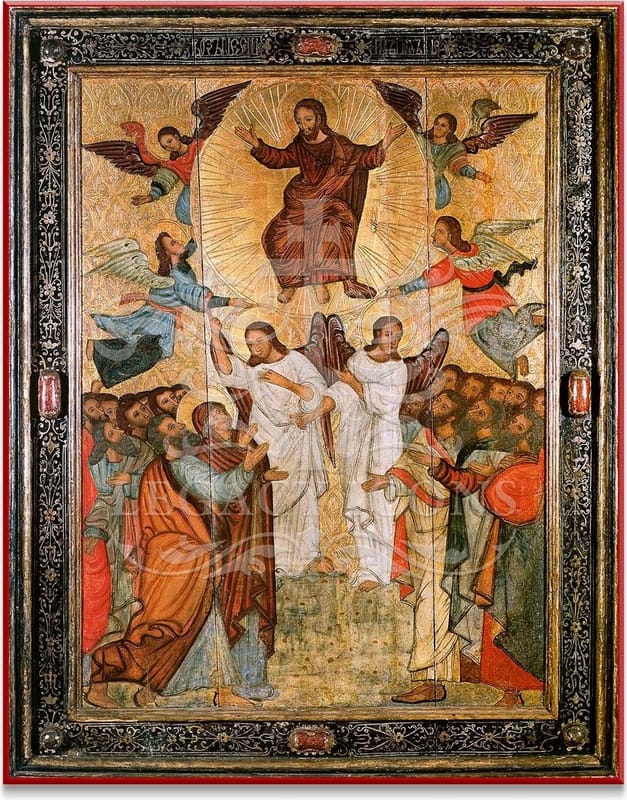
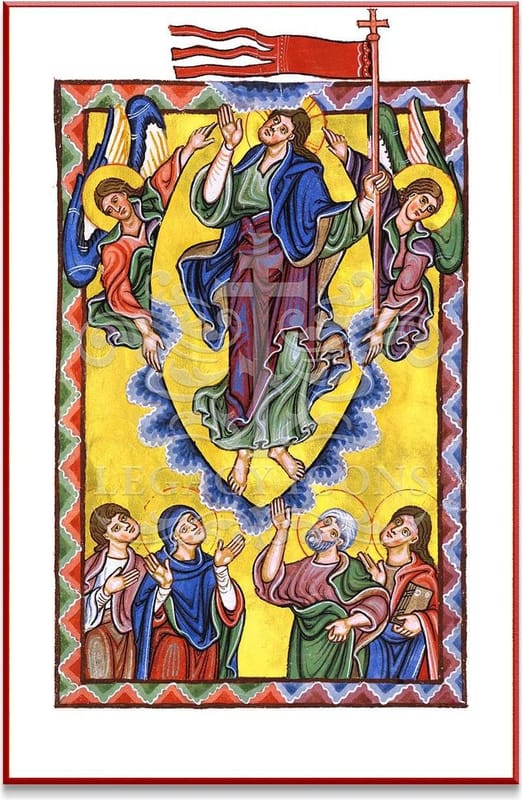
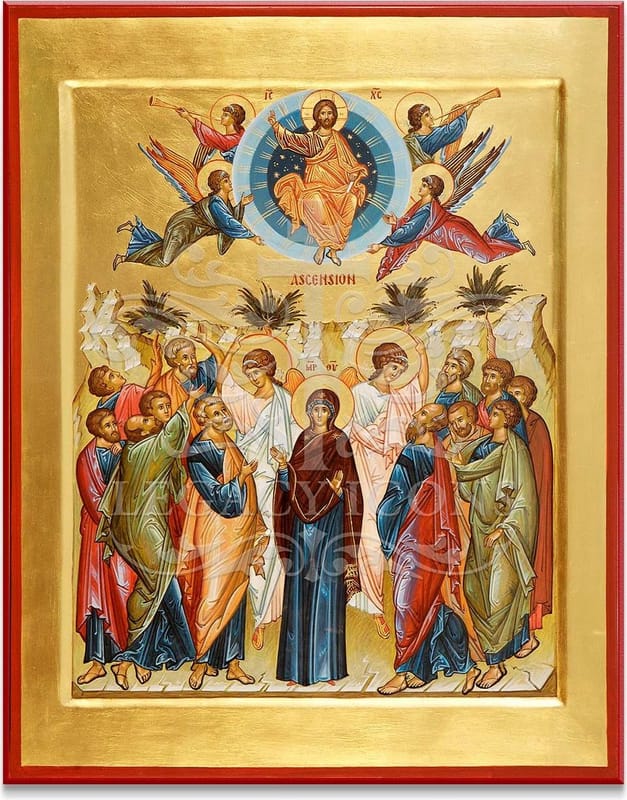
Ascension iconography developed by the sixth century — the Rabbula Gospels of about 586 include among the earliest images — with its conventions established by the ninth century, when the scene came to decorate church domes. The composition is characteristically arranged in two registers: an upper heavenly realm and a lower earthly section.
The ascending Christ appears in the upper register, often bearing a resurrection cross-banner or making a gesture of benediction with his right hand directed toward the figures below, signifying that he blesses the whole Church, while his left hand frequently holds a Gospel or scroll representing his teaching and preaching authority. Clouds commonly obscure the upper part of his body, and celestial figures or angels witness the departure.
In Eastern Orthodox iconography the Virgin Mary stands at the center of the earthly scene with her hands raised heavenward, frequently accompanied by the apostles, who gaze upward in wonder. These upward-looking figures answer the Eastern liturgical summons of the feast to rise and turn one's eyes and thoughts on high.
Hymnography
The hymnody of the feast dwells on the themes of Christ's triumph, his intercession before the Father, and the promise of the Comforter to come. The services call the faithful to lift their eyes and thoughts on high as they contemplate the Lord's heavenly entry, a summons mirrored in the upward gaze of the festal icon.
Customs & Traditions
An all-night vigil precedes the feast in Orthodox practice, with special readings from Acts 1:1-12 and Luke 24:36-53.
The Epitaphios, a liturgical cloth, is carried in procession.
In some traditions processions of torches and banners symbolize Christ's journey to the Mount of Olives and his entry into heaven.
Ideas for Celebrating This Feast
Ways to keep the Ascension of the Lord at home.
- Attend the Ascension Liturgy (usually a Thursday) and learn the feast's troparion beforehand so children can follow along.
- Dress in white and set fresh white flowers before the festal icon to echo the feast's brightness.
- Take a family hike and picnic on a hilltop under the open sky, retelling the ascent of the Mount of Olives.
- Lie on a blanket and watch the clouds, talking about Christ taken up in a cloud and His promise to return the same way.
- Trace Jerusalem, Judea, Samaria, and the wider world on a map, showing how the apostles would carry the Gospel "to the ends of the earth."
- At the table, explain simply how Christ raises human nature up to God.
Ideas gathered and adapted from Orthodox family resources — Orthodox Motherhood, OCA. These are optional, inviting ideas, not liturgical requirements.
Scripture
- Luke 24:36-53 — The risen Christ appears to the disciples and is carried up into heaven from the Mount of Olives; read at the Orthodox vigil.
- Acts 1:1-12 — The fullest narrative of the Ascension, forty days after the Resurrection; the feast's principal reading.
- Mark 16:14-19 — Christ commissions the eleven and is received into heaven to sit at the right hand of God.
- John 20:17 — The risen Jesus tells Mary Magdalene, 'Do not hold me, for I have not yet ascended to my Father.'
- Psalm 110:1 — 'Sit at my right hand' — the interpretive framework by which early Christians understood the Ascension.
- Ephesians 1:19-20 — Among the epistolary references to Christ's exaltation to God's right hand (with Romans 8:34, Colossians 3:1, 1 Peter 3:21-22).
Place in the calendar
The Ascension falls forty days after Pascha by inclusive counting and is always a Thursday, making it a moveable feast dependent on the date of Pascha; in the Western reckoning its possible date range spans from April 30 to June 3.
In the Orthodox tradition the eve of the Ascension is the Leavetaking of Pascha itself, so the Paschal season concludes as the feast opens; the feast has no forefeast for this reason. An eight-day afterfeast follows, with its Apodosis on the Friday before Pentecost, the forty-seventh day after Pascha, and the Sunday within the afterfeast commemorates the Holy Fathers of the First Ecumenical Council at Nicaea.
Many Western Catholic provinces have moved the observance from Thursday to the following Sunday — a shift that began in Australia in 1992 and spread to parts of the United States by 1999, though England and Wales reinstated the Thursday observance from 2018. Protestant traditions including Lutheran, Anglican, Methodist, and Reformed churches also retain the feast.