
Pascha
Also known as: Easter, Feast of Feasts, Resurrection of Christ, Bright Sunday
Pascha· Movable · Paschal cycle
The Resurrection of Christ from the dead, the center and crown of the whole Church year, celebrated as the passage from death to life. It is not counted among the Twelve Great Feasts but stands above them as the "Feast of Feasts."
Depictions & Icons
How the Church has written this feast — festal icons across the centuries.
Overview
Pascha is the Orthodox celebration of the Resurrection of Christ from the dead, the center and crown of the whole Church year. It is not counted among the Twelve Great Feasts but stands above them as the "Feast of Feasts," the passage from death to life to which the entire liturgical calendar is oriented.
The feast is approached through a long preparation: the pre-Lenten Sundays, the forty days of Great Lent, and Holy Week, which together span roughly twelve weeks before the day itself. Pascha ends the Great Fast, and its light extends outward across Bright Week and the fifty days to Pentecost, its leavetaking (apodosis) falling on the Wednesday before Ascension.
As a movable feast, Pascha has no fixed calendar date. It is reckoned by the ecclesiastical rule fixed in the early Church rather than assigned to a single day, so the surrounding Paschal cycle of movable observances shifts with it each year.
Timeline
c. 190 — Quartodeciman controversy
The churches of Asia Minor keep Pascha on Nisan 14 while Rome and Alexandria keep the following Sunday; Pope Victor I's attempted excommunication is rescinded after the intervention of Irenaeus and others.
325 — First Council of Nicaea
Convened in part to settle the Paschal question, the council fixes a common reckoning independent of the Jewish calendar, following the practice of Rome and Alexandria.
History
The dating of Pascha was among the earliest questions to divide the Christian world. In the 2nd century the Quartodeciman controversy set the churches of Asia Minor, which ended the Lenten fast on Nisan 14 of the Hebrew calendar in step with Passover, against Rome and Alexandria, which kept the feast on the following Sunday. The dispute sharpened around 190, when Pope Victor I attempted to excommunicate the Quartodeciman churches; the attempted excommunication was rescinded and the two sides reconciled after Bishop Irenaeus and others reminded Victor of the tolerant precedent of his predecessor Anicetus.
The First Council of Nicaea in 325 took up the question, and settling the Quartodeciman controversy was among the reasons the Emperor Constantine convened the council. Nicaea determined that the churches would no longer reckon the feast by the Jewish calendar but would adopt a common method following the practice of Rome and Alexandria. The rule that emerged places Pascha on the first Sunday after the first full moon on or after the spring equinox (reckoned as March 21). The calculation is ecclesiastical rather than astronomical: the "Paschal full moon" is the fourteenth day of a lunar month and may differ from the observed full moon by as much as two days.
The Orthodox Church continues to reckon this rule on the Julian calendar. Because the Julian lunar tables now run several days behind the Gregorian, Orthodox Pascha falls between April 4 and May 8 on the civil (Gregorian) calendar and generally lands one or five weeks after Western Easter, though the two dates occasionally coincide. The feast keeps its name and historical anchor in the Jewish Passover, during whose week the crucifixion and resurrection took place, even as the method of reckoning was made independent after Nicaea.
Meaning
Pascha proclaims that in the Resurrection of Christ death itself has been overthrown. The Church expresses this as Christ "trampling down death by death": his own dying breaks the power of the grave, so that the day is kept not as a memorial of a past event but as the present reality of life triumphant over corruption.
The feast is understood as a passage — the meaning carried in the name Pascha, the Passover — from death to life and from bondage to freedom. Christ's descent into Hades to raise the dead held captive since the beginning makes the Resurrection a cosmic renewal rather than a private restoration, the opening of the tomb becoming the opening of Paradise to the whole human race.
For this reason Pascha is celebrated as an eighth-day mystery: it belongs not to the ordinary week of seven days but to the age to come. The whole Paschal season, from the day through the forty days to Ascension, is treated liturgically as a single unending day, a foretaste of the eternal life the feast announces.
Iconography
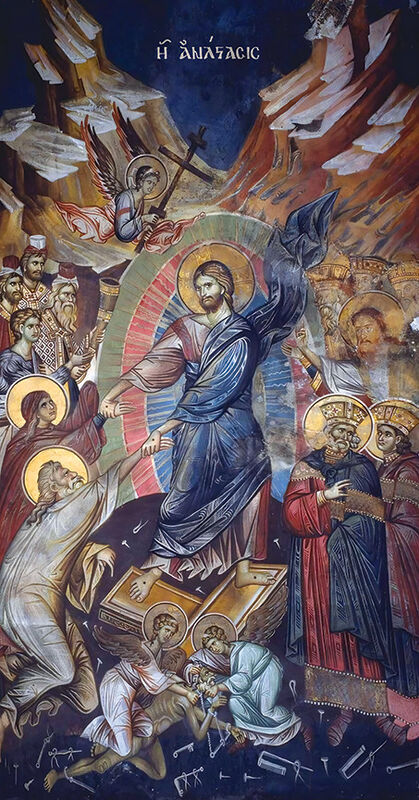
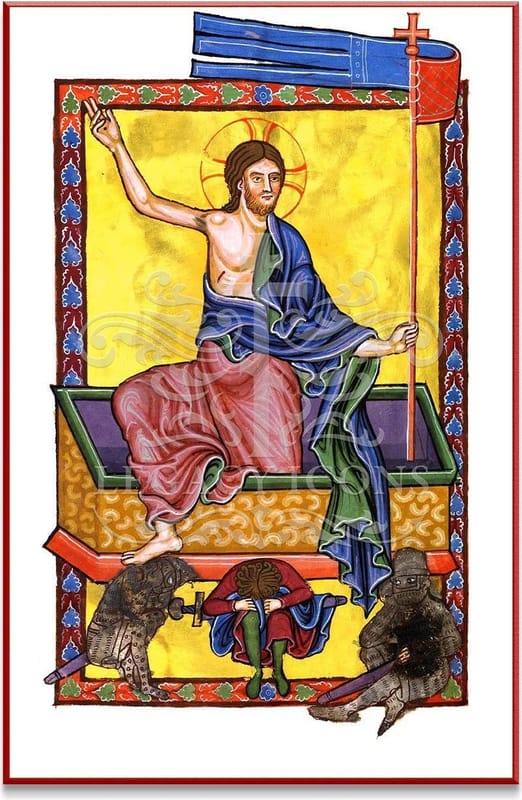
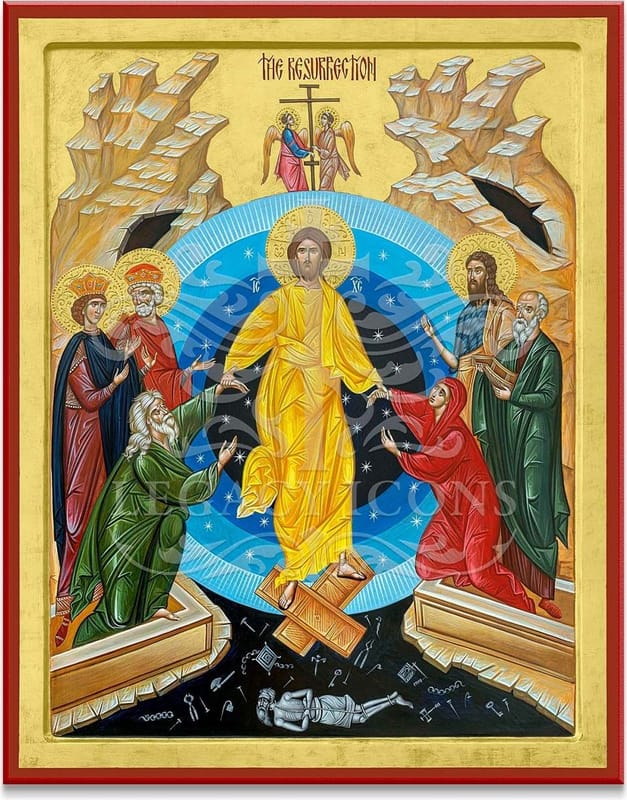
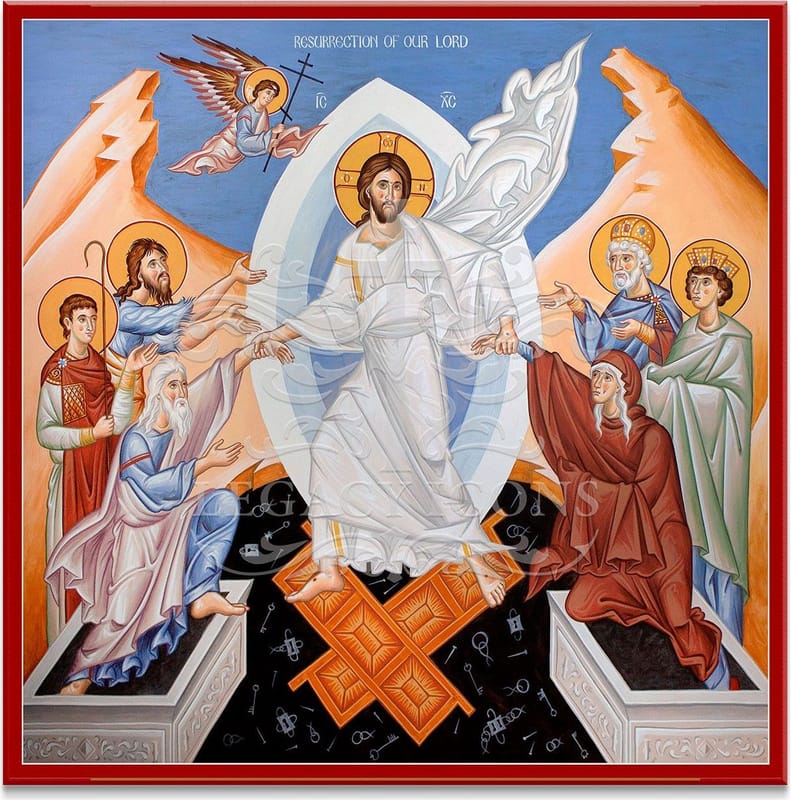
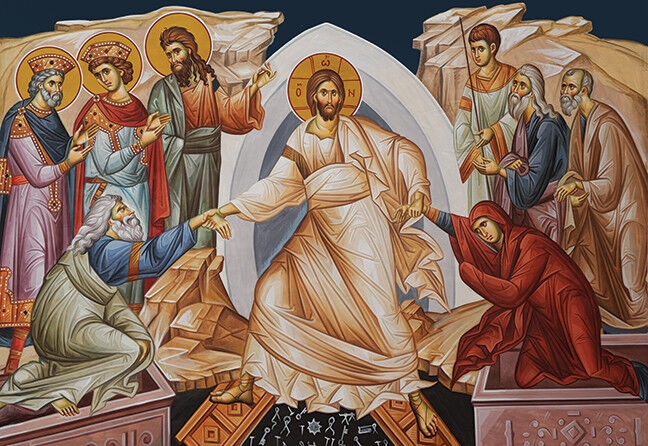
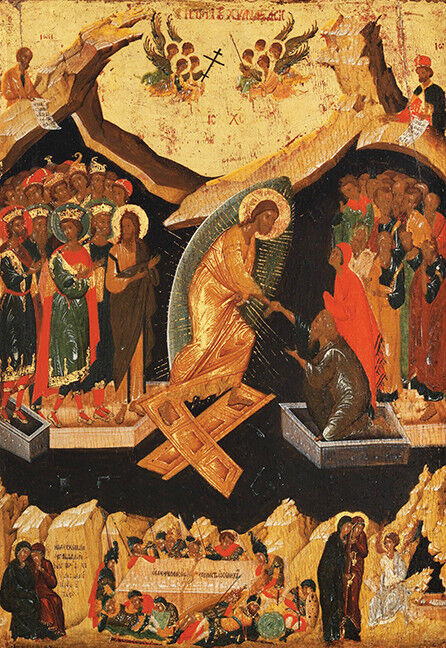
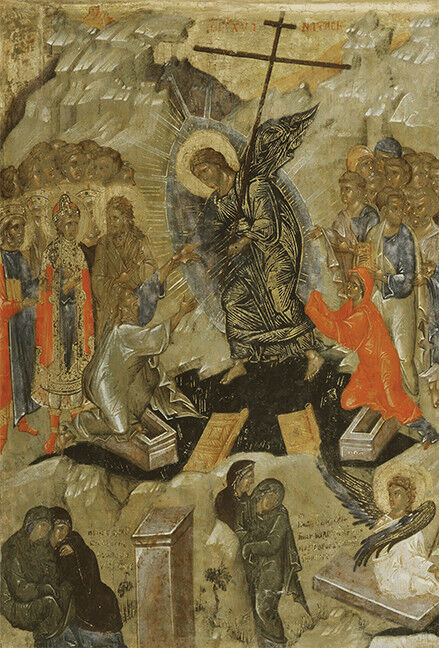
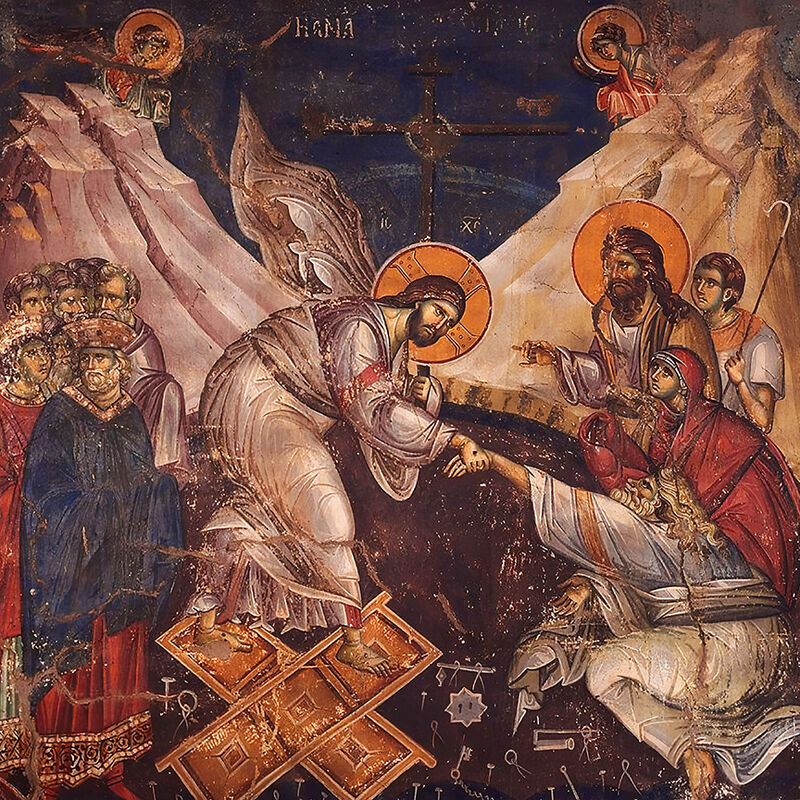
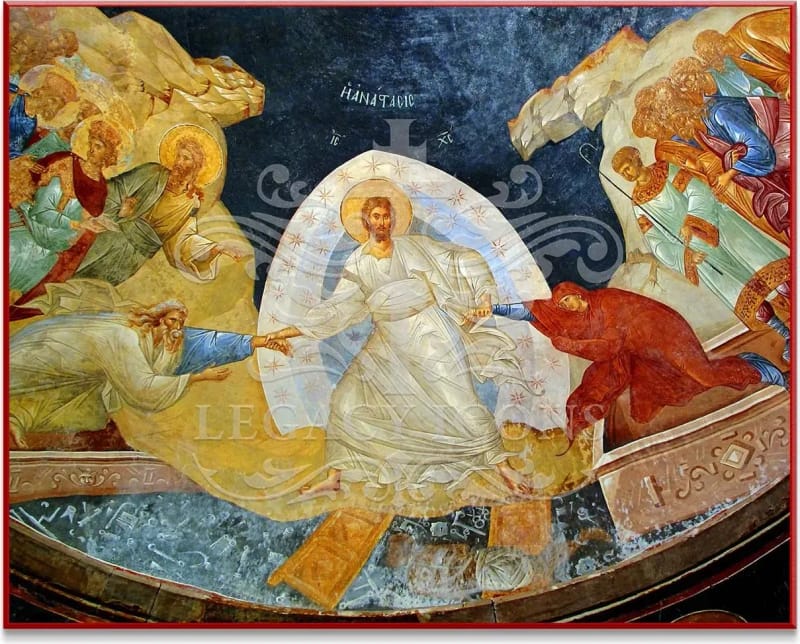
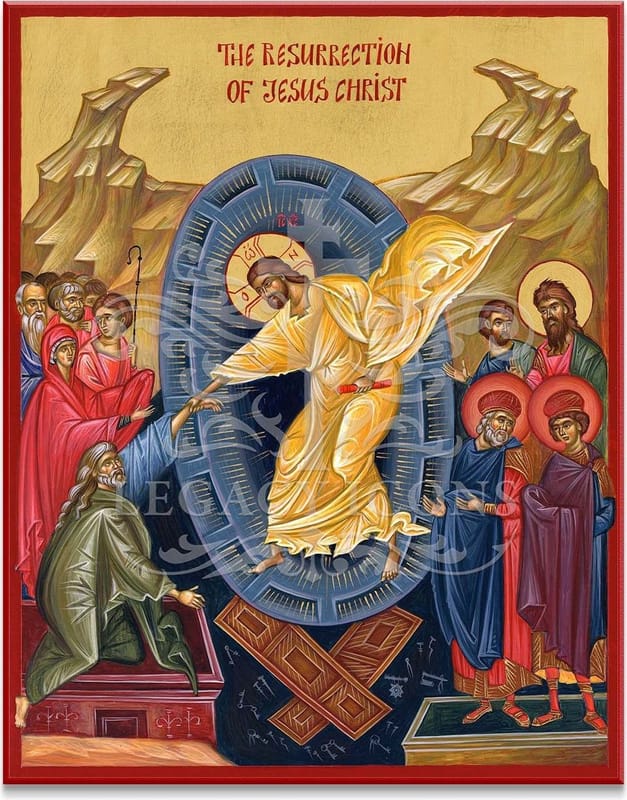
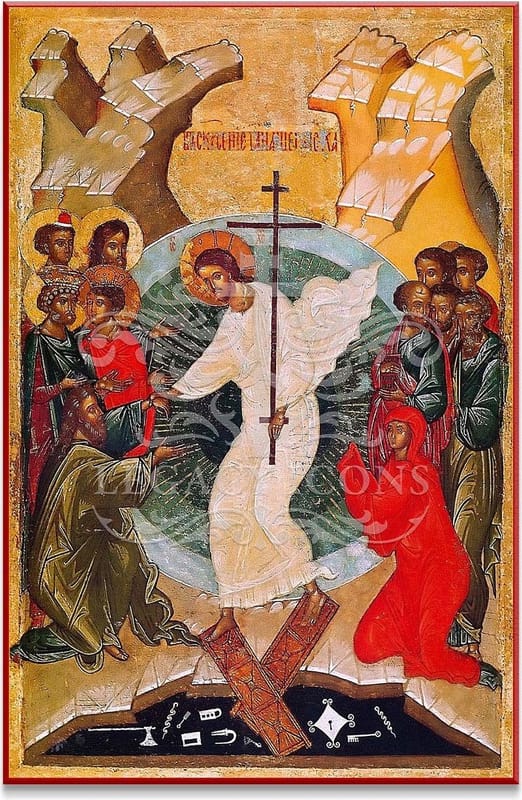
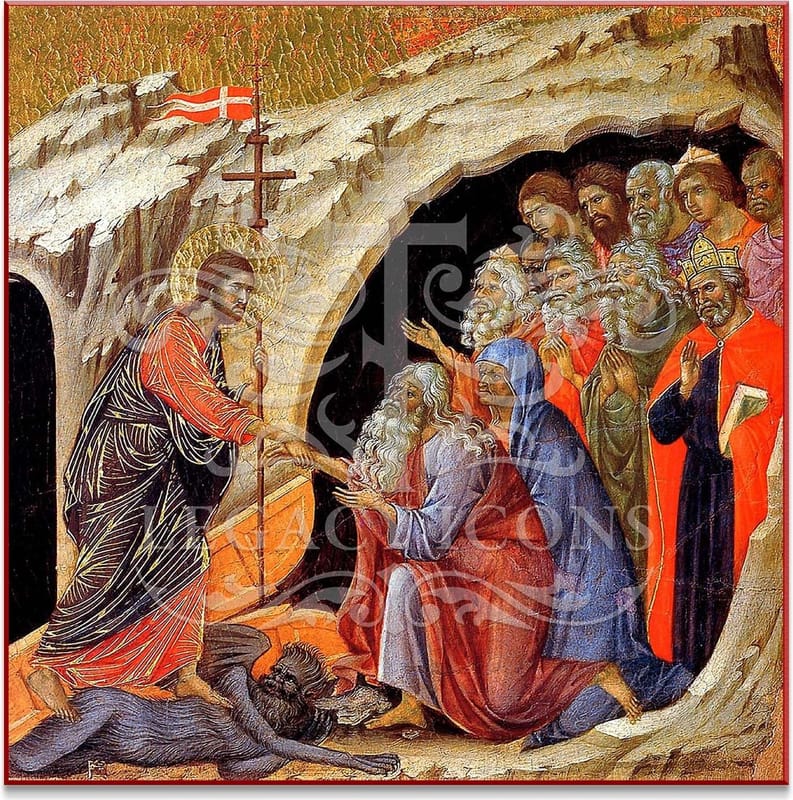
The festal icon of Pascha is the Anastasis, the Descent into Hades. It shows Christ standing in triumph upon the gates of Hades, which have been torn from their place and lie fallen in the form of a cross. He grasps Adam and Eve by the wrists — not the hands — to signify that humanity could not raise itself from the ruin of sin but is lifted only by the work of God.
Around Christ stand the righteous of the Old Covenant, among them Abraham, David, Solomon, and John the Baptist. Below yawns the chasm of Hades, dark and strewn with broken locks and shattered chains, and sometimes Death or the devil is shown bound in the depths. Long used as the icon of Holy Saturday, this image is the Church's chief pictorial confession of the Resurrection: by his death Christ has trampled down death and emptied the prison of the dead.
Hymnography
The Paschal Matins is built around the canon attributed to St. John of Damascus, sung at midnight after the procession. Its themes are the passage from death to life, the dawn of the new creation, and the summons of the whole world to rejoice.
The Paschal troparion, sung for the first time at the procession and repeated throughout the services, proclaims Christ risen from the dead and trampling down death by death; it is paired with verses from Psalm 67(68). The services also include the Paschal Sermon of St. John Chrysostom, read at Matins, which invites all the faithful — those who have fasted and those who have not — to forget their sins and enter fully into the joy of the feast.
Fasting in Practice
Pascha ends the Great Fast of Lent, the longest and most rigorous fasting season of the year. The day itself and the whole of Bright Week that follows are kept entirely fast-free, so that the fast of preparation gives way to unbroken festal celebration. Particular practices vary by jurisdiction; the faithful are directed to their own priest for guidance.
Customs & Traditions
The midnight Paschal service, in which the faithful process outside the darkened church with banners, icons, candles, and the Gospel and return to hear "Christ is risen!"
The Paschal greeting "Christ is risen!" answered "Truly He is risen!", exchanged through Bright Week.
The blessing of Paschal baskets and foods after the Liturgy — eggs, cheese, meat, and festal breads such as kulich; Greek practice includes lamb soup.
The Artos, a loaf stamped with the Cross or the Resurrection, consecrated in honor of Christ the Bread of Life.
Red-dyed eggs, whose color signifies the renewed life received through the Blood of Christ.
Ideas for Celebrating This Feast
Ways families keep the Feast of feasts and carry its joy through Bright Week.
- Bake kulich (tall sweet Easter bread) and paska (a sweet cheese spread), and let children frost the kulich or shape the "XB" (Christ is Risen) on top.
- Dye red eggs with onion skins and play the egg-cracking game (tsougrisma) at the table, greeting one another "Christ is risen!"
- Bake Lazarus buns on Lazarus Saturday to begin the turn toward the feast.
- Pack a Pascha basket with festal foods — eggs, cheese, meat, bread — to be blessed after the midnight service, then feast on the blessed food at dawn.
- Bring the children (even sleepy ones) to the midnight procession with candles and singing — the joy they will remember.
- Set a bright, festal Paschal table with red eggs, flowers, and candles to mark that Great Lent is over.
- Share extra kulich, paska, and baskets with widows, new mothers, the newly baptized, and anyone unable to prepare their own.
- Read Catherine's Pascha to draw children into the wonder, and keep greeting "Christ is risen! — Truly He is risen!" through Bright Week. The Paschal greeting is exchanged until the Leave-taking of Pascha, just before Ascension.
Ideas gathered and adapted from Orthodox family resources — Charlotte Riggle, Ascetic Life of Motherhood. These are optional, inviting ideas, not liturgical requirements.
Scripture
- Acts 1:1-9 — The Paschal Divine Liturgy epistle.
- John 1:1-17 — The Paschal Gospel, customarily read in several languages.
- 1 Peter 3:18-19 — Scriptural basis for the descent into Hades depicted in the festal icon.
Fasting is described here at the season-summary level and differs by jurisdiction and person — please consult your parish priest about how to keep the fasts.