
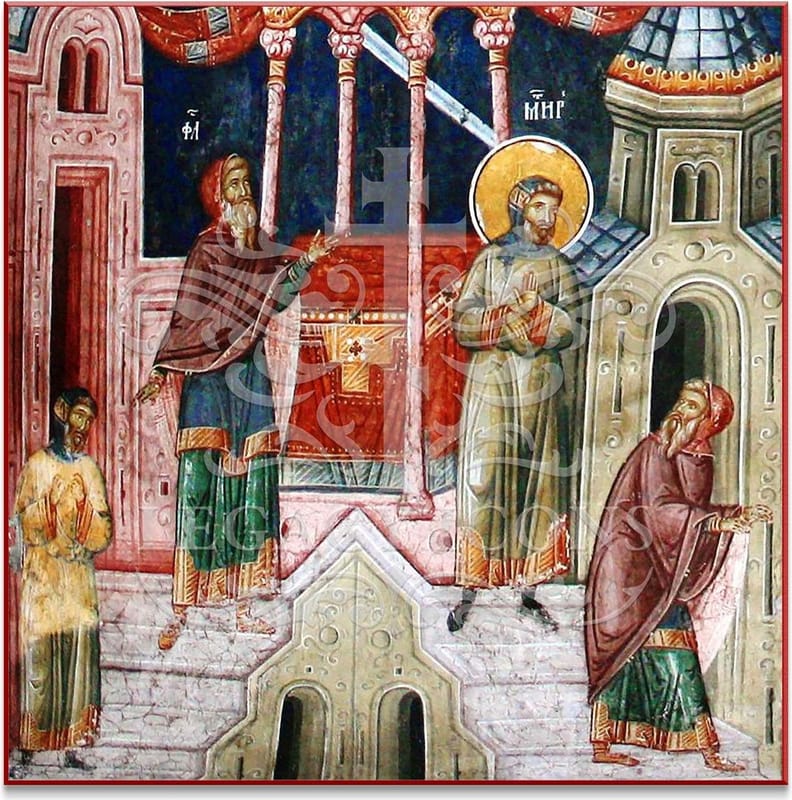
Sunday of the Publican and the Pharisee
Also known as: Publican and Pharisee
P−70· Movable · Paschal cycle
The first Sunday of the Lenten Triodion. Its Gospel parable (Luke 18:10-14) contrasts the self-righteous Pharisee with the humble, repentant publican, teaching that God justifies the lowly of heart.
Overview
placeholder
History
The Sunday of the Publican and the Pharisee marks the beginning of the liturgical use of the Lenten Triodion, the service book covering the period from this Sunday through Holy Saturday. The Triodion has a long history as a printed book in the Orthodox world, with editions dating back at least to 1491, when the Triod Postnaja was issued by the Swietopelk Printery in Cracow.
The Sunday functions as one of the pre-Lenten preparatory Sundays that gradually ease the faithful into the Lenten discipline. In the sequence commonly observed, the five pre-Lenten Sundays progress through Zacchaeus Sunday (awakening the desire to seek Christ), the Sunday of the Publican and the Pharisee (understanding true repentance), the Sunday of the Prodigal Son (returning to God with the assurance of forgiveness), Meatfare Sunday (serving Christ through one's neighbor), and Cheesefare or Forgiveness Sunday (forgiveness and the exile of Adam). This first Sunday initiates the Church's gradual approach to the full fast, which begins on Clean Monday.
The parable that gives the Sunday its name appears within a section of Luke's Gospel concerned with prayer, following immediately upon the Parable of the Unjust Judge; both address the importance and manner of prayer. The parable has drawn artistic and literary attention across the centuries: it inspired works by James Tissot, John Everett Millais, Hans Holbein the Younger, and Gustave Doré, and in 1685 John Bunyan authored a book-length meditation upon it. Within Eastern Orthodoxy the parable also features prominently in festal iconography.
Meaning
The parable contrasts two spiritual attitudes rather than two professions. The Pharisee, outwardly righteous, kept the Jewish law punctiliously and exceeded its requirements by fasting twice weekly and tithing all his income; yet he boasted before God and was condemned. The publican, a tax collector genuinely regarded as sinful, stood at a distance, beat his breast in contrition, and simply begged for mercy as a sinner; he received it and returned home justified. The Church teaches through this that authentic repentance and the acknowledgment of one's unworthiness open a person to God's mercy, while self-righteousness closes it off.
The parable does not condemn the publican's occupation as such. Tax collectors were despised as Jews who collaborated with the Roman Empire through the collection of tolls and taxes, which makes the publican's justification the more striking. His vindication rests not on his conduct but on his humble recognition of his need for reconciliation with God, demonstrating that divine mercy operates independently of a person's prior life.
Set within a Gospel section on prayer, the Sunday underscores the necessity of humble prayer as the faithful begin their preparation for Great Lent. The Pharisee's error was to assume that his moral achievements guaranteed divine favor; the publican's humility made him worthy of justification. As the pre-Lenten Sundays exercise the mind before Great Lent addresses the body and Holy Week the spirit, this day sets humility and true repentance as the foundation of the whole penitential season.
Hymnography
The hymnography of the day sets the humility of the publican against the pride of the Pharisee as the model for the faithful entering the pre-Lenten season. The theme is captured in a well-known liturgical text that calls the faithful to flee the pride of the Pharisee and to learn humility from the tears of the publican.
Fasting in Practice
The week following the Sunday of the Publican and the Pharisee is kept fast-free. Fasting is suspended even on the Wednesday and Friday of that week, which are ordinarily observed as fast days throughout the year. This makes the week the gentlest step in the Church's gradual movement toward Great Lent, whose full discipline begins later on Clean Monday. Typikon practice varies, and the faithful are directed to consult their priest.
Customs & Traditions
The Lenten Triodion is opened and used for the first time in the annual cycle at the services of this Sunday.
Scripture
- Luke 18:9-14 — The parable of the Publican and the Pharisee, appointed for the Divine Liturgy; Christ concludes that the publican, rather than the Pharisee, went home justified.
Fasting is described here at the season-summary level and differs by jurisdiction and person — please consult your parish priest about how to keep the fasts.