
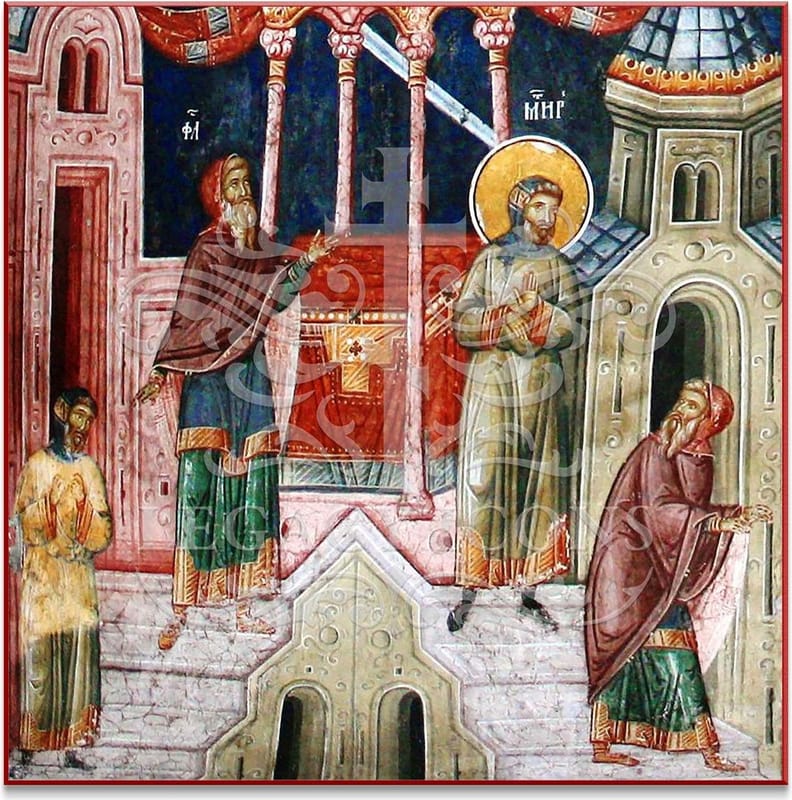
Week after the Publican and the Pharisee
Also known as: Solid Week, Continuous Week, Pre-Lenten Fast-Free Week, Sploshnaya Sedmitsa
P−69 → P−63· Movable · Paschal cycle
The first fast-free week of the pre-Lenten season, following the Sunday of the Publican and the Pharisee, when the customary Wednesday and Friday fast is lifted to teach humility over outward observance.
Overview
The Week after the Publican and the Pharisee is the first fast-free week of the Orthodox pre-Lenten season. It runs from the Monday following the Sunday of the Publican and the Pharisee through the Sunday of the Prodigal Son, during which the customary Wednesday and Friday fast is lifted.
The week takes its name from the Sunday that precedes it, on which the Church reads the parable of the Publican and the Pharisee (Luke 18:9-14). That Sunday inaugurates the three-week pre-Lenten period and marks the first use of the liturgical Triodion, the book that governs the services of the pre-Lenten and Lenten seasons.
The relaxation of the fast during this week is deliberate and instructive: the Church loosens the discipline so that the faithful will not, like the Pharisee, place their trust in outward observance. It thus forms the opening movement of a graduated spiritual preparation that culminates in Great Lent and Holy Week.
History
The week belongs to the framework of the Triodion, the liturgical text that governs the pre-Lenten and Lenten periods. The Sunday of the Publican and the Pharisee marks the point at which the Triodion begins, opening at Vespers or the All-Night Vigil on the Saturday evening before. On that first Sunday the Triodion is used only for the Sunday services, with nothing yet pertaining to weekdays or Saturday.
In the reckoning of the Triodion, the Sunday of the Publican and the Pharisee falls in the tenth week before Pascha, twenty-two days before the beginning of Great Lent proper. The three weeks that commence on the fourth Sunday prior to Great Lent constitute the weeks of preparation, each carrying its own theme drawn from the Gospel appointed for its Divine Liturgy.
By long-established custom, the pre-Lenten period opens with a week in which there is no fasting, including on the Wednesday and Friday that are otherwise kept as fast days throughout the year. The three primary Sundays of the pre-Lenten period follow in sequence: the Sunday of the Publican and the Pharisee, the Sunday of the Prodigal Son, and the Sunday of Meatfare, also called the Sunday of the Last Judgment. In the Triodion's arrangement each week is named for the Gospel theme of its concluding Sunday, and its services run from Monday to Sunday rather than in the conventional Sunday-to-Saturday pattern.
Meaning
The theological rationale for the fast-free week is drawn directly from the parable that gives it its name. In Luke 18:9-14, a self-righteous Pharisee stands praying and boasts of his virtues, fasting twice each week and tithing all his income, while a tax collector stands apart, beating his breast and asking God for mercy as a sinner. Jesus concludes that the publican 'went down to his home justified rather than the other,' teaching that humility and divine mercy matter more than self-perceived righteousness.
The suspension of the ordinary Wednesday and Friday fast is meant to remind the faithful not to be prideful in their fasting as the Pharisee was, who boasted precisely of fasting twice a week (Luke 18:12). The message of the Sunday is that righteous actions alone do not lead to salvation and that God can only be approached in a spirit of humility and repentance; the loosened discipline of the following week enacts that message in the life of the Church.
The pre-Lenten weeks as a whole prepare the faithful for the spiritual work of the Great Fast. Where the fasting of Lent focuses on the body and the services of Holy Week exercise the spirit, these preparatory weeks first exercise the mind, setting before it the successive themes of humility, repentance, and judgment that will be developed over the forty days that follow.
Fasting in Practice
This is a fast-free week: no fasting is kept, including on the Wednesday and Friday that are normally observed as fast days throughout the year. The relaxation is intended as a deliberate rebuke to the pride of the Pharisee who boasted of his fasting, and it allows the faithful to mark the spiritual transition into the pre-Lenten season before the more austere practices of Great Lent begin. Typikon prescriptions and local practice vary; the faithful consult their own priest.
Customs & Traditions
The Church lifts the customary Wednesday and Friday fast for the whole week, so that the faithful will not, like the Pharisee, trust in fasting itself.
The Lenten Triodion opens at Vespers or the All-Night Vigil on the Saturday evening before the Sunday of the Publican and the Pharisee, though on that first Sunday it is used only for the Sunday services.
Scripture
- Luke 18:9-14 — The parable of the Publican and the Pharisee, read on the Sunday that gives the week its name and its theme.
- Luke 18:12 — The Pharisee's boast that he fasts twice a week — the specific pride the fast-free week answers.
Place in the Triodion cycle
The pre-Lenten weeks of the Triodion unfold as a sequence of Gospel themes. The Sunday of the Publican and the Pharisee is followed by the Sunday of the Prodigal Son, which traces the process of falling into sin, the realization of one's sinfulness, the road to repentance, and finally reconciliation; then comes the Sunday of Meatfare, or the Last Judgment. The Triodion period as a whole divides into three sections: the pre-Lenten period, the Great Forty Days, and Holy Week.
Fasting is described here at the season-summary level and differs by jurisdiction and person — please consult your parish priest about how to keep the fasts.