
Great and Holy Thursday
Also known as: Holy Thursday, Great Thursday, Maundy Thursday
P−3· Movable · Paschal cycle
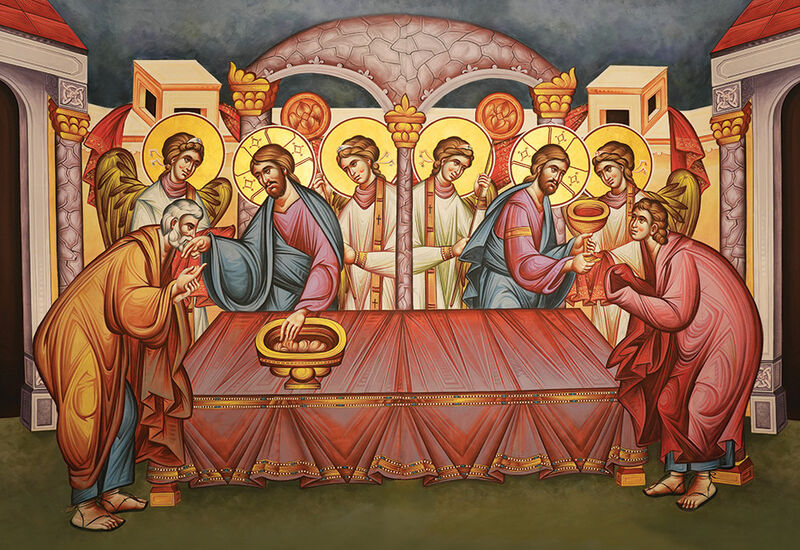
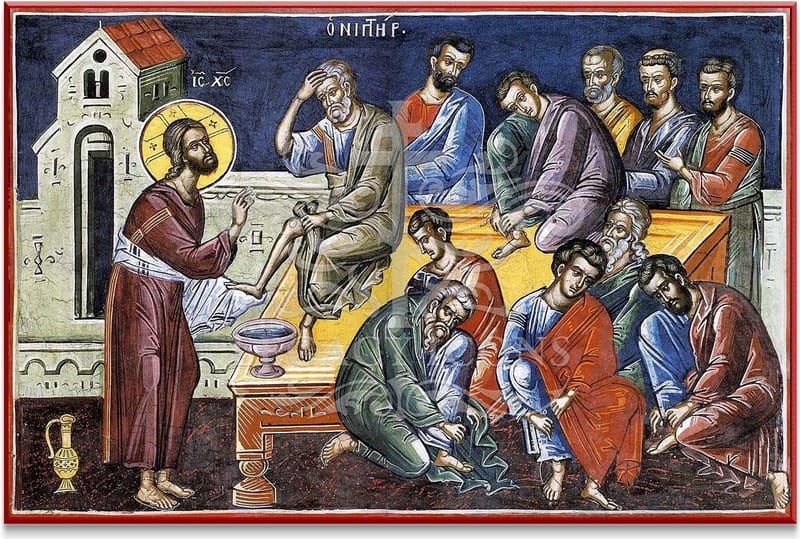
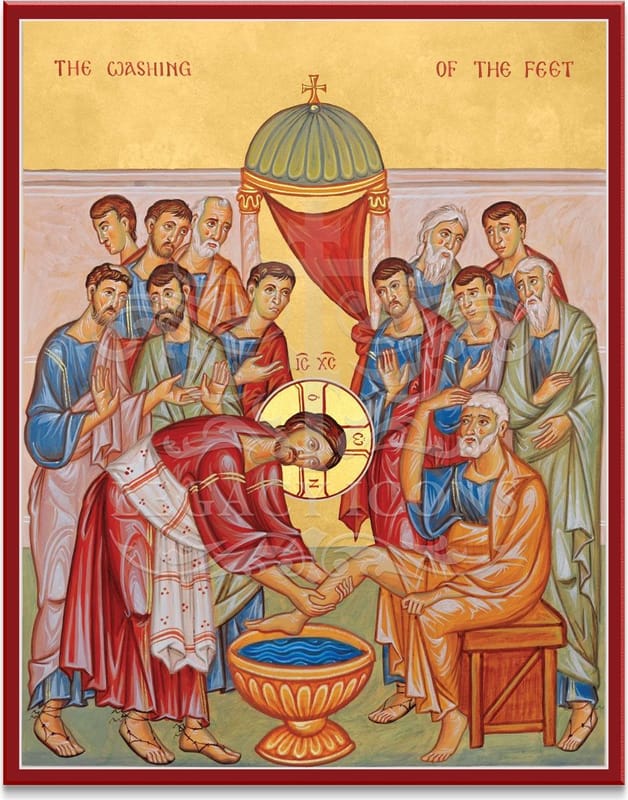
On this day the Church commemorates the Mystical Supper, at which Christ instituted the Eucharist, together with His washing of the disciples' feet, the prayer in Gethsemane, and the beginning of the betrayal.
Depictions & Icons
How the Church has written this feast — festal icons across the centuries.
Overview
Great and Holy Thursday is an observance of Holy Week that commemorates the Mystical Supper, at which Christ instituted the Eucharist, together with His washing of the disciples' feet, His prayer in the Garden of Gethsemane, and the beginning of the betrayal by Judas. In the Orthodox reckoning it falls three days before Pascha, and its liturgical dedication is to the Lord.
The day's principal service is the Divine Liturgy of Saint Basil the Great, celebrated in combination with Vespers. Uniquely among the days of Holy Week, the strict Lenten fast is relaxed for this day alone, so that wine and oil are permitted. In cathedral and monastic practice the washing of feet is reenacted, and the primates of the autocephalous Orthodox churches consecrate the Holy Chrism used for Chrismation.
The observance holds together the two commemorations of the Last Supper and the betrayal — the ultimate expression of divine love set against humanity's capacity for spiritual corruption. Following the evening liturgy the tone of the services turns from the brighter colors proper to the institution of the Eucharist toward the somber commemoration of the Passion, as the Matins of the Twelve Passion Gospels begins the drama that leads to the Crucifixion.
History
The commemoration of Great and Holy Thursday draws on the earliest layers of Christian worship surrounding the Eucharist. Sources within the first centuries show how rapidly the Eucharist became central: the Didache of the late first century includes instructions for the Eucharist; Ignatius of Antioch, who died between 98 and 117, called it 'the flesh of our Saviour Jesus Christ'; and Justin Martyr, writing around 100 to 165, described the consecrated elements as genuine nourishment. From this foundation the Church developed the annual commemoration of the Supper at which the mystery was instituted.
In its present Orthodox form the day is kept with three components — Matins, Vespers, and the Liturgy of Saint Basil the Great. The primary service is Vespers combined with the Liturgy of Saint Basil, during which a composite Gospel, drawn primarily from Matthew but incorporating passages from John on the foot-washing and from Luke on the agony in Gethsemane, is read. The traditional Cherubic Hymn is replaced by a special hymn used at the offertory, Communion, and post-Communion portions of the service, and scriptural readings preceding the Gospel are taken from Exodus, Job, Isaiah, and the first letter of Paul to the Corinthians.
Two ceremonies particular to cathedral and hierarchical practice attach to the day. Following the Divine Liturgy a bishop washes the feet of twelve priests in a reenactment of Christ's act before the Crucifixion, demonstrating that His love is the foundation of life in the Church. On the same day the primates of the autocephalous Orthodox churches consecrate the Holy Chrism, the sacred oil used in Chrismation, an act signifying the gift of the Holy Spirit to the Church.
After the evening liturgy the hangings and vestments are changed to black or another dark color to mark the beginning of the Passion, and the solemn Matins of the Twelve Passion Gospels follows. This service presents twelve Gospel passages, drawn from John, Matthew, Mark, and Luke, chronicling Christ's final instructions, prayers, and the events leading to the Crucifixion.
Meaning
The Church understands the Mystical Supper not merely as a historical event but as the eternal purpose of creation itself — the restoration of humanity's original eucharistic relationship with God. Tradition holds that God is Love and made humanity to live in communion with the divine; sin severed that connection, and the Last Supper represents Christ's restoration of communion, in which He offers Himself as the true food of man to renew the paradise of bliss. The feast thus proclaims that the eternal purpose of creation is that humanity might commune with God perpetually in His kingdom.
The day sets forth a profound paradox, embodying the ultimate expression of divine love alongside humanity's capacity for spiritual corruption. Its hymnography emphasizes spiritual choice: the Troparion contrasts Christ's transformative love with Judas's insatiable desire for material wealth, framing money as a symbol of misdirected love. The same hymn dwells on the penitent thief's recognition of Christ's kingship and calls worshippers to decisive spiritual choice — accepting Christ's love or following Judas into spiritual darkness.
Orthodox theology stresses the perpetual presence of Christ in the eucharistic celebration, so that the historical meal is bound to the Church's continuing liturgical experience. It teaches an objective transformation of the bread and wine into the body and blood of Christ, described as a mystery beyond complete human understanding — a conviction the tradition holds while avoiding the Latin term transubstantiation. The consecration occurs during the anaphora, with particular emphasis on the epiclesis, the invocation of the Holy Spirit; in Byzantine practice the liturgy uses either the anaphora of John Chrysostom or of Basil the Great, and employs leavened bread, whose leaven symbolizes the presence of the Holy Spirit.
Iconography
Eastern Orthodox depictions of the Supper historically focused on the Apostles receiving Communion rather than on reclining figures sharing a meal. This shifts attention away from the social aspect of the meal toward the sacramental reception, highlighting the transformative spiritual dimensions of the event.
Hymnography
The Troparion of the day invokes Christ's mystical supper and addresses the themes of discipleship, confession, and redemption. It contrasts Christ's transformative love with Judas's insatiable desire for material wealth, and calls worshippers to decisive spiritual choice — accepting Christ's love or following Judas into spiritual darkness. At the combined Vespers and Liturgy the traditional Cherubic Hymn is set aside and replaced by a special hymn sung at the offertory, at Communion, and after Communion.
The Russian Orthodox tradition employs the designation 'Secret Supper' (Taynaya vecherya in Church Slavonic) for the same event that the wider Eastern Orthodox tradition calls the Mystical Supper, a term referring both to the biblical event and to the eucharistic celebration within the liturgy.
Fasting in Practice
Great and Holy Thursday is distinguished by a relaxation of the strict Lenten fast that holds for this day alone during Holy Week: the Church's practice permits the consumption of wine and oil. The liturgical colors of the day are correspondingly brighter, white being common, in contrast to the somber tones of the days that follow, until after the evening liturgy the hangings and vestments are changed to a dark color to mark the beginning of the Passion.
Customs & Traditions
The Divine Liturgy of Saint Basil the Great is served in combination with Vespers.
In cathedral and monastic practice the washing of feet is reenacted, a bishop washing the feet of twelve priests after the Liturgy.
The primates of the autocephalous Orthodox churches consecrate the Holy Chrism on this day.
After the evening liturgy hangings and vestments are changed to black or another dark color, and the Matins of the Twelve Passion Gospels is served.
Scripture
- Exodus — Read among the passages preceding the Gospel at the Divine Liturgy of Saint Basil.
- Job — Read among the passages preceding the Gospel.
- Isaiah — Read among the passages preceding the Gospel.
- 1 Corinthians 11 — Paul's account of the Supper, read as an epistle.
- Luke — Read at the Matins vigil.
- Matthew — The primary source of the composite Gospel read at the combined Vespers and Liturgy.
- John — Supplies the passages on the washing of the disciples' feet within the composite Gospel.
Fasting is described here at the season-summary level and differs by jurisdiction and person — please consult your parish priest about how to keep the fasts.