
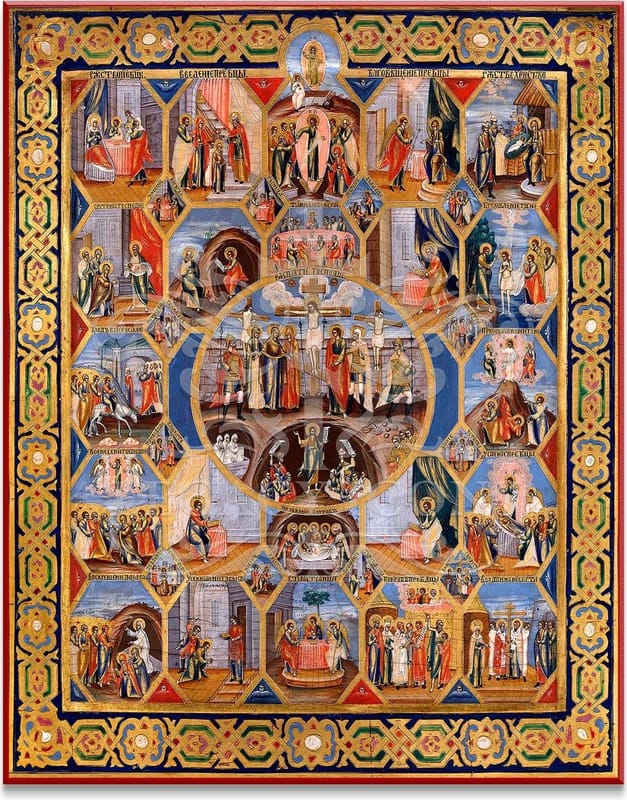
Holy Week Fast
Also known as: Great and Holy Week, Passion Week
P−6 → P−1· Movable · Paschal cycle
The week following Palm Sunday in which the Church accompanies Christ through His Passion, Crucifixion, and burial, culminating at the threshold of Pascha.
Overview
Holy Week (also called Passion Week or, in service books, the Great and Holy Week) is the week following Palm Sunday in which the Orthodox Church accompanies Christ through His Passion, Crucifixion, and burial, culminating at the threshold of Pascha. Each day is designated as "great and holy" in the liturgical books.
Though continuous with the Forty Days of Great Lent, Holy Week is kept as a distinct fast: extending from the conclusion of Great Lent on the Saturday of Lazarus to the celebration of Pascha, it is the point at which the fast reaches its peak. The observance runs, on the New (Revised Julian) calendar convention, from Great and Holy Monday through Great and Holy Saturday.
The week carries an intense cycle of services that follow the day-by-day movement of the Gospel narrative: the Bridegroom Matins of the first three days, the Holy Thursday commemoration of the Mystical Supper, the Twelve Passion Gospels and the taking-out of the Epitaphios on Holy Friday, and the Lamentations at the Tomb on Holy Saturday. It is the strictest fasting period of the entire year.
History
Little is recorded of the development of the Holy Week celebrations during the earliest years of the Church, but they apparently had very early origins. By the fourth century the observance appears well-founded and similar in shape to present practice. The pilgrim Egeria documented the Jerusalem practices in the late fourth century, describing "the week of the Pasch, which they called here the Great Week," and including a procession that commemorated Christ's entry into Jerusalem.
The services follow the ecclesiastical calendar operating from sundown to sundown, and are anticipated: the Matins service for the coming day is celebrated the evening before, while Vespers is celebrated in the morning. This reversal is understood to give the faithful a sense that the world is in travail and turned upside-down because of the Passion the Lord endured for the salvation of humanity.
Several of the week's observances developed over time. The reading of the Twelve Passion Gospels on Holy Thursday evening draws together passages from all four Gospels. The mystery of Holy Unction associated with Holy Wednesday is described as having developed within the past two centuries in Byzantine practice, commemorating Christ's anointing with myrrh. The Holy Saturday Vespers and Liturgy of St. Basil derives from the ancient liturgical tradition of the Church of Constantinople and was that Church's primary Paschal service, featuring the hymn "Arise, O God" before "Christ is risen" became the principal Paschal hymn.
The Epitaphios — the embroidered liturgical cloth central to the Holy Friday and Holy Saturday services — has its own history. The oldest surviving embroidered example, of about 1200 and now in Venice, depicts Christ alone with angels. During the Late Byzantine period, versions were painted beneath images of Christ Pantocrator in church apses, and panel versions influenced Western religious art, developing into the Man of Sorrows motif.
Meaning
Holy Week is the Church's entry into the mystery of Christ's saving Passion, moving through His last instructions to the disciples, His betrayal, arrest, trials, Crucifixion, death, and burial. The anticipated ordering of the services — Matins at night, Vespers in the morning — is itself a theological sign, conveying that the created order is in travail because of what the Lord suffered for the salvation of the world.
The first three days (Monday through Wednesday) recall Christ's last instructions to His disciples, and their Bridegroom services carry a general theme of the end of the world and the judgment of Christ. Holy Monday sets before the faithful the parable of the sterile fig tree, a symbol of fruitlessness and condemnation. Holy Tuesday emphasizes vigilance through the parable of the wise virgins who were prepared when the bridegroom arrived. Holy Wednesday contrasts the repentant woman who anointed Christ with the lost apostle Judas — one gives her wealth to Christ, the other betrays Him for money — and this remembrance of the betrayal is connected to the ancient practice of fasting on Wednesday throughout the year.
Holy Thursday commemorates the Mystical Supper: the Vespers and Divine Liturgy of St. Basil represent the earthly presence of Christ realized at the Last Supper, while the evening service of the Twelve Gospels presents His last instructions, the prophecy of the drama of the Cross, His prayer, and His new commandment.
Great and Holy Friday and Saturday hold the death and rest of Christ. The removal of the Body from the Cross and the burial in the tomb, enacted with the Epitaphios, give way to the descent into Hades, which Holy Saturday celebrates as the First Resurrection — the raising of Adam and the conquering of Death — the still point at the threshold of Pascha.
Iconography
The Epitaphios is the principal icon of the end of Holy Week: a liturgical image of Christ's body after its removal from the Cross, most commonly rendered as a large cloth, embroidered and often richly adorned. Its name derives from the Greek Επιτάφιος; in the Slavonic tradition it is called the Plashchanitsa (Плащаница).
The iconographic composition, based on the Gospel of John (19:38–42), shows Christ lying supine as His body is prepared for burial. The mourning figures typically include the Theotokos, the Apostle John, Joseph of Arimathea, Mary Magdalene, Nicodemus, and angels. A troparion concerning Joseph of Arimathea wrapping the body in linen and spices is customarily embroidered around the edges. The oldest surviving embroidered example, of about 1200 (Venice), shows Christ alone with angels, and later Byzantine versions were painted beneath the Pantocrator in church apses, celebrating Christ enthroned above and in the tomb below.
Hymnography
The Matins services of the first three days are traditionally called the Bridegroom services, drawn from the Parable of the Ten Virgins and carrying the theme of preparedness for the Second Coming; they are customarily celebrated at night. The Holy Thursday evening Holy Passion service is built around the reading of the Twelve Gospels, spanning all four evangelists from John 13:31–18:1 through Matthew 27:62–66 and covering the Last Supper, arrest, trials, Crucifixion, death, and sealing of the tomb.
On Holy Saturday at Matins the Lamentations are sung before the Epitaphios while the faithful hold lighted candles, their verses alternating with sections of Psalm 118, followed by a solemn procession with the funeral toll of the bells. The ancient Holy Saturday Liturgy of St. Basil, the primary Paschal service of the Church of Constantinople, is marked by readings of psalms and resurrection hymns that tell of Christ's descent into Hades, and it featured the hymn "Arise, O God" before "Christ is risen" became the principal Paschal hymn.
Fasting in Practice
Holy Week is the strictest fasting period of the entire year. The Church's traditional practice is a strict (xerophagy) fast through the week, with many keeping an especially rigorous fast on Great Friday and Great Saturday. Observance varies with pastoral counsel; the faithful are directed to their priest for guidance.
The week's fasting is bound up with the day-by-day remembrance of the Passion. The Holy Wednesday commemoration of Judas's betrayal is connected to the tradition, held from Apostolic times, of fasting on Wednesday throughout the year.
Customs & Traditions
Bridegroom Matins on the evenings of Palm Sunday through Holy Tuesday, derived from the Parable of the Ten Virgins.
The mystery of Holy Unction on Holy Wednesday in Byzantine practice, commemorating Christ's anointing with myrrh.
The Holy Thursday commemoration of the Mystical Supper at the Vespers and Divine Liturgy of St. Basil, followed by the evening service of the Twelve Passion Gospels.
On Holy Friday, the Royal Hours, and at Vespers the taking-down of the Body of Christ from the Cross, with the priest removing the Epitaphios, wrapping it in white cloth, and carrying it into the altar.
The Lamentations at the Tomb, in which the priest carries the Epitaphios around the church before placing it in the Sepulcher, the faithful carrying lighted candles that represent Christ's descent into Hades. In Greek churches the whole bier with its carved canopy is carried; in Slavic churches the Epitaphios alone is processed.
Ideas for Celebrating This Feast
Ways to walk Holy Week with children, keeping the focus on the services.
- Make a Holy Week plan in advance — choose the services you can be fully present at, and simplify meals so the week stays focused.
- Walk each day with a small craft tied to its Gospel — oil lamps for the Ten Virgins (Monday), a fragrant spice mix for the woman who anointed Christ (Tuesday), a silver-coins craft (Wednesday).
- Dye red eggs with onion skins on Holy Thursday, recalling Christ's blood, and attend the reading of the Twelve Gospels.
- On Holy Friday, build a small flower-heaped "tomb" at home, and let children bring flowers to the church epitaphios and carry a lantern in the Lamentations procession.
- Give the children a quiet book or paper for the long services so they can stay through them.
- Prepare the Pascha basket together on Holy Saturday, ready to be blessed at the midnight Liturgy.
Ideas gathered and adapted from Orthodox family resources — Ascetic Life of Motherhood, Orthodox Motherhood. These are optional, inviting ideas, not liturgical requirements.
Scripture
- John 13:31–18:1 — The first of the Twelve Passion Gospels read on Holy Thursday evening, opening the Holy Passion service.
- Matthew 27:62–66 — The last of the Twelve Passion Gospels, recounting the sealing of the tomb.
- John 19:38–42 — The scriptural basis for the Epitaphios iconography — the taking-down of Christ's body and its preparation for burial.
- Matthew 25:1–13 — The parable of the wise and foolish virgins, source of the Bridegroom services of the first days.
- Psalm 118 — The Lamentations sung before the Epitaphios on Holy Saturday alternate with sections of this psalm.
The reading of the four Gospels
Through the first three days, the Church prescribes reading all four Gospels at the Hours, following the narrative up to the Passion. While this is challenging to accomplish fully in a parish setting, communities often attempt to read at least one complete Gospel before Holy Thursday.
The Epitaphios through the Paschal season
After Holy Week the Epitaphios does not immediately disappear. During the Midnight Office of the Paschal Vigil, at the words "weep not for me, O Mother, for I shall arise," the priest and deacon raise the Epitaphios and carry it to the Holy Table, where it remains as the winding sheet left in the empty tomb. In Greek tradition it stays on the Holy Table until Ascension Thursday; in Slavic practice it remains on the central catafalque until the Midnight Office of the Paschal Vigil. During Bright Week the Royal Doors remain open so that the Epitaphios is visible as a symbol of the empty tomb, and it stays on the Holy Table for forty days, commemorating Christ's post-resurrection appearances before the Ascension.
Fasting is described here at the season-summary level and differs by jurisdiction and person — please consult your parish priest about how to keep the fasts.