
Sunday of All Saints
Also known as: First Sunday after Pentecost
P+56· Movable · Paschal cycle
The first Sunday after Pentecost gathers into one commemoration all the saints of every time and place, known and unknown -- the fruit of the Holy Spirit poured out at Pentecost, and a witness to the holiness to which every Christian is called.
Depictions & Icons
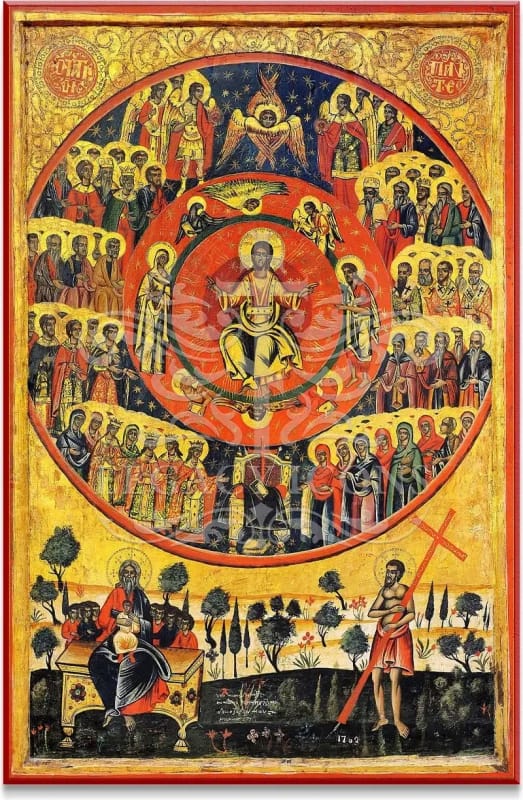
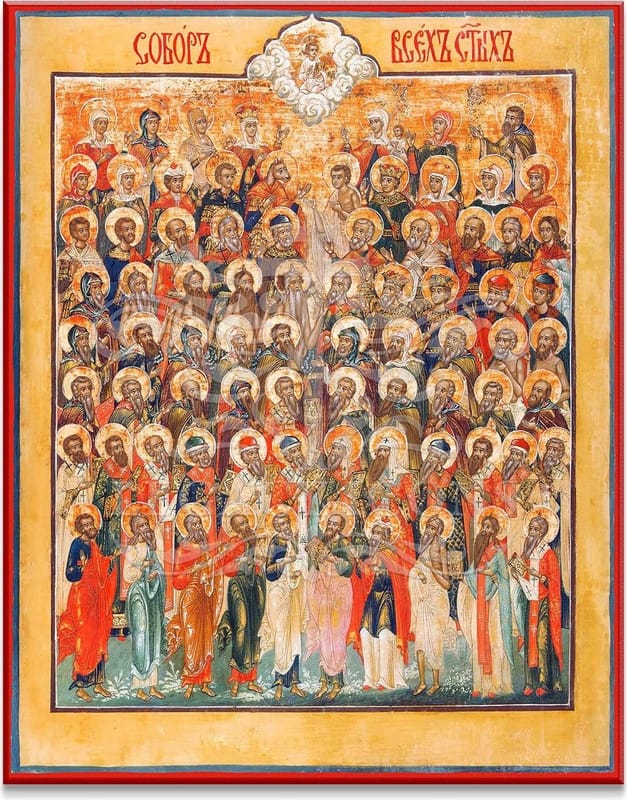
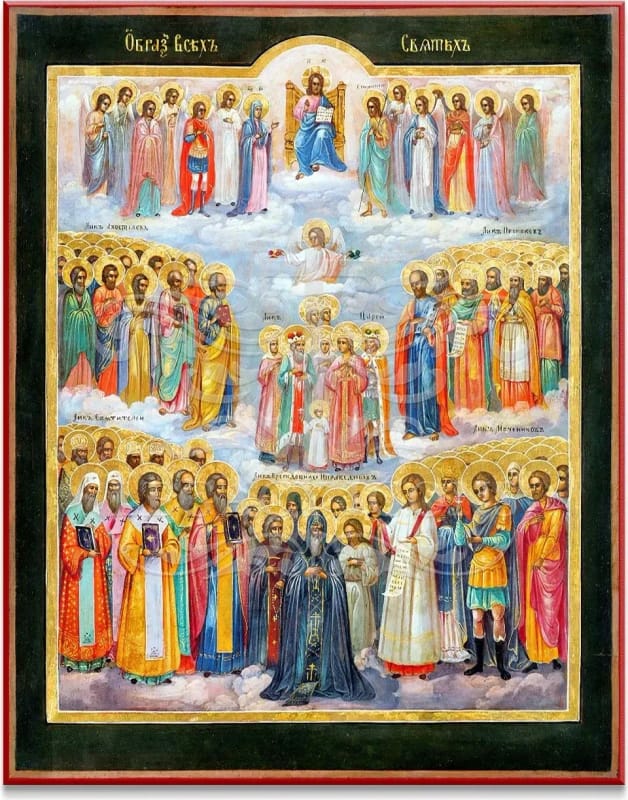
How the Church has written this feast — festal icons across the centuries.
Overview
The Sunday of All Saints is observed on the first Sunday after Pentecost, fifty-six days after Pascha (P+56). It gathers into a single commemoration all the saints of every time and place, both those known and named by the Church and the countless holy men and women whose sanctity is known to God alone. Dedicated to the Saints and classed as a movable observance of the Pentecostarion cycle, it draws together patriarchs, prophets, apostles, martyrs, hierarchs, ascetics, and the righteous of every age and race.
Its placement is deliberate. Set immediately after the feast of Pentecost, the day presents the whole company of saints as the fruit of the Holy Spirit poured out upon the Church. Having celebrated the descent of the Spirit, the Church at once celebrates the harvest that descent produced: human lives brought to holiness across the whole inhabited earth, in Asia, Libya, and Europe, north and south, east and west.
The commemoration also marks the conclusion of the Pentecostarion, the liturgical book that governs the season from Pascha to this Sunday. In some traditions the general theme continues on the following Sundays with regional commemorations of local saints, such as All Saints of America or All Saints of Mount Athos.
Timeline
4th century — Earliest Eastern commemoration at Antioch
A sermon of Saint Ephrem the Syrian (died 373) and a homily of Saint John Chrysostom (died 407) refer to a common day for the saints, kept on the Sunday after Pentecost and originally honoring the martyrs and Saint John the Baptist.
609–610 — Western dedication of the Pantheon
Pope Boniface IV consecrated the Pantheon in Rome to the Virgin Mary and all the martyrs.
731–741 — Western feast fixed for November 1
Pope Gregory III dedicated a chapel in Saint Peter's Basilica to all the saints for November 1, the date the Western Church maintained.
c. 893–894 — Death of the Empress Theophano
After the death of his wife Theophano, the emperor Leo VI wished to honor her; the Church declined to canonize her and the bishops discouraged a church dedicated in her name.
886–912 — Leo VI expands the feast
Leo VI the Wise built a Church of All Saints and, by tradition, broadened the Sunday after Pentecost from a commemoration of all martyrs into a general commemoration of all saints, whether martyrs or not.
History
The earliest traces of an Eastern commemoration of all the saints are found at Antioch on the Sunday after Pentecost. A sermon of Saint Ephrem the Syrian (died 373) and a homily of Saint John Chrysostom (died 407) both refer to a common day honoring the saints. In its original form the observance was more restricted: it honored the martyrs, and Saint John the Baptist, rather than saints of every category.
The impetus toward a collective feast arose in part from practical necessity. During the persecution under Diocletian the number of martyrs grew so great that a separate day could not be assigned to each, which encouraged the Church to keep a single communal observance. As Chrysostom's writings attest, the earliest form of the day was designated for the martyrs alone.
Later Fathers broadened the scope of the day to embrace, together with the martyrs, the patriarchs, prophets, apostles, hierarchs, ascetics, and all the righteous of every age and race. Because so many, and almost innumerable, persons had become sanctified across different regions and periods, individual commemoration of each proved impossible, and the Church established one annual feast honoring all saints alike, known and unknown, past and future.
The feast gained particular prominence in the ninth century under the Byzantine emperor Leo VI, called the Wise (reigned 886 to 912). His wife, the empress Theophano, commemorated on December 16, lived a devout life: she was generous to the poor and to monasteries, cared for widows and orphans, and gave much of her time to prayer, psalmody, and hymns. Tradition connects her with the Monastery of Saint Anastasia on Halki island near Constantinople.
After Theophano's death, around 893 or 894, Leo wished to honor her and to have her canonized, but the Church declined and the local bishops discouraged dedicating a church to her by name. Leo instead built a Church of All Saints, reasoning that his wife, if she were indeed righteous, would be numbered among all the saints. Tradition holds that he thereby expanded the feast from a commemoration of all martyrs into a general commemoration of all saints, whether martyrs or not, so that she would be honored whenever the feast was kept.
The Eastern Church has maintained this Pentecost-linked Sunday, in contrast to the Western observance fixed on November 1. In the West, Pope Boniface IV consecrated the Pantheon in Rome to the Virgin Mary and all the martyrs in 609 or 610, and Pope Gregory III (731 to 741) dedicated a chapel in Saint Peter's Basilica to all the saints for November 1.
Meaning
The feast presents the saints as the fruit of Pentecost. Christ assumed human nature, ascended into heaven, and sent the Holy Spirit upon the apostles so that they might preach and gather the elect into the Kingdom of Heaven. The Sunday of All Saints celebrates the result of that mission: the sanctification of human lives in every land and every generation.
It witnesses to the catholicity and universality of holiness. The saints commemorated are drawn from throughout the inhabited earth, across Asia, Libya, and Europe and every cardinal direction, and from every age and race. This breadth expresses the conviction that holiness is not confined to one people, place, or period, and that the great multitude of the holy exceeds any list the Church could keep.
The day is understood as bound up with the very purpose of Orthodoxy: it holds out the calling to holiness as the vocation of every Christian. By honoring the saints as a single company, the Church exhorts the living to imitate their virtuous lives and their patience and courage in the contests of virtue.
In gathering the known and the unknown into one commemoration, the feast also affirms that sanctity is finally known to God. Countless persons have become holy whose names the Church does not record, and this day honors them together with those it names, past, present, and to come.
Hymnography
The services of the day address the whole assembly of the saints, with scriptural readings and hymns honoring the saints both known and unknown. The patristic homiletical tradition attached to the feast is rich, including reflections associated with Saint Gregory Palamas, Saint Gregory Thaumaturgus, Saint Theophylact of Ochrid, and Saint John of Kronstadt.
Scripture
- John 12:32 — Christ's promise, drawn all men to himself, read as fulfilled in the gathering of the saints.
- Epistle of the First Sunday after Pentecost — The appointed apostolic reading for the day.
- Gospel of the First Sunday of Matthew — The appointed Gospel reading for the day.
Related and regional commemorations
A general commemoration of all the saints is also kept on Saturdays through the liturgical year, using hymns from the Octoechos.
In several traditions the Sunday of All Saints is followed by Sundays honoring locally venerated saints, such as All Saints of America and All Saints of Mount Athos.