
3 Baruch (The Greek Apocalypse of Baruch)
Baruch is taken up through the heavens and shown the builders of Babel, a dragon that devours the wicked, the phoenix that shields the earth from the sun, and Michael carrying a bowl to receive the virtues of humanity.
The Heavens Baruch Visits
Five heavens, unevenly proportioned — the third holds most of the book.
Do not force the tour into a perfectly regular scheme; the manuscripts do not support one, and this is not the seven-heaven cosmology of 2 Enoch or the Ascension of Isaiah.
| Heaven | What Baruch sees | Version |
|---|---|---|
| First | Men with the faces of oxen, horns of stags, feet of goats — those who built the tower of Babel | Greek |
| Second | Men of worse aspect, dog-faced with the feet of deer — those who gave the counsel to build it | Greek |
| Third | The dragon that devours the bodies of the wicked, and Hades; the vine and the story of the transgression; the sun in its chariot with the phoenix before it; the moon and why it wanes | Greek, with the planting of Paradise in the Slavonic |
| Fourth | A plain with a pool and birds beyond counting — the souls of the righteous, singing | Greek |
| Fifth | A shut gate, opened only by Michael, who holds the keys and receives the virtues of humanity in a bowl | Greek |
The tour is organised around administration rather than altitude — who runs what. It ends at a gate Baruch is not taken through.
Phamael and Michael
The angel who takes Baruch up, and the archangel who meets him at the last gate.
One belongs to this book alone; the other is the commander of the host — with an office here that goes well beyond Scripture.
Phamaelnamed in the Greek; the Slavonic families do not all give this name
3 Baruch 1–2 (Greek)
Baruch is weeping over the ruins of Jerusalem when the angel is sent to stop him — God has other things to show him — and the guide names himself Phamael, the angel of the powers.
He conducts the whole ascent, explains what Baruch sees, and answers his questions, in the ordinary office of the interpreting angel found in Daniel, Zechariah, the Enoch literature and Revelation. At the fifth heaven he stops: the gate opens only for Michael.
The name is not in Scripture, does not appear in Orthodox liturgical books or Byzantine angel lists, and is not consistent across the Slavonic families. It belongs to this text.
He should not be catalogued as an archangel of the Church on the strength of guiding Baruch — the same rule this section applies to Dokiel and Puriel in the Testament of Abraham and to Yahoel in the Apocalypse of Abraham.
- Not in Scripture; not in Orthodox liturgical tradition; not in Byzantine angel lists
- Named in the Greek text of this book only, and not uniformly across the Slavonic
- Never to be listed as an Orthodox archangel
Michael, with the keys and the bowl
3 Baruch 11–16 (Greek) · Daniel 10.13, 21 · Daniel 12.1 · Jude 9 · Revelation 12.7 · Tobit 12.15 · Revelation 5.8 · Revelation 8.3–4
At the fifth heaven the gate is shut, and it opens only for Michael, who holds the keys of the kingdom of heaven. The angels of the other heavens wait for him; he is commander of the host, and the guide can go no further without him.
He comes down carrying an enormous bowl. The angels arrive with baskets of flowers — the virtues of the righteous, the prayers and good works of the people in their charge — and pour them in. Michael carries the bowl through the gate and offers it before God, and returns with oil, which he gives to the angels whose baskets were full, for their people; those whose baskets came half empty or empty are sent away without it and rebuked.
The motif has real scriptural relatives: Raphael in Tobit 12 presenting the prayers of the saints before the Holy One; the golden bowls of incense which are the prayers of the saints in Revelation 5; the angel at the altar offering incense with the prayers of all saints in Revelation 8. Angels bearing human prayer upward is not this book's invention.
What is its own is Michael as heavenly high priest — entering the sanctuary with an offering and returning with oil. The parallel with Hebrews needs stating carefully rather than enjoyed: Hebrews argues that Christ is the great High Priest who entered once for all, and Orthodox doctrine knows one such priesthood. Michael's priestly role here is apocalyptic literature, and it must never be presented as Orthodox teaching about Michael.
- Holy Scripture — Michael as prince and commander; angels presenting prayers in Tobit and Revelation
- This book — the keys, the bowl of virtues, the oil, and the priestly entry
- Not doctrine — Michael as high priest is a literary conception; Christ's priesthood is the Church's teaching
The Angels Who Planted Paradise
A Slavonic tradition, and it should never be attributed to the book without that label.
God commands angels to plant the garden, each a different tree. The manuscript families name Michael, Gabriel, Raphael and Satanael — with either Uriel or Phanuel as the fifth, depending on the family. Lists giving all six merge traditions that do not agree.
| Angel | Register in this catalogue | Note |
|---|---|---|
| Michael | Scriptural | Named in Daniel, Jude and Revelation |
| Gabriel | Scriptural | Named in Daniel and Luke |
| Raphael | Deuterocanonical | Named in Tobit |
| Uriel or Phanuel | Traditional / Apocryphal | The families differ over which; they should not be combined |
| Satanael | Fallen | Plants the vine — which becomes the tree of the transgression |
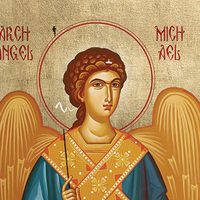 MichaelFirst among the planters in the Slavonic account, and the archangel the Church names and honours. The particular tree assigned to him varies between witnesses and needs checking against the critical editions.
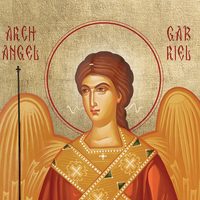 GabrielScriptural, named in Daniel and in Luke's account of the Annunciation — the second of the planters in this tradition.
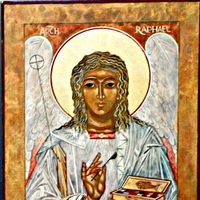 RaphaelKnown from Tobit, where he presents the prayers of the saints before the Holy One — the same office the angels perform at Michael's bowl later in this book.
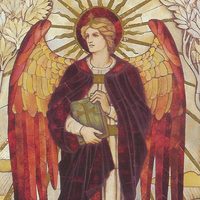 UrielNamed in one family of the Slavonic witnesses. His standing in Orthodox tradition rests on the Church's liturgical tradition, not on this book.PhanuelNamed in the other family, in place of Uriel. Known chiefly from 1 Enoch, apocryphal in register, and not an archangel the Church names.SatanaelPlants the vine, which becomes the tree of the transgression. The -el ending marks what he was before the fall — a literary device of particular textual traditions, not an Orthodox name for the devil.
The five registers in the table are worth noticing: Scriptural, Deuterocanonical, Traditional, Apocryphal, Fallen. One Slavonic scene reaches across the whole range this catalogue uses — which is a good illustration of why the registers are kept apart rather than flattened into a single list of angels.
The Cosmic Creatures
A dragon, a devouring Hades, and a bird that shields the world from the sun.
None of these is an angel, and the text does not call them angels. Forcing every supernatural being into that category is how a taxonomy goes wrong.
The dragon, and Hades
3 Baruch 4–5 (Greek) · Revelation 12.9
In the third heaven Baruch is shown a serpent of enormous size which eats the bodies of those who pass through life wickedly, and Hades is bound up with it — in the Greek the dragon's belly is Hades itself.
Baruch is told that Hades drinks about a cubit of the sea each day and the sea does not diminish, because three hundred and sixty rivers feed it. The picture is of an appetite that cannot be satisfied and a sea that cannot be emptied.
Scholars classify this differently — mythic geography, personified death, a chaos power, underworld symbolism, or a demonological being — and the text supports more than one reading. This page does not choose between them.
Two cautions. The text does not identify this dragon with Satan, and it should not be equated with the dragon of Revelation 12. And Hades here is the realm of the dead in the older sense, nearer to Sheol than to the later Christian conception of hell.
- Not an angel and not called one
- Not identified with Satan by the text
- Hades: realm of the dead in the older sense, not Gehenna
The phoenix, guardian of the earth
3 Baruch 6–8 (Greek) · 1 Clement 25 · Psalm 19.4–6
The sun goes out in a fiery chariot with a crown, attended and drawn by angels — and flying in front of it is a bird of immense size, which Baruch is told is the guardian of the inhabited world.
It spreads its wings and receives the sun's fiery rays, and if it did not, no living thing on earth would survive. It feeds on the manna of heaven and the dew of earth, and cries out at dawn to wake the cocks.
Here the phoenix is cosmological rather than a symbol of resurrection, and it is not called an angel — it should not be catalogued as one. The bird had a long prior life in Egyptian and Greco-Roman literature, and early Christians used it for resurrection, as 1 Clement does. Whether this book draws on any of that or shares a common inheritance is not something to assert.
- A cosmic creature, not an angel and not a demon
- Cosmological in function here; the resurrection symbolism belongs to other Christian usage
- Not evidence for the historical existence of the phoenix
Why the moon wanes
3 Baruch 9 (Greek) · Genesis 3 · Job 38.7
The moon travels in a chariot of its own, and Baruch asks why it waxes and wanes. The answer is Adamic: at the transgression, when the adversary took the serpent's form and deceived Adam, the moon gave light and did not hide itself as the sun did — and for that it was diminished. Lunar phases become a standing penance.
None of this is astronomy and none of it was written as astronomy. Psalm 19 has the sun as a bridegroom coming out of his chamber and rejoicing as a strong man to run a race; Job has the morning stars singing together at creation.
Ancient cosmology of this kind is theological picture-language about who governs the world. Reading it literally misses the genre entirely, and reading it as an Orthodox account of the heavens misreads its authority as well.
Angels, demons, cosmic creatures, personified realms and symbolic figures were distinct categories in this literature. Keeping them distinct is what stops a catalogue turning a phoenix into an archangel.
The Souls of the Righteous
A plain, a pool, and birds beyond counting that are not birds.
The one glimpse this book gives of the departed — conscious, in company, at worship.
The birds of the fourth heaven
3 Baruch 10 (Greek) · Revelation 6.9–11 · Revelation 7.9–12
Baruch is brought to a plain with a pool of water and birds without number, unlike any on earth, and he asks what they are. They are the souls of the righteous, who send up praise to the Lord perpetually.
The phrase that has drawn most attention is that they exist and worship in ordered ranks — choir by choir, in some renderings. The image of the departed righteous as birds singing over water is unusual and lovely, and it is one of the earliest such pictures to survive.
The resonance with Orthodox liturgical language about the choirs of the saints and the ranks of the righteous is immediate. It is a resonance and nothing more: the Church's language has its own roots in Scripture and its own worship, and no dependence on this book has been shown.
What the passage does show is that the picture of the departed righteous as consciously worshipping, in company, awaiting the resurrection, was already current. That is its historical value and also its limit — it offers no complete afterlife system and should not be pressed into one.
- That the departed righteous are conscious and at worship is Orthodox teaching, grounded in Scripture
- The birds, the plain and the pool belong to this book's imagery
- Not toll-house literature: an ascent with a guide is not a soul passing tollgates, and there are no accusers, examinations or advocates here
About the bookReadHide
3 Baruch is the strangest and most cosmological book in this section, and the most fun to read. Baruch is weeping over the ruins of Jerusalem when an angel is sent to stop him — God has other things to show him — and what follows is a guided tour of the heavens with the furniture of the universe laid open.
He sees men with the faces of oxen and the horns of stags, who built the tower of Babel, and worse-shaped men in the next heaven who made them build it. He sees a dragon whose belly is Hades, drinking a cubit of the sea each day and never filling. He sees the sun going out in a chariot with a crown, attended by angels, and flying before it an immense bird — the phoenix — with its wings spread to shield the earth from the fire, because unshielded the sun would burn everything living. He learns why the moon wanes, and it is Adam's fault. He sees a plain of birds that are the souls of the righteous, singing. And at the last gate he meets Michael with a great bowl in his hands, into which the angels pour the virtues of humanity.
Two textual traditions carry it, Greek and Slavonic, and they are not the same book. The Greek names Baruch's guide Phamael and carries material the Slavonic does not; the Slavonic preserves traditions the Greek lacks — most famously a scene in which five named angels plant the trees of Paradise, Satanael among them, and the vine he plants becomes the tree of transgression. Harmonising the two into one seamless account produces a text nobody wrote, and this page keeps them labelled throughout.
It is dated somewhere between the late first and the third century, with a Jewish core and Christian redaction that scholars separate with difficulty. It is not canonical Scripture in any Orthodox tradition, and it was preserved by Greek and Slavonic Christian scribes — which is a fact about transmission, not about reception. Catalogued here for study.
The book in depth11ShowHide
Greek and Slavonic — Two Traditions, Not One Book
This must come first, because more errors are made here than anywhere else with this text.
The Greek survives in very few manuscripts and gives the version most English readers meet. The Slavonic survives in many more, in distinct manuscript families, and preserves material that the Greek does not — while lacking or altering some of what the Greek contains, including passages scholars identify as Christian redaction.
Neither is simply the original. The Slavonic appears to descend from a Greek form no longer extant, so at particular points the Slavonic may preserve an earlier reading than the surviving Greek does. The relationship has to be worked out passage by passage.
The most consequential differences: the guide is named **Phamael in the Greek**, and the Slavonic families do not all give that name. The scene in which angels plant Paradise is a **Slavonic** tradition. The Slavonic names five angels — Michael, Gabriel, Raphael, Satanael, and either Uriel or Phanuel depending on the manuscript family — and combining Uriel and Phanuel into one list, as popular summaries do, merges two families that do not agree.
So no sentence on this page begins "3 Baruch says" where the versions differ. It says Greek, or Slavonic, and names the family where it can.
Date, Origin, and the Christian Layer
The dating range usually given runs from the late first century to the third, and it is a range rather than a estimate because the composition is layered.
A Jewish core is widely accepted: the opening lament over Jerusalem's destruction, the cosmological tour, the Adamic and Babel traditions all belong comfortably to Jewish apocalyptic writing of the period after AD 70. Christian redaction is equally accepted, and shows most clearly in the Greek — which is one reason the Slavonic matters, since where it lacks a Christian-looking passage the question of which is earlier becomes live.
Separating the layers cleanly is the difficulty. As with the Testaments of the Twelve Patriarchs, the transmission is thorough enough that a pristine Jewish original cannot simply be extracted by deleting the Christian-sounding lines.
Geographic origin is proposed rather than established; an eastern Mediterranean setting is the most that should be claimed. Greek is the likely language of the early form, with the caveat that the Slavonic descends from a Greek text we no longer have.
How Many Heavens?
3 Baruch is routinely summarised as a journey through five heavens, and that summary is useful and slightly too tidy.
The text numbers a first, second, third, fourth and fifth heaven, and the tour stops there — at a gate Baruch is not taken through. But the proportions are uneven: the third heaven holds most of the book, the first and second are brief, and the transitions are not always marked the way a systematic cosmology would mark them. Some scholars have suggested that the work is truncated, or that it once had a fuller scheme.
Two observations follow. This is not the seven-heaven scheme of 2 Enoch or the Ascension of Isaiah, and the disagreement between these books is again the evidence: ancient authors shared the idea of layered heavens without a fixed diagram. And a reader should not force every scene into a perfectly regular five-level system, because the manuscripts do not support one.
What the tour is really organised around is not levels but administration — who runs what. Babel and its punishment, the dragon and Hades, the sun and its angels and the phoenix, the moon and its chariot, the souls of the righteous, and finally Michael at the gate with the virtues of humanity.
Babel, and the Beasts It Made of Men
The first two heavens hold the builders of the tower, and the treatment of Genesis 11 is startling.
In the first heaven Baruch sees men with the faces of oxen, the horns of stags, the feet of goats and the loins of lambs, and is told these are they who built the tower of the war against God. In the second, men of yet worse aspect, dog-faced with the feet of deer — and these are they who gave the counsel to build it.
The distinction is moral and it is sharp: the ones who ordered the tower are in the worse condition than the ones who built it. The Greek elaborates the cruelty — the counsellors drove multitudes to make bricks, refused rest, would not let a woman who gave birth in the works stop carrying, and set themselves to bore through heaven to see what it was made of.
Genesis 11 says the people wished to build a tower with its top in the heavens and to make themselves a name. This book turns that into a deliberate assault on heaven and an atrocity against the workers, and reads the punishment as a transformation of those who committed it into the shapes their conduct deserved.
They are not called demons and should not be catalogued as such — they are human beings under judgment. Later traditions about Nimrod and Babel belong to their own streams and should not be poured into this one.
The Dragon, and Hades
In the third heaven Baruch is shown something he cannot at first take in: a serpent of enormous size, and a plain, and the belly of Hades.
The dragon eats the bodies of those who pass through life wickedly. Hades is bound up with it — in the Greek the dragon's belly *is* Hades — and Baruch is told that Hades drinks about a cubit of the sea each day and the sea does not diminish, because three hundred and sixty rivers feed it. The imagery is of an appetite that cannot be satisfied and a sea that cannot be emptied.
How to classify this is a real question and scholars answer it differently: mythic geography, personified death, a chaos power, underworld symbolism, or a demonological being. The text supports more than one reading and this page does not choose between them.
Two cautions. This dragon should not be identified automatically with the dragon of Revelation 12, which the text does not do. And Hades here is the realm of the dead in the old sense — closer to Sheol than to the later Christian conception of hell — so translating it flatly as Hell imports what the book does not say.
The Sun, the Phoenix, and the Moon
The most memorable passage in the book is its cosmology of the sun.
The sun goes out in a fiery chariot with a crown on its head, attended and drawn by angels — the Greek gives a number of them. And flying in front of it is a bird of immense size, which Baruch is told is the guardian of the inhabited world: it spreads its wings and receives the sun's fiery rays, and if it did not, no living thing on earth would survive. The bird feeds on the manna of heaven and the dew of earth, and cries out at dawn to wake the cocks.
The bird is the phoenix. It is a cosmological figure here rather than a symbol of resurrection, and it should not be classified as an angel — the text does not. The phoenix already had a long life in Egyptian and Greco-Roman literature, and early Christians used it for resurrection, as 1 Clement does. Whether 3 Baruch draws on any of those or shares a common inheritance is not something to assert.
The moon travels in a chariot too, and Baruch asks why it waxes and wanes. The answer is Adamic and strange: at the transgression, when the adversary took the serpent's form and deceived Adam, the moon gave light and did not hide itself as the sun did — and for that it was diminished. Lunar phases are made a standing penance.
None of this should be read as astronomy, and it was not written as astronomy. Psalm 19 has the sun as a bridegroom coming out of his chamber and rejoicing as a strong man to run a race; Job has the morning stars singing together. Ancient cosmology of this kind is theological picture-language about who governs the world, and taking it literally misses the genre entirely.
The Angels Who Planted Paradise, and the Vine
This is the Slavonic tradition, and it should never be attributed to the book without that label.
In the Slavonic, God commands angels to plant the garden, and each plants a different tree. The manuscript families give Michael, Gabriel, Raphael and Satanael, with either Uriel or Phanuel as the fifth depending on the family — which is exactly why lists naming all six should be distrusted.
Satanael plants the vine. And the vine, in this tradition, is the tree of the transgression — the plant from which Adam and Eve ate. God curses it because of what Satanael did through it; and after the Flood, Noah is uncertain whether he may plant it, and receives permission with a warning about what wine does.
The identification of the forbidden fruit with the grape is one of several ancient guesses — the fig, the wheat and the citron all had advocates — and it is not Orthodox teaching. Genesis names no species. What makes this version interesting is the moral logic: the tree that undid Adam becomes, after the Flood, permitted but dangerous, which is a comment on wine as much as on Eden.
The name Satanael carries the same feature seen in 2 Enoch: the divine element -el marking what he was before the fall, dropped afterwards. It is a literary device belonging to particular textual traditions, not an Orthodox name for the devil, and this catalogue does not treat it as one.
Phamael, and Michael at the Gate
Baruch's guide names himself in the Greek as Phamael, described as the angel of the powers. The name is not in Scripture, is not found in Orthodox liturgical books or Byzantine angel lists, and does not appear consistently across the Slavonic families. It belongs to this text, and Phamael should not be catalogued as an archangel of the Church on the strength of guiding Baruch — the same rule this section applies to Dokiel, Puriel and Yahoel.
At the fifth heaven the guide cannot go further. The gate is shut, and it opens only for Michael, who holds the keys.
Michael comes down, and he is described in terms that go far beyond his scriptural portrait: commander of the angelic host, keeper of the keys of the kingdom of heaven, the one before whom the angels of the other heavens must wait. And he carries an enormous bowl.
The angels come with baskets of flowers, and these are the virtues of the righteous — the prayers and good works of human beings, brought up by the angels set over them. They pour them into Michael's bowl. Michael carries the bowl through the gate and offers it before God, and comes back with oil, which he gives to the angels whose baskets were full, for the people in their charge; and those who came with baskets half empty or empty are sent away without it and rebuked.
The scriptural relatives for the motif are genuine: Raphael in Tobit 12 presenting the prayers of the saints before the Holy One; the golden bowls full of incense which are the prayers of the saints in Revelation 5; the angel at the altar offering incense with the prayers of all saints in Revelation 8. Angels bearing human prayer upward is not this book's invention.
What is this book's own is Michael as heavenly high priest, entering the sanctuary with an offering and returning with oil. The parallel with Hebrews is obvious and needs stating carefully: Hebrews argues that Christ is the great High Priest who entered once for all, and Orthodox doctrine knows one such priesthood. Michael's priestly role here is a literary and apocalyptic conception, and it should never be presented as Orthodox teaching about Michael.
The Souls of the Righteous
The fourth heaven is a plain, with a pool of water, and birds beyond counting — and they are not birds. Baruch asks, and is told they are the souls of the righteous, who send up praise to the Lord perpetually.
The image of the departed righteous as birds singing over water is unusual and lovely, and the phrase that has attracted most attention is that they exist and worship in ordered ranks — choir by choir, in some renderings.
The resonance with Orthodox liturgical language about the choirs of the saints and the ranks of the righteous is immediate. It is also a resonance and nothing more: the Church's language has its own roots in Scripture and its own worship, and no dependence on this book has been shown.
What the passage does show is that the picture of the departed righteous as consciously worshipping, in company, awaiting the resurrection, was already current — which is the historical value of the text and the limit of it. It does not offer a complete afterlife system and should not be pressed into one.
And it is not toll-house literature. An ascent through numbered heavens with an angelic guide is not a passage through tollgates: there are no accusers, no examinations of individual sins, no advocate answering charges. Baruch is a visionary being shown the universe, not a soul being tried.
Reception, and Whether It Is Orthodox Scripture
It is not. 3 Baruch appears in no Orthodox biblical canon, was received by no council, and is not read liturgically. Its distinctive material carries no doctrinal authority.
Its preservation is nonetheless genuinely Eastern Christian, in both Greek and Slavonic manuscript culture, and the Slavonic transmission is the more substantial — which makes it valuable for reconstructing a Greek text that has largely vanished. That is a fact about scribes and libraries, and the distinction between preservation and reception holds here as everywhere in this section.
Patristic use is not established, and this page claims none. Proposals of early Christian knowledge have been made and should be verified rather than repeated.
The thematic parallels with Orthodox tradition are real and worth naming without overclaiming: Michael as commander of the host, angels bearing prayers, the choirs of the righteous, the heavenly sanctuary. Michael's title as commander is genuinely Orthodox usage; the rest rest on Scripture — Tobit, Isaiah 6, Revelation — rather than on this book. No surviving Orthodox artwork is known to illustrate 3 Baruch.
A sourcing note, as on the other pages in this section written from research briefs. The Greek/Slavonic distinction, the shape of the ascent, the major episodes, Phamael's confinement to the Greek, and Michael's role at the gate are reliable. Chapter and verse references, the numbers given for attendant angels, the assignment of particular trees to particular angels in the Slavonic, and bibliographic particulars have not been checked against Picard's edition or the Slavonic families, and should be verified before this profile is promoted.
What It Can and Cannot Establish
It can illuminate ancient heavenly-ascent literature and its angelic guides; the conception of creation administered by heavenly beings; Michael traditions well beyond the scriptural portrait; Satanael traditions and the Adamic vine; the interpretation of Babel as cosmic rebellion; ancient cosmology of the sun and moon; the phoenix in Jewish and Christian imagination; the picture of the righteous departed at worship; angels bearing human prayer; and the Christian preservation of a Jewish apocalypse in two divergent traditions.
It cannot establish an Orthodox cosmology; the literal structure of the heavens; canonical names for angels; Orthodox teaching about Satan; the species of the forbidden fruit; the geography of Hades; the existence of the phoenix; Orthodox teaching about the departed; a source for Orthodox liturgy; or Michael's priesthood as doctrine.
| Commonly said | Status | What can be said |
|---|---|---|
| 3 Baruch is the Book of Baruch | False | The canonical Book of Baruch is a different work read in the Orthodox Old Testament |
| 3 Baruch is 2 Baruch | False | 2 Baruch is the Syriac Apocalypse — a different book with a different angel and a different subject |
| The Greek and Slavonic are the same text | False | They differ in what they contain; neither is simply the original |
| Phamael guides Baruch in every version | No | He is named in the Greek; the Slavonic families do not all give that name |
| Phamael is an Orthodox archangel | No | Not in Scripture, not in Orthodox liturgical books, not in Byzantine angel lists |
| Five angels including both Uriel and Phanuel plant Paradise | Merges two families | The Slavonic gives Michael, Gabriel, Raphael, Satanael, and either Uriel or Phanuel depending on the manuscript family |
| 3 Baruch says the forbidden fruit was a grape | Slavonic tradition | The vine identification belongs to that tradition; Genesis names no species and this is not Orthodox teaching |
| The phoenix is an angel | No | A cosmological creature in this text, guarding the earth from the sun's fire; it is not called an angel |
| The dragon is Satan | Not stated | The text does not identify it, and it should not be equated with the dragon of Revelation 12 |
| Hades here means Hell | Imprecise | Hades is the realm of the dead in the older sense, nearer to Sheol |
| Michael's high priesthood is Orthodox doctrine | No | A literary and apocalyptic conception; Hebrews and Orthodox teaching know one High Priest |
| The ascent through the heavens is a toll-house journey | No | No accusers, no examinations, no advocate — a visionary is shown the universe, not a soul tried |
| Its cosmology describes the actual heavens | No | Theological picture-language about who governs the world, in the manner of Psalm 19 and Job 38 |
SourcesShowHide
- J.-C. Picard, Apocalypsis Baruchi Graece (Pseudepigrapha Veteris Testamenti Graece 2; Brill, 1967) — the critical Greek edition
- H. E. Gaylord Jr., "3 (Greek Apocalypse of) Baruch", in James H. Charlesworth, ed., The Old Testament Pseudepigrapha, vol. 1 (Doubleday, 1983) — translates both the Greek and the Slavonic; cited for scholarship, not reproduced
- M. R. James, who published the Greek text in Apocrypha Anecdota II (Cambridge, 1897) — public domain
- Andrei A. Orlov and other specialists in the Slavonic pseudepigrapha, on the Slavonic manuscript families
- The Online Critical Pseudepigrapha, for the Greek text after Picard and the manuscript evidence
- Genesis 3 and 11; Job 38; Psalm 19.4–6; Psalm 24.7–10; Isaiah 6; Daniel 10 and 12; Tobit 12.15; Revelation 5.8, 8.3–4 and 12.9 (Holy Scripture)
- 1 Clement 25, for the early Christian use of the phoenix
- Catalogued for study; requires clergy/source review before any devotional use. This page was written from a research brief rather than a completed source dossier — see the sourcing note in Reception