
The Testament of Adam
A Syriac Christian work in three parts, attributed to Adam and addressed to Seth — an hour-by-hour account of the whole creation at prayer, a prophecy of Christ, and one of the earliest Christian attempts to set the angelic orders in rank.
The Three Parts
Horarium, Prophecy, Hierarchy — modern scholarly labels, not ancient headings.
They travel together in the manuscripts and were not necessarily written together. Any claim from this book should say which part it comes from.
| Section | What it contains | Age |
|---|---|---|
| The Hours (Horarium) | Who praises God in each hour of the night and the day — the creation taken in turn, closing with human prayer | Generally the earliest layer; an older core has been proposed, not demonstrated |
| The Prophecy | Adam's instruction to Seth: the Flood, and the coming of Christ — born of a virgin, suffering, rising | Christian in its present form, explicitly |
| The Hierarchy | The orders of the heavenly host, each with a sphere of governance | Usually taken as the latest section; bears directly on the Dionysius question |
The Hours of Creation
The cosmos as one choir, keeping watch in shifts, so that no hour passes unpraised.
The scheme is secure and is the reason to read this book. The hour-by-hour assignments differ between witnesses and are not printed here — see the note below.
The pattern of the Hours
Testament of Adam 1–2 (the Horarium) · Psalm 148 · Psalm 19.1–4 · Psalm 103.4 · Song of the Three Holy Children
Twelve hours of the night and twelve of the day, and for each one the text names who is praising God at that hour.
The worshippers are the parts of creation rather than congregations: the depths and the waters, fire and the winds, the fish and the birds and the beasts, and the ranks of angels before the throne — each with an appointed hour, the cycle closing with the prayer and petition of human beings. At no hour is God unpraised.
Hostile spirits appear within the scheme as well, their activity placed inside the allotment rather than outside it. The night is not surrendered to them; it is apportioned, hour by hour, like everything else.
This page describes the scheme and deliberately does not print a twenty-four-row table. The specific assignment of each hour differs between the Syriac and Greek witnesses and between manuscripts, and the list has not been checked here against Robinson's critical edition. A reader wanting the hours themselves should go there.
- Holy Scripture — that creation praises its Maker: Psalm 148, Psalm 19, the Song of the Three Holy Children
- This book — the schedule; what Psalm 148 lists, the Horarium puts on a clock
- Not established — any dependence between this scheme and the Christian hours of prayer
The praising cosmos in Scripture
Psalm 148 · Psalm 19.1–4 · Psalm 103.4 · Song of the Three Holy Children · Revelation 5.8 · Revelation 8.3–4
The idea is not this book's invention. Psalm 148 summons sun and moon, stars, the waters above the heavens, sea creatures and deeps, fire and hail, snow and vapour, mountains, trees, beasts and birds, and last of all human beings — a sweep through creation ordered much as the Hours are ordered.
The Song of the Three Holy Children, sung in the furnace and read in the services of Great Saturday, does the same: every part of creation called in turn to bless the Lord. Psalm 19 has the heavens declaring the glory of God without speech; Psalm 103 sets the angels who do His word beside the winds and the flames.
Revelation adds the other half of the picture — the prayers of the saints as incense in golden bowls, and an angel offering them at the altar before the throne. Human prayer rising and angelic worship receiving it is a scriptural conception, and the Testament works within it.
The hours, and the Church's hours
Acts 3.1 · Acts 10.9 · Orthodox Horologion
The resonance with Orthodox liturgical theology is immediate: the Church prays at appointed hours because heaven is already praying, and earthly worship joins something unceasing.
It is a resonance and not a derivation. The Orthodox Hours have their own history in early Christian and monastic practice — the apostles going up at the hour of prayer, Peter praying at the sixth hour — and the Divine Liturgy's joining of earthly worship to angels and archangels rests on Isaiah 6 and Revelation.
The most that should be said is that the Testament of Adam probably reflects an existing way of thinking about prayer and time rather than causing one. Similar structure is not evidence of dependence, and no scholarship has demonstrated a link.
- That the Church's worship joins the unceasing worship of heaven is Orthodox teaching, grounded in Isaiah 6 and Revelation
- The Horologion has its own documented sources in early Christian and monastic practice
- No dependence on this book has been shown, and none is claimed here
The Orders of the Heavenly Host
One of the earliest Christian attempts to set the angelic vocabulary of Scripture into rank.
The vocabulary is biblical throughout. The arrangement and the functions are the Testament's own, differ between witnesses, and should be checked against Robinson before being quoted.
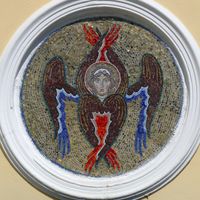 SeraphimNearest the throne. The name and the imagery come from Isaiah 6, where they cover themselves with their wings and cry the Trisagion — the passage the Church's own worship takes up.
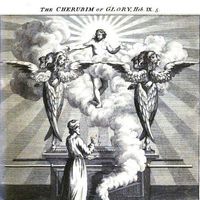 CherubimSet at the gate of Paradise in Genesis 3 and beneath the divine chariot in Ezekiel 1 and 10. The Testament places them among the highest, as Scripture does.
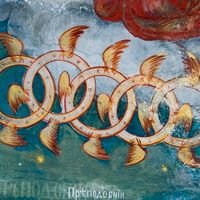 ThronesNamed by Paul in Colossians 1.16 among the things created in Christ, visible and invisible. Paul names them without ranking them; this is one of the first texts to try.
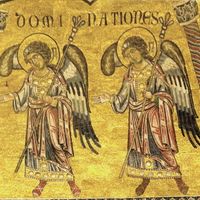 DominionsColossians 1.16 and Ephesians 1.21. In the Testament, as in the later hierarchy, an order of governance rather than of direct service to humanity.
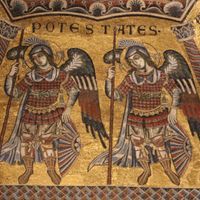 PowersEphesians 1.21, 3.10 and 6.12, and Romans 8.38. Paul's language for the powers is used in the Testament for holy orders — the same words Scripture also uses of hostile ones.
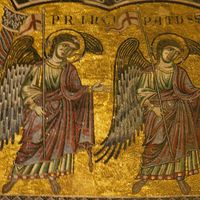 PrincipalitiesThe archai of Romans 8.38, Ephesians 3.10 and Colossians 1.16 — rulers, in the plain sense of the word, over parts of the created order.
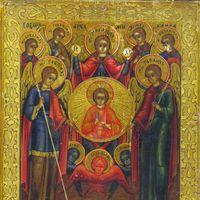 ArchangelsThe chief messengers, distinguished from the angels by rank and by mission. Whether the Testament names any individually is one of the details needing verification.
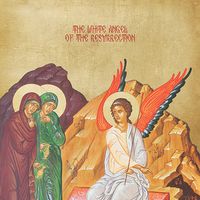 AngelsThe order nearest to human affairs — the messengers of Scripture, and in the Testament the rank most directly concerned with people.
Nine records are linked above because the Church's own nine orders are the natural comparison. That is not a claim that this text contains them — the vocabulary overlaps because both draw on Isaiah, Ezekiel and Paul, while the arrangement and functions differ. See the Beside the Nine Orders section.
Adam, Seth, and What Adam Foretells
The testamentary frame, and the prophecy that settles the book's character.
Christian prophecy placed on Adam's lips is a device of the author's own age, and this page never presents it as a pre-Christian prediction.
About the bookReadHide
The Testament of Adam is a Christian work, preserved above all in Syriac, written as Adam's last instruction to his son Seth. It is short, and it is three quite different things bound together.
The first is an hour-by-hour account of who praises God through the night and through the day — not human worshippers but the creation itself, taken in turn: the depths, the waters, the fire and the winds, the birds and the beasts, and the ranks of angels, each with its appointed hour, until the cycle closes with the prayer of human beings. The second is a prophecy: Adam tells Seth what is to come, including the Flood and, unmistakably, the Incarnation, death and resurrection of Christ. The third is a list of the orders of the heavenly host, each with a sphere of governance — one of the earliest surviving Christian attempts to set the angelic vocabulary of Scripture into rank.
Those three parts are conventionally called the Horarium, the Prophecy and the Hierarchy. Those are modern scholarly labels, not ancient manuscript headings, and the sections do not appear to be of one age: scholars generally treat the Hours as the oldest layer, possibly resting on older material, with the Hierarchy the latest. Dating the whole work to a single year is therefore not possible, and this page does not attempt it.
For a catalogue of the heavenly hosts, its interest is unusual and twofold. The Hours give the fullest early Christian picture of the cosmos as a single choir keeping watch in shifts — an idea with deep scriptural roots in Psalm 148 and the Song of the Three Holy Children, and one that resonates strongly with Orthodox liturgical theology. And the Hierarchy is a genuine rival witness to how Christians before or around the time of St Dionysius the Areopagite were organising the ranks of angels. It has never been canonical Scripture in any Orthodox tradition, and it is catalogued here for study.
The book in depth10ShowHide
Three Parts, and Three Dates
The work divides into three sections which modern scholarship calls the Horarium, the Prophecy and the Hierarchy. Those names are conveniences invented by scholars to describe the contents; they are not titles the ancient manuscripts carry, and a reader should not imagine an original author who set out to write three named books.
Nor are they of one age. The Hours are generally treated as the earliest layer and may rest on older material; the Prophecy is unmistakably Christian in its present form; and the Hierarchy is usually taken to be the latest addition. The three travel together in the manuscript tradition and were not necessarily composed together.
This matters for every claim made from the text. A statement about the Testament of Adam that does not say which section it comes from has left out the part that determines how old the material might be.
| Section | Contents | Position in the scholarship |
|---|---|---|
| Horarium — the Hours | Who praises God in each hour of the night and of the day; the whole creation taken in turn | Generally treated as the oldest layer; a pre-Christian core has been proposed and is not settled |
| Prophecy | Adam's instruction to Seth about what is to come — the Flood, and the coming of Christ | Christian in its present form; the Christological passages are explicit |
| Hierarchy | The orders of the heavenly host, each with a sphere of governance | Usually taken as the latest section; its date bears directly on the Dionysius question |
Date, Origin and Language
The surviving work is Christian. The Prophecy names Christ in terms no pre-Christian Jewish text would use, and the question is not whether the book as we have it is Christian but whether any of it rests on older Jewish material — a possibility raised chiefly for the Hours, and not demonstrated.
Syriac is the language of the principal manuscript tradition and the most likely language of composition for the work as a whole, though Greek witnesses also survive and the relationship between the traditions is part of what Robinson's study exists to sort out. Arabic, Ethiopic, Armenian and Georgian transmission carry the material further east and south.
For date, the honest form is a range for a composite: the work took the shape we have somewhere in the early Christian centuries, with the Hours possibly the oldest part and the Hierarchy plausibly considerably later. Precise dating of the whole is not available, and assigning one year to the Testament of Adam is a mistake the sources do not support.
Syriac Christian — Which Is Not the Same as Eastern Orthodox
One distinction has to be made carefully here, because it is easy to get wrong and this site would be wrong to blur it.
This text was preserved in Syriac Christian manuscript culture. That culture includes the Syriac Orthodox Church, the Assyrian Church of the East, the Maronite Church and others — communions with their own histories, and not part of the Eastern Orthodox Church whose saints this site catalogues. "Eastern Christian" and "Eastern Orthodox" are not synonyms, and a Syriac manuscript is not evidence of Byzantine Orthodox reception.
So the sentence that can be made here is narrower than the one made for, say, the Testaments of the Twelve Patriarchs. That collection was preserved in Greek monastic libraries of the Orthodox world. This one was preserved chiefly by Syriac-speaking Christians, some of them not in communion with the Orthodox Church. Both facts are interesting; they are not the same fact.
Where Greek witnesses exist, Byzantine knowledge of the material becomes a real question — and it is a question, not an established transmission. This page does not claim Orthodox preservation for the Testament of Adam on the strength of its Syriac survival.
The Hours — the Whole Creation at Prayer
The Horarium is the most striking thing in the book. It runs through the twelve hours of the night and the twelve hours of the day and says, for each one, who is praising God then.
The worshippers are not congregations. They are the parts of creation, taken in turn: the depths and the waters, the fire and the winds, the fish and the birds and the beasts, the ranks of the angels before the throne — each with its own hour, and the cycle closing with the prayer and petition of human beings. The whole cosmos is presented as a single choir keeping watch in shifts, so that at no hour of the day or night is God unpraised.
One feature deserves particular notice: hostile spirits appear in the scheme too, and their activity is placed within it rather than outside it. The night is not surrendered to them; it is allotted, hour by hour, like everything else.
A caution on detail, which this page takes seriously. The pattern above is secure, and it is what makes the section worth reading. The precise assignment of each of the twenty-four hours differs between the Syriac and Greek witnesses and between manuscripts, and the hour-by-hour list has not been checked here against Robinson's critical edition. This page therefore describes the scheme and does not print a twenty-four-row table it cannot yet stand behind. Anyone wanting the specific hours should go to Robinson.
The Scriptural Roots of a Praising Cosmos
The idea that creation itself praises God is not this book's invention, and its biblical relatives are strong ones.
Psalm 148 summons the sun and moon, the stars, the waters above the heavens, the sea creatures and the deeps, fire and hail, snow and vapour, mountains and trees, beasts and birds, and finally human beings — a sweep through creation ordered very much as the Hours are ordered. The Song of the Three Holy Children, sung in the furnace and read in the Orthodox services of Great Saturday, works the same way: every part of creation in turn is called to bless the Lord. Psalm 19 has the heavens declaring the glory of God without speech or language, and Psalm 103 sets the angels who do His word beside the winds and the flames.
The Testament's contribution is to put a clock on it. What Psalm 148 lists, the Horarium schedules.
The resonance with Orthodox liturgical theology — earthly worship joining an unceasing heavenly one, the Church praying at appointed hours because heaven is already praying — is real and worth feeling. It is also not evidence of dependence. The Orthodox Hours have their own history in early Christian and monastic practice, and the Divine Liturgy's joining of the earthly to the angelic rests on Isaiah 6 and Revelation, not on this book. Where the Testament is useful is as a witness that this way of imagining the cosmos was current in early Christianity — most likely reflecting an existing prayer tradition rather than causing one.
Adam, Seth, and the Prophecy
The frame is testamentary: Adam, at the end of his life, hands on to Seth what he knows. The knowledge includes the schedule of the Hours — Adam as the first man knowing how creation praises its Maker — and a prophecy of what is to come.
The prophecy is explicitly Christian. Adam foretells the Flood, and then the coming of the Son of God: born of a virgin, becoming man, suffering, and rising. Whatever the age of the Hours, this section settles the character of the surviving work.
Two things follow, and the second is the one usually missed. First, Christian prophecy placed on Adam's lips is a literary device of the writer's own age, not an authentic pre-Christian prediction, and it should never be presented as evidence that Adam foretold Christ. Second, this is precisely the kind of text where a Christian author's convictions become visible — which makes the Testament valuable as a window onto late-antique Syriac Christian belief rather than onto the antediluvian world.
The section also carries a line often quoted in modern discussions of deification: God's word to Adam that He will yet make him a god — not now, but after the passing of many years. The resonance with the Orthodox doctrine of theosis is obvious and should be handled the way every such resonance on this site is handled. Orthodox teaching on deification is drawn from Scripture and the Fathers — St Athanasius, St Maximus, the whole tradition — and not from a Syriac pseudepigraphon. That the phrase turns up here shows the idea's antiquity and reach; it does not make this book a source of doctrine.
One further caution about Seth. Seth's prominence in this text does not make it Sethian in the Gnostic sense, and it should not be read alongside the Nag Hammadi Apocalypse of Adam, which belongs to a different religious world entirely. Adam instructing Seth is an ordinary feature of Jewish and Christian Adam literature.
The Hierarchy, and the Watchers
The third section lists the orders of the heavenly host and gives each a sphere of governance — the angels closest to human affairs, and the higher ranks over the wider order of things, up to those nearest the throne. The vocabulary is assembled from Scripture: the seraphim of Isaiah 6, the cherubim of Genesis 3 and Ezekiel 1 and 10, and the thrones, dominions, principalities, powers and authorities that Paul names in Romans 8, Ephesians 1, 3 and 6, and Colossians 1 and 2.
That is the section's real interest. Paul names these powers without arranging them, and Isaiah and Ezekiel describe their beings without ranking them. The Testament of Adam is one of the earliest surviving Christian attempts to take that scattered vocabulary and make a system of it.
A word on watchers, since the term appears in Syriac angelology and is regularly misread. In Syriac Christian usage the watchers — following Daniel 4, where a watcher and a holy one comes down from heaven — are ordinarily the holy angels, not fallen ones. The Enochic sense of Watcher as a rebel who descended and sinned is a different tradition, and the word should not be assumed to carry it here. Checking the context is the rule, and the Syriac default is the opposite of the Enochic one.
A caution matching the one on the Hours: the ordering of the ranks and the specific function assigned to each differ between witnesses, and the details have not been verified here against Robinson's edition. The presence of the section and its scriptural vocabulary are secure; the exact scheme should be checked before being quoted.
Beside the Nine Orders
The obvious question is how this relates to the ninefold hierarchy the Orthodox Church received through St Dionysius the Areopagite — Seraphim, Cherubim and Thrones; Dominions, Powers and Authorities; Principalities, Archangels and Angels.
The terminology overlaps heavily, because both are drawing on the same scriptural vocabulary. The arrangement and the functions do not simply match, and the Testament should not be described as containing the nine orders as Orthodoxy knows them.
On the chronology, two errors are worth naming. The first is to assume that because some of this material may be early, Dionysius must have used it. Earlier does not mean source, and no such dependence has been demonstrated. The second is subtler: the Hierarchy is usually taken to be the latest of the three sections, so its priority to the Dionysian corpus is not even established. Its date is genuinely uncertain and may be later than or contemporary with Dionysius.
What can be said, and what makes the section valuable, is this: the Testament of Adam is evidence that Christians other than Dionysius were trying to organise the biblical angelic terminology into ranks, and that the ninefold arrangement the Church received emerged from a wider current of such attempts rather than from nowhere. That is a genuinely useful thing for this catalogue to be able to show — and it stops well short of making Orthodox angelology derivative of pseudepigrapha.
| The Testament of Adam | The Nine Orders received by the Church | |
|---|---|---|
| Vocabulary | Drawn from Isaiah, Ezekiel and Paul | Drawn from the same passages |
| Number of orders | A list of ranks; the count and order vary between witnesses | Nine, fixed |
| Arrangement | Ranked by sphere of governance | Three triads, ranked by nearness to God |
| Function of each | Each order governs a part of the created order | Each order mediates illumination to the one below |
| Source of authority | A pseudepigraphon; no ecclesial reception | Received through St Dionysius into the Church's tradition |
| Date | Uncertain; probably the latest section of the work | The Dionysian corpus, from the late 5th or early 6th century |
| Relationship | Not demonstrated in either direction | — |
Canonicity & Reception
The Testament of Adam is not canonical Scripture in any Orthodox tradition, appears in no Orthodox biblical manuscript as Scripture, and was received by no council. Its distinctive material — the schedule of the Hours, the ranking of the orders, Adam's prophecy — carries no doctrinal authority.
Patristic use is not established, and this page claims none. St Ephrem the Syrian, Aphrahat, St Jacob of Serugh and the wider Syriac tradition share a great deal thematically with this text — Adam, Paradise, the creation at prayer, the restoration of humanity — because they inhabit the same Syriac Christian world and read the same Scriptures, not because dependence has been shown. The graded categories used across this section apply, and most of these cases fall under shared tradition or thematic parallel rather than probable dependence.
The same holds for the liturgical question, which is the one readers will most want answered. The Orthodox Hours, the Horologion, the Cherubic Hymn and the Trisagion have their own well-documented sources in Scripture and early Christian practice. Nothing in them has been shown to derive from this book, and the presence of hourly prayer and angelic worship in both traditions is not evidence of a link. No surviving Orthodox image is known to illustrate the Testament of Adam.
A sourcing note, as on the two other pages in this section written from research briefs rather than completed dossiers. The structure of the work, its Syriac character, the composite dating, the scriptural vocabulary of the Hierarchy and the Christian character of the Prophecy are reliable. The hour-by-hour contents of the Horarium, the precise ordering and functions in the Hierarchy, and some bibliographic particulars have not been checked against Robinson's critical edition, and should be verified before this profile is promoted.
What It Can and Cannot Establish
It can illuminate early Christian angelology and the development of angelic hierarchies; Syriac Christianity and its Adam traditions; the conception of the cosmos as a single choir at prayer; early Christian ideas about the hours; the figure of Adam reinterpreted as prophet and transmitter of revelation; Seth's place in Christian Adam literature; and the language of spiritual powers in late-antique Christian cosmology.
It cannot establish the Orthodox angelic hierarchy; anything Adam historically said or knew; a canonical revelation given to Seth; the origin of the Orthodox Hours or of the Divine Liturgy; a source for Dionysian angelology; official names or functions of angels; or any doctrine resting on pseudepigraphal material alone.
| Commonly said | Status | What can be said |
|---|---|---|
| The Testament of Adam is the Life of Adam and Eve | False | Separate works. The Life of Adam and Eve is a Greek and Latin family about the fall and Adam's death; this is a Syriac work about the hours, prophecy and the angelic orders |
| It is the Apocalypse of Adam | False | The Nag Hammadi Apocalypse of Adam belongs to a different religious world entirely |
| It is the Cave of Treasures | Different work | Both are Syriac Adam literature; they are not the same text and should not be merged |
| The whole work dates from one period | No | The three sections are of different ages; the Hours are generally the earliest and the Hierarchy the latest |
| It is a Jewish text | Not as it stands | The surviving work is Christian; an older Jewish core has been proposed for the Hours and not demonstrated |
| Syriac preservation means Orthodox preservation | No | Syriac Christian communions are not the Eastern Orthodox Church; Eastern Christian and Eastern Orthodox are not synonyms |
| Adam established the hours of prayer | Not history | A literary attribution; the Christian hours have their own documented origins |
| The Orthodox Hours derive from this work | No evidence | Similar structure does not show dependence; the Horologion has its own sources |
| Its hierarchy is the nine orders | No | The vocabulary overlaps because both draw on Scripture; arrangement and function differ |
| Pseudo-Dionysius borrowed from it | Not established | No dependence has been shown, and the Hierarchy section may not even predate the Dionysian corpus |
| The watchers in it are fallen angels | Check the context | In Syriac usage, following Daniel 4, watchers are ordinarily the holy angels |
| Adam prophesied Christ | A literary device | Christian prophecy placed on Adam's lips by a Christian author, not a pre-Christian prediction |
SourcesShowHide
- Stephen Edward Robinson, The Testament of Adam — An Examination of the Syriac and Greek Traditions (SBL Dissertation Series 52; Scholars Press, 1982) — the standard critical study and the basis for any serious use of this text
- Stephen E. Robinson, "Testament of Adam", in James H. Charlesworth, ed., The Old Testament Pseudepigrapha, vol. 1 (Doubleday, 1983) — standard English translation; cited for scholarship, not reproduced
- Michael E. Stone, on Adam literature and its Armenian and Georgian transmission
- Genesis 1–5; Isaiah 6; Ezekiel 1 and 10; Daniel 4.13–17; Romans 8.38–39; Ephesians 1.21; Ephesians 3.10; Ephesians 6.12; Colossians 1.16; Colossians 2.15; Revelation 5.8; Revelation 8.3–4; Psalm 148; the Song of the Three Holy Children (Holy Scripture and the Greek Old Testament)
- St Dionysius the Areopagite, The Celestial Hierarchy — for the comparison in the Hierarchy section below
- Catalogued for study; requires clergy/source review before any devotional use. This page was written from a research brief rather than a completed source dossier — see the sourcing note in Canonicity & Reception