Nativity of the Theotokos
Also known as: Nativity of the Virgin Mary, Birth of the Mother of God
Sep 8· Fixed date
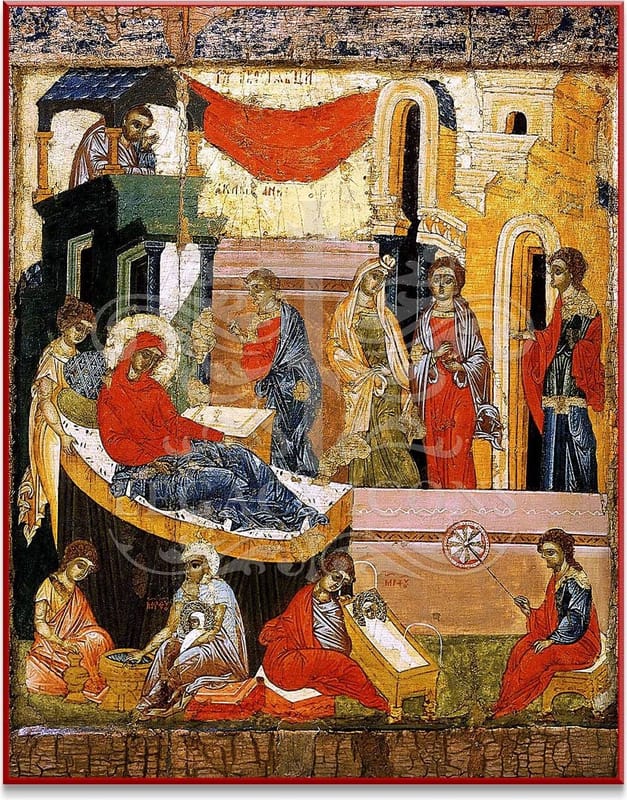
The birth of the Virgin Mary to the aged and childless Joachim and Anna, who conceived her after long prayer. It opens the Church year (which begins Sep 1) with the coming into the world of the one who would bear Christ.
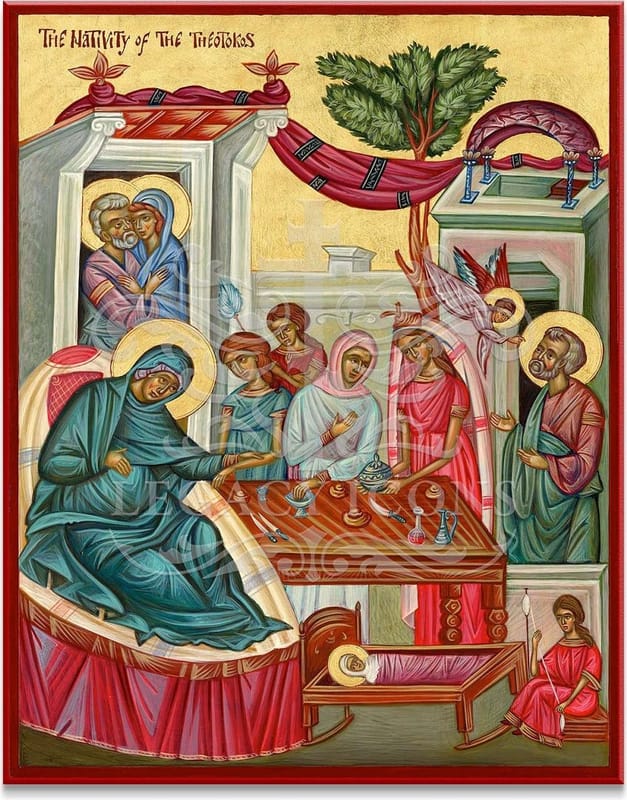
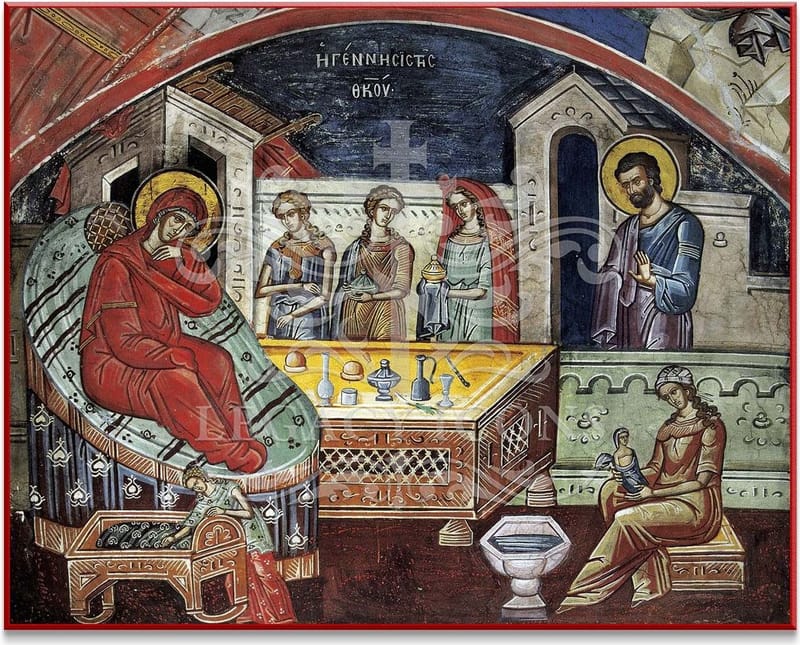
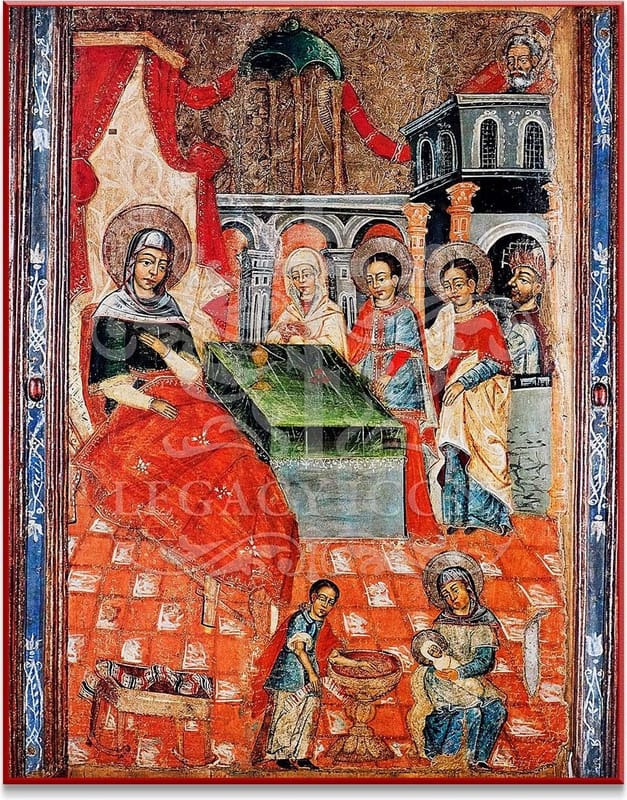
Depictions & Icons
How the Church has written this feast — festal icons across the centuries.
Overview
The Nativity of the Theotokos commemorates the birth of the Virgin Mary to her aged and previously childless parents, the Righteous Joachim and Anna, who conceived her in answer to long prayer. It is celebrated on September 8 and is counted among the Twelve Great Feasts of the liturgical year.
Because the Orthodox Church year opens on September 1, the Nativity of the Theotokos stands as the first of the Great Feasts in the fixed calendar cycle. Its placement is understood to be fitting: the year of salvation history begins with the coming into the world of the one who would bear Christ.
The feast is served with a forefeast on September 7 and concludes with its apodosis (leave-taking) on September 12. Its scriptural and hymnographic tradition presents Mary's birth not merely as a family event but as the dawn of humanity's redemption.
Timeline
c. 150 AD — Protoevangelium of James
The earliest known account of Mary's birth and of her parents Joachim and Anna appears in the apocryphal Gospel of James.
431 — Council of Ephesus
Following the council, veneration of the Mother of God intensified, providing the setting in which the feast arose.
early 6th century — Origin in Syria or Palestine
The feast likely originated in this period; the first liturgical commemoration is tied to the sixth-century dedication of the Church of Saint Anne in Jerusalem.
mid-6th century — Georgian Chantbook of Jerusalem
Sixth-century hymns and this compiled chantbook provide early evidence for the feast.
7th century — Byzantine observance
The Byzantine churches formally kept the day as the Feast of the Birth of the Blessed Virgin Mary; the feast reached Rome toward the end of the century through Eastern monks.
1243 — Roman octave
Pope Innocent IV established an octave for the feast in the Western Church.
History
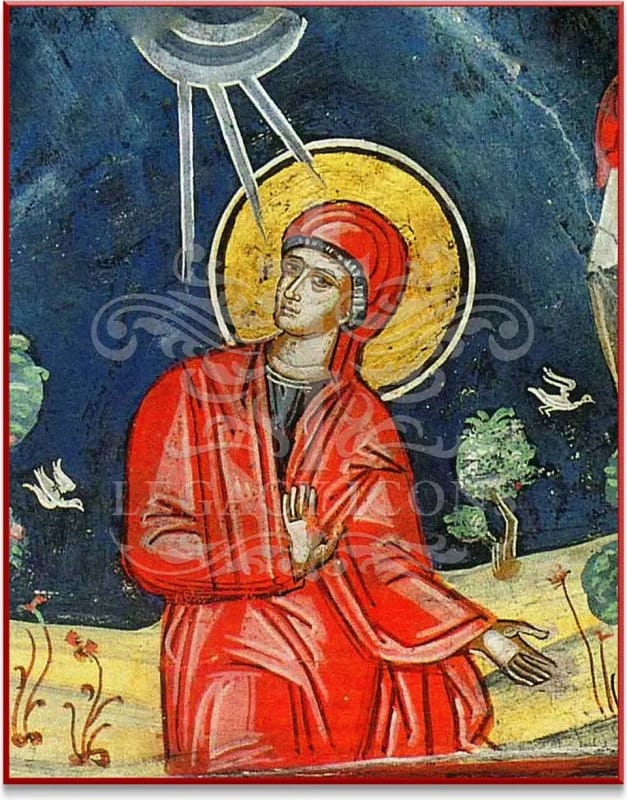
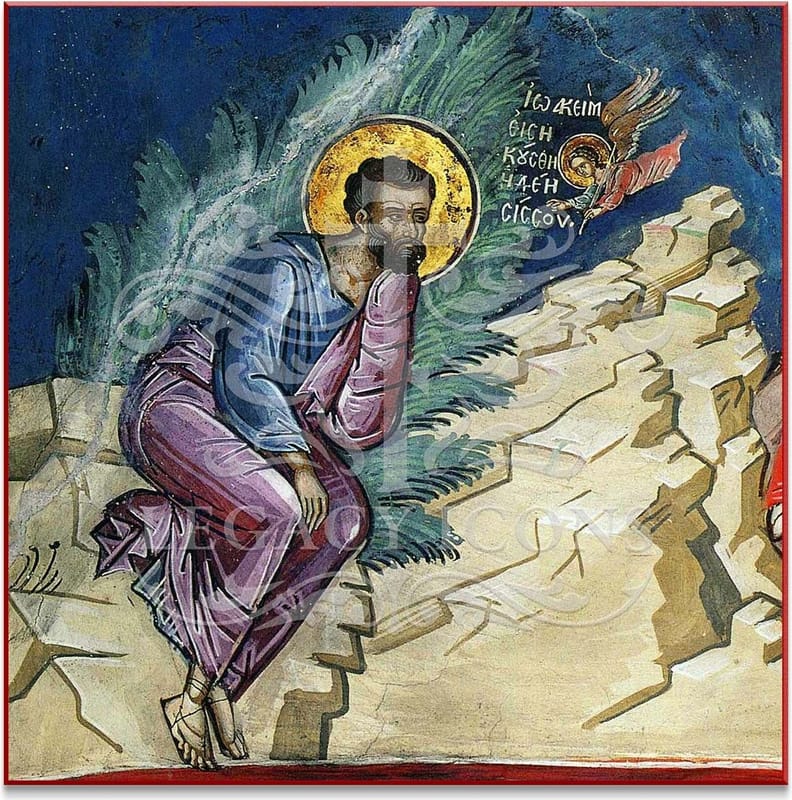
The earliest known account of Mary's birth is preserved in the Gospel of James, also called the Protoevangelium of James, an apocryphal text dated to around 150 AD. There her parents are named Joachim and Anna. Joachim is described as a wealthy member of one of the Twelve Tribes of Israel who, together with Anna, was deeply grieved by their childlessness; tradition holds that each was informed separately by an archangel of Anna's coming pregnancy.
The feast itself likely originated in Syria or Palestine at the beginning of the sixth century, in the period following the Council of Ephesus (431), when veneration of the Mother of God intensified. Evidence for it appears in sixth-century hymns and in the Georgian Chantbook of Jerusalem, compiled in the mid-sixth century. The first liturgical commemoration is connected with the sixth-century dedication of the Basilica Sanctae Mariae ubi nata est — now the Church of Saint Anne in Jerusalem — which stood at the site known as the Shepherd's Pool, thought to have been the home of Mary's parents.
By the seventh century the Byzantine churches were formally keeping the day as the Feast of the Birth of the Blessed Virgin Mary. At Rome the feast began to be observed toward the end of the seventh century, brought there by Eastern monks; Pope Innocent IV established an octave for it in 1243. Across both Eastern and Western traditions the feast is celebrated on September 8.
The theological and liturgical elaboration of the feast owes much to its early hymnographic tradition, associated especially with Saint Andrew of Crete and Saint John of Damascus. A wider body of patristic homilies and encomia developed around the day, attributed to Saint John of Damascus, Saint Andrew of Crete, Saint Photios the Great, Saint Nicholas Cabasilas, Saint Gregory Palamas, and Saint John of Kronstadt.
Meaning
The Church understands the birth of Mary as the beginning of the age of salvation. The OCA synaxarion situates her arrival at a time when human moral decay seemed to make restoration altogether impossible; her coming into the world is understood as the dawn of redemption, since she would become the vessel through whom God would take flesh.
The liturgical texts present the feast as a cosmic salvific event. The Troparion (Tone 4) proclaims universal joy and names Christ the Sun of Righteousness rising through Mary, celebrating the reversal of the ancestral curse and of death through her role as Theotokos. The Kontakion (Tone 4) celebrates the resolution of Joachim and Anna's barrenness and announces liberation from death's corruption and freedom from the guilt of sin, declaring that the barren woman gives birth to the Theotokos. Recurring themes are the reversal of human fallenness — Adam and Eve, barrenness, death — Mary's instrumental role in redemption as the God-bearer, and joy and restoration as spiritual outcomes.
Orthodox theology maintains a distinction from the Roman Catholic doctrine of the Immaculate Conception, which it explicitly rejects. Instead, it holds that Mary received ancestral sin through normal human conception and required salvation like all humanity, while there is general Orthodox consensus that she was cleansed from sin at the Annunciation. This understanding is captured in the verse from the tradition: 'Anna, all mothers truly you surpassed, until your daughter should become your Mother' — Anna's motherhood of Mary is itself surpassed by Mary's divine maternity as Mother of God incarnate.
Hymnography
The feast's principal hymns are the Troparion and Kontakion, both in Tone 4. The Troparion proclaims universal joy and names Christ the Sun of Righteousness rising through Mary, celebrating the reversal of the curse and of death through her role as Theotokos. The Kontakion celebrates the ending of Joachim and Anna's barrenness and announces liberation from the corruption of death and freedom from the guilt of sin. The early hymnographic tradition, associated especially with Saint Andrew of Crete and Saint John of Damascus, contributed greatly to the feast's theological and liturgical elaboration.
Customs & Traditions
Numerous shrine icons across Greece are celebrated on September 8, including Panagia Tsambika on Rhodes and icons on Samos, Chios, and Tinos, many associated with healing and with answered prayers for childless couples — a devotional pattern mirroring the narrative of Joachim and Anna.
Several Theotokos icons are venerated on this day, among them the Kursk Root Icon ('Of the Sign'), one of the most ancient icons of the Russian Church; the Pochaev Icon, connected with a monastic vision of 1340; and the Kholm Icon, traditionally attributed to the Evangelist Luke.
Ideas for Celebrating This Feast
Ways to celebrate the birth of the Theotokos, the first Great Feast of the Church year.
- Bake a "birthday cake" for the Theotokos and let the children help decorate it to celebrate Mary's birth.
- Make blueberry treats — muffins, pancakes, or a cobbler — nodding to the blue traditionally associated with the Mother of God.
- Place fresh flowers in the icon corner and, with little ones, gently "shower" flowers before an icon of the infant Theotokos.
- Refill the bird feeders and go birdwatching together, recalling the garden of Ss Joachim and Anna as they longed for a child.
- Serve a meal with grapes and freshly harvested produce, tying the feast to the early-autumn harvest.
- Do an act of almsgiving as a family to honor the day.
- Read The Story of Mary the Mother of God aloud and sing the troparion of the feast.
Ideas gathered and adapted from Orthodox family resources — Charlotte Riggle. These are optional, inviting ideas, not liturgical requirements.
Scripture
- Genesis 28:10–17 — Vespers reading; Jacob's Ladder, understood as the divine-human union realized through Mary.
- Ezekiel 43:27–44:4 — Vespers reading; the Temple vision with the sealed eastern door, read as a figure of Mary's perpetual virginity.
- Proverbs 9:1–11 — Vespers reading; Mary as the house of Divine Wisdom.
- Luke 1:39–49, 56 — Matins Gospel; the Magnificat.
- Philippians 2:5–11 — Epistle at the Divine Liturgy.
- Luke 10:38–42; 11:27–28 — Gospel at the Divine Liturgy.