
Dormition of the Theotokos
Also known as: Dormition of the Mother of God, Falling-Asleep of the Virgin Mary, Assumption
Aug 15· Fixed date
The falling-asleep (repose) of the Virgin Mary and, by the Church's tradition, the taking up of her body to her Son. It is the last of the Twelve Great Feasts in the Church year.
Depictions & Icons
How the Church has written this feast — festal icons across the centuries.
Overview
The Dormition of the Theotokos commemorates the falling-asleep — the repose in death — of the Virgin Mary and, by the tradition of the Church, the taking up of her body to her Son. Its Greek name, Koimisis, means "a falling asleep," the same root from which the word cemetery derives, and it frames Mary's death not as an end but as a sleep from which she was raised. It is the last of the Twelve Great Feasts of the Church year, kept on August 15.
The feast is preceded by a one-day Forefeast on August 14 and followed by an Afterfeast that extends to its Apodosis (leave-taking) on August 23. It concludes the two-week Dormition Fast, kept from August 1 through 14, and on the feast day itself fish is permitted. In some traditions the feast is called the "Summer Pascha," because it proclaims resurrection and joy rather than mourning.
The Church teaches that Mary died a natural death like all humanity; that her soul was received by Christ; and that her body was raised on the third day and taken into the heavenly kingdom. Because the canonical Scriptures do not record her death or Dormition, the feast rests wholly on the Church's Sacred Tradition.
Timeline
c. 330 — Earliest known depiction
The earliest known artistic depiction of the Dormition appears on a sarcophagus in the crypt of a church in Zaragoza, Spain.
before 500 — Palestinian observance
The feast is celebrated in Palestine, likely in August, initially on August 13 at a kathisma outside the walls of Jerusalem before the date shifts to August 15.
451 — Testimony at Chalcedon
According to tradition preserved by St. John of Damascus, St. Juvenal of Jerusalem reports at the Council of Chalcedon that Mary's tomb was found empty when opened at Thomas's request.
582–602 — Emperor Maurice standardizes the date
Emperor Maurice issues an edict fixing the Eastern celebration on August 15, connected to Mary's tomb at Gethsemane.
7th century — The Dormition Fast established
The two-week fast preceding the feast is established, at first in two periods, later merged into a unified fourteen-day observance beginning August 1.
687–701 — Feast established in Rome
Pope Sergius I establishes the feast in Rome, borrowed from Constantinople; in the eighth century its Roman title changes from Dormitio to Assumptio.
History
The belief in Mary's repose and bodily assumption developed gradually, transmitted first through apocryphal and later through genuine patristic writings. Christian canonical Scripture records neither her death nor her Dormition, and the earliest formal narratives emerged only over several centuries. The earliest known artistic depiction of the Dormition appears on a sarcophagus in the crypt of a church in Zaragoza, Spain, dated around 330, though the feast was not widely celebrated as a holy day before the fourth or fifth century.
Tradition preserved by St. John of Damascus records testimony attributed to St. Juvenal, Bishop of Jerusalem, who at the Council of Chalcedon in 451 reported that Mary died in the presence of the Apostles, and that when her tomb was opened at the request of St. Thomas it was found empty — from which the Apostles concluded that her body had been taken up to heaven. Genuine Eastern sources, including sermons by St. John of Damascus and St. Andrew of Crete, affirmed the tradition, while in the West St. Gregory of Tours was among the first to mention it. More formal narratives also emerged from authors such as Jacob of Serug and Theodosius of Alexandria.
The feast's date and observance varied by region before being standardized. In Palestine it was celebrated before the year 500, likely in August, and was initially kept on August 13 at a kathisma outside the walls of Jerusalem before the date shifted to August 15. Egypt and Arabia observed it in January, a practice later adopted by Gallic monks who placed the Gallican observance on January 18. Emperor Maurice (582–602) issued an edict standardizing the Eastern celebration on August 15, connecting it to Mary's tomb in the Church of the Panagia at Gethsemane.
In the West, Rome's oldest Marian feast was January 1; the Assumption was later established in Rome by Pope Sergius I (687–701), borrowed from Constantinople. In the Roman calendar the feast was added in the seventh century as the Dormitio, and in the eighth century its title was changed to the Assumptio. The two-week Dormition Fast that precedes the feast was itself established in the seventh century: originally divided into two periods, it merged into a unified fourteen-day observance beginning August 1.
Meaning
The Orthodox Church understands the Dormition in two distinct but joined movements: the Dormition itself, a real death — the separation of soul and body — followed by the translation of the Theotokos, described as a resurrection, the reunion of her soul and body, and her ascension near her Son. The feast therefore commemorates not only Mary's death but her resurrection and glorification, proclaiming that she was assumed by God into the heavenly kingdom of Christ in the fullness of her spiritual and bodily existence.
The Church holds that Mary died as all humanity dies, falling asleep in the way the feast's name indicates. Though she is understood to be without personal sins, she truly needed to be saved by Christ, as every human person is saved from the trials, sufferings, and death of this world; she truly died and was raised up by her Son as the Mother of Life. In this the Theotokos is understood to have already undergone the bodily resurrection and to stand in heaven in that glorified state ahead of the final judgment.
For this reason the Church interprets the empty tomb — discovered when the Apostles opened it at Thomas's request — as a firstfruits of the resurrection of all the faithful that will occur at the Second Coming of Christ. What is promised to the whole Church at the end is shown already fulfilled in the Mother of God, so that the feast reads as a pledge and image of the hope held out to every believer.
Iconography
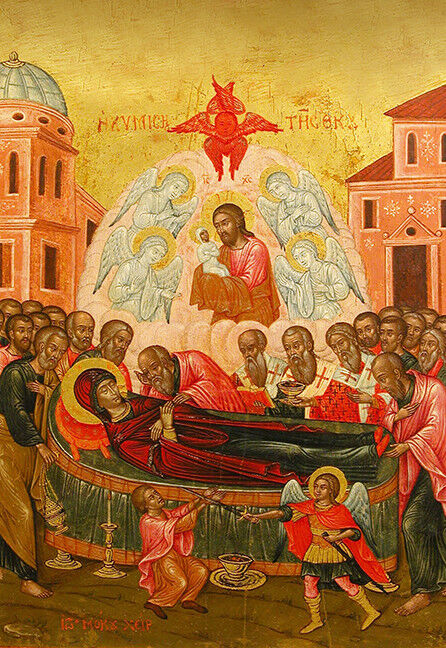
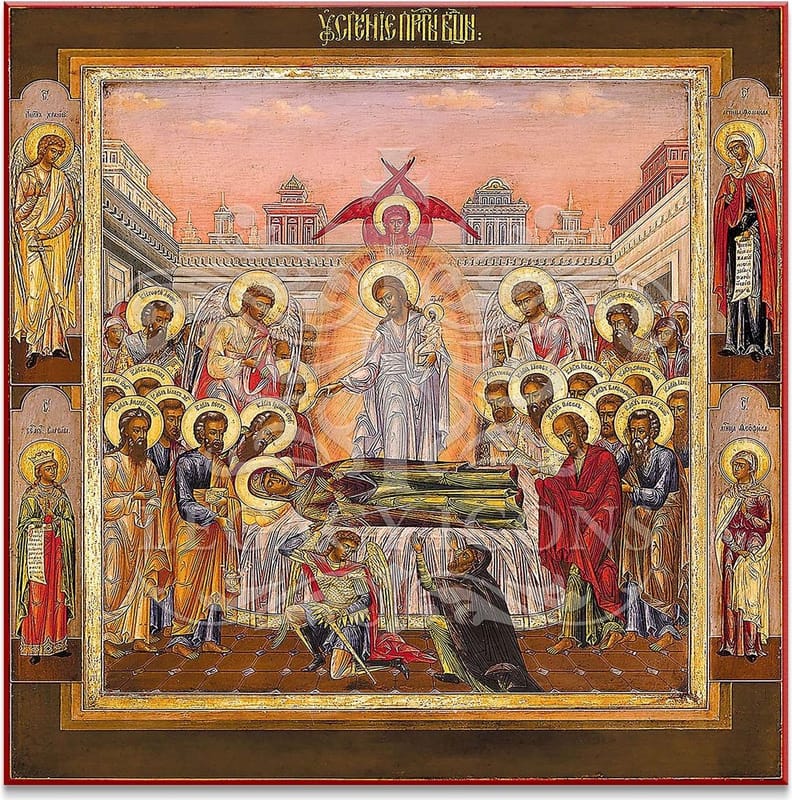
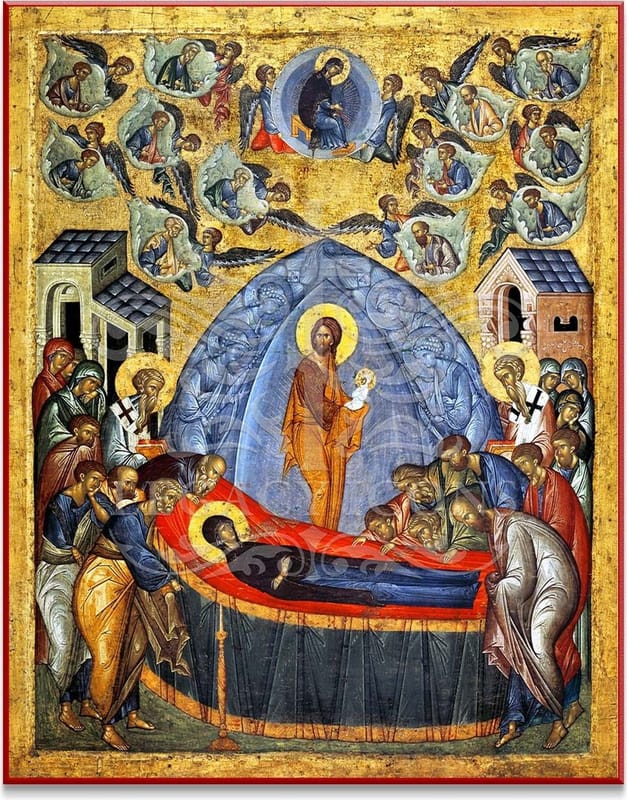
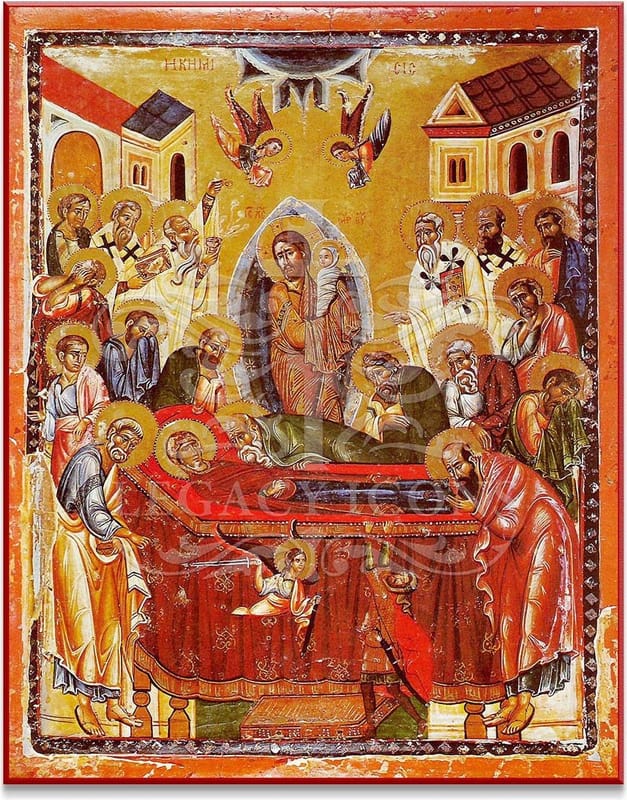
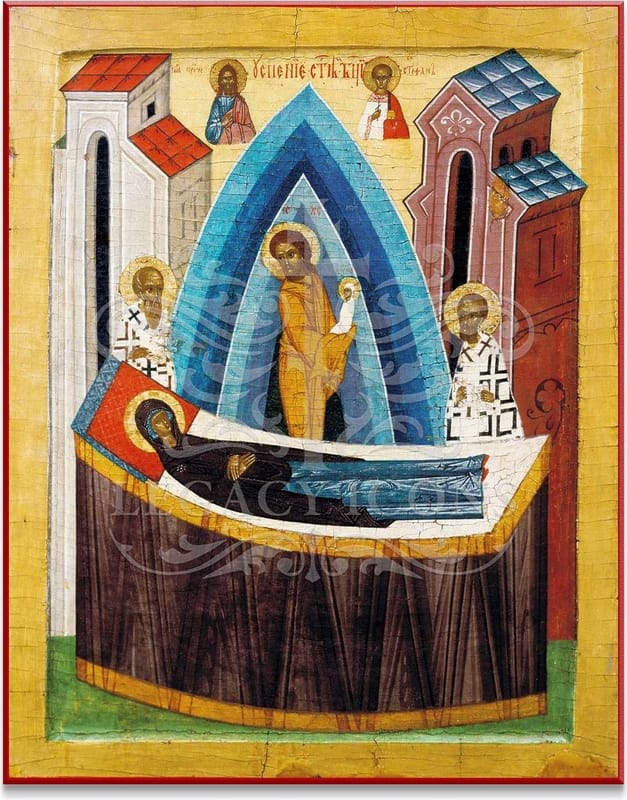
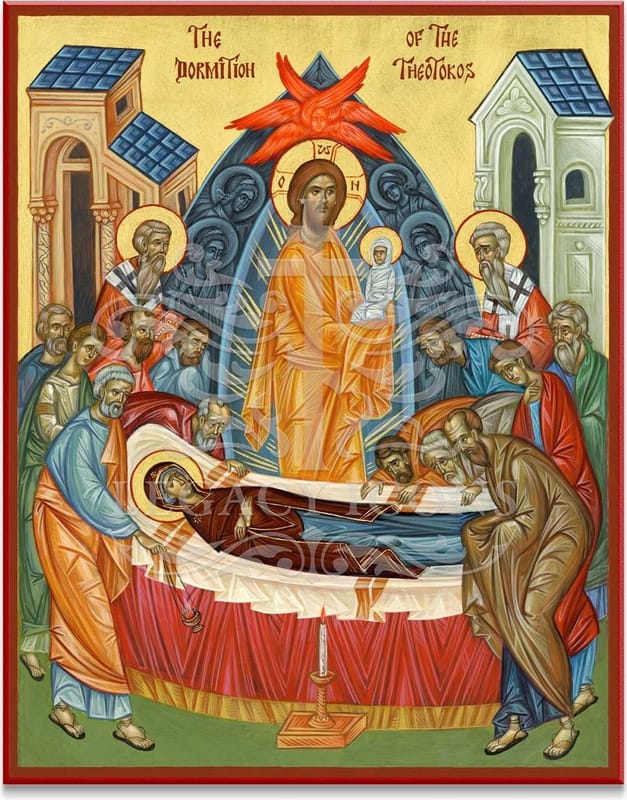
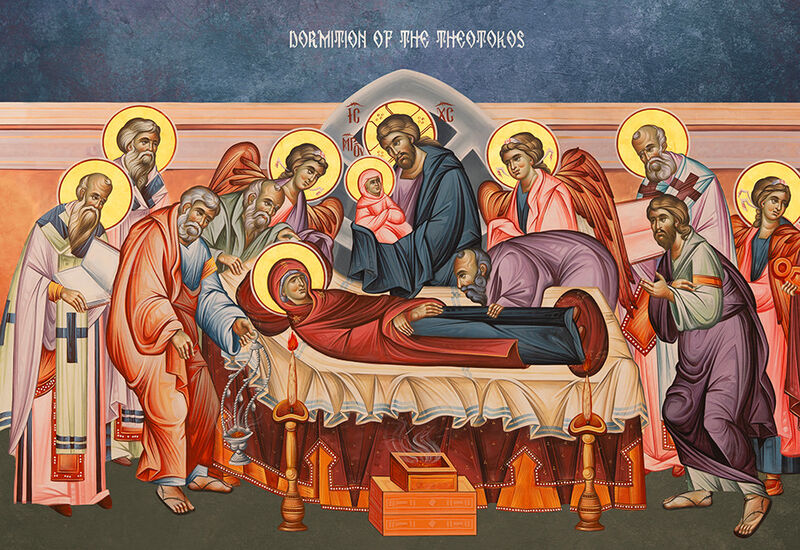
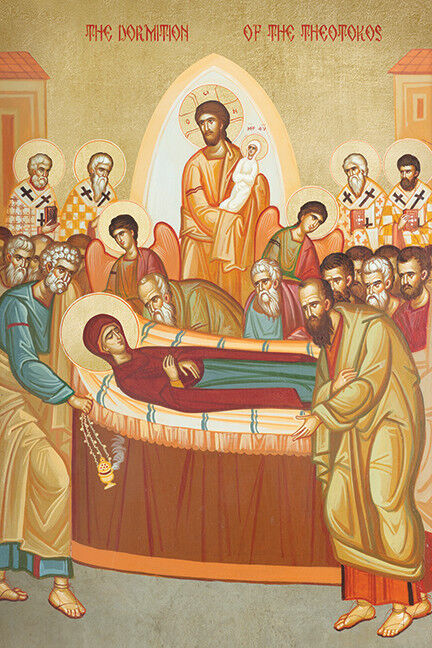
The traditional festal icon shows the body of the Theotokos lying in repose on a bed or bier, surrounded by the Apostles who were gathered to her passing. Behind the bier stands Christ, holding a small figure wrapped in a winding cloth that represents her soul, which he receives at her death. The composition inverts the natural order of mother and child: as she once held the infant Christ, so now he holds her soul in his arms.
Christ is set within a mandorla, the radiance of divine glory, and the surrounding sky may include angels, saints, and prophets attending the scene. The icon thus depicts at once her real death and her passage into the glory of her Son, holding both movements of the feast — the falling-asleep and the translation — in a single image.
Hymnography
The services of the feast draw on the tradition of Mary's passing: the Archangel Gabriel announcing her repose three days beforehand, the miraculous gathering of the Apostles from throughout the world, the late arrival of Thomas, and the discovery of the empty tomb. Frescoes at church entrances depict these sacred funeral compositions, and hymns and patristic eulogies are central to the memorial character of the celebration.
During the two weeks of the Dormition Fast, the Church chants the Paraklesis — the supplicatory canon to the Most Holy Theotokos — on weekday evenings, with the Great Paraklesis and the Small Paraklesis sung on alternating days. These canons prepare the faithful through the fast for the feast itself.
Fasting in Practice
The feast concludes the Dormition Fast, a two-week period kept from August 1 through 14. The fast was established in the seventh century; originally divided into two periods, it was merged into a single fourteen-day observance. The Church's practice during the fast is to abstain from oil except on Saturdays and Sundays, with fish permitted on the feast of the Transfiguration (August 6) that falls within it. On the feast of the Dormition itself, fish is permitted. Typikon prescriptions vary by tradition; the faithful should consult their priest.
Customs & Traditions
The two-week Dormition Fast is kept before the feast, with the Great and Small Paraklesis canons sung to the Theotokos on weekday evenings.
The blessing of flowers and fragrant herbs on the feast.
In some places a Rite of the Burial of the Theotokos is celebrated during the All-Night Vigil, modeled on Christ's burial service, in which an embroidered cloth icon (Epitaphios) of the Theotokos is carried in procession with special hymns — a practice that originated in Jerusalem and spread particularly through Russian Orthodox tradition.
On several Aegean islands, including Tinos, Paros, and Patmos, decorated epitaphioi of the Theotokos are carried in procession.
In Greece the feast is called the "Summer Pascha," kept as a celebration of resurrection and joy; on Tinos, August 15 also commemorates the victims of the torpedoing of the Greek cruiser Elli in 1940.
Ideas for Celebrating This Feast
Ways families keep the Dormition Fast and honor the falling-asleep of the Theotokos.
- Keep the two-week fast (Aug 1–14) simply with plant-based meals — beans, grains, vegetables — with wine and oil on weekends.
- Pray a short Paraklesis (supplication) to the Theotokos at home in the evenings, or attend the Paraklesis services during the fast.
- Make a Dormition countdown where children add a paper flower each day, finishing with the Dormition icon on the feast.
- Bring flowers or fragrant herbs to be blessed (customs vary by parish) and fill the icon corner with flowers in the Theotokos's honor.
- Turn the fast into daily almsgiving — add a food or household item to a box each day to donate to a shelter by the feast.
- Bake edible-flower shortbread or festal treats and share a small "Dormition tea" to mark the end of the fast.
- Read a children's book on the life of the Theotokos and sing the troparion of the Dormition.
Ideas gathered and adapted from Orthodox family resources — Ascetic Life of Motherhood. These are optional, inviting ideas, not liturgical requirements.
Scripture
- Genesis 28:10–17 — Read at Vespers; Jacob's Ladder, understood typologically as the union of God with humankind realized most fully in Mary.
- Ezekiel 43:27–44:4 — Read at Vespers; the temple vision, understood as a symbol of Mary.
- Proverbs 9:1–11 — Read at Vespers; identifies Mary with the house that Divine Wisdom built for herself.
- Luke 1:39–49, 56 — Gospel of the morning service, including the Magnificat.
- Philippians 2:5–11 — Epistle at the Divine Liturgy.
- Luke 10:38–42; 11:27–28 — Combined Gospel reading at the Divine Liturgy.
Related commemorations
The Church remembers the Dormition of the Righteous Anna, the mother of the Theotokos, on July 25.
Fasting is described here at the season-summary level and differs by jurisdiction and person — please consult your parish priest about how to keep the fasts.