
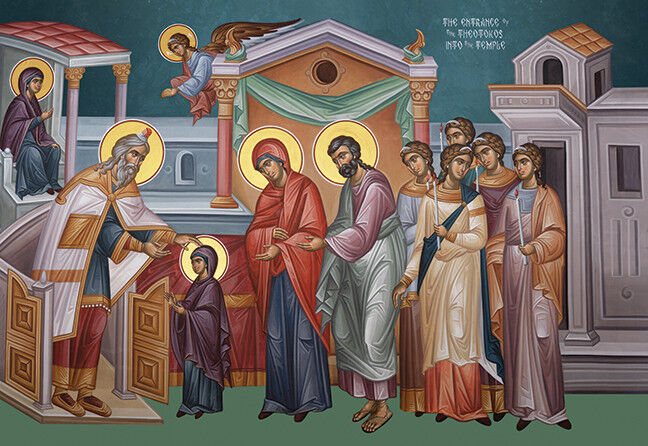
Entry of the Theotokos into the Temple
Also known as: Presentation of the Virgin Mary in the Temple, Entrance of the Mother of God
Nov 21· Fixed date
The presentation of the child Mary in the Temple at Jerusalem by her parents Joachim and Anna, where by tradition she was received by the priest Zechariah and dwelt in preparation for her role as the living temple of God.
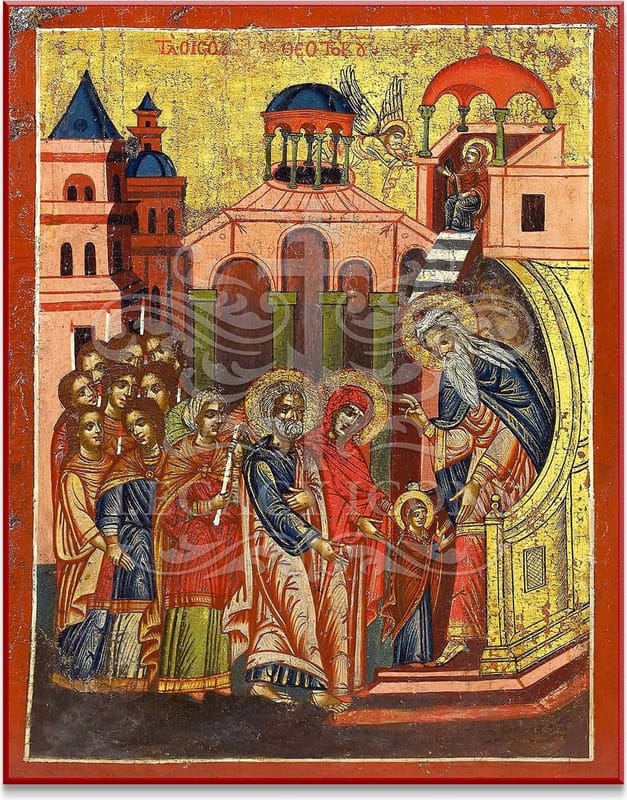
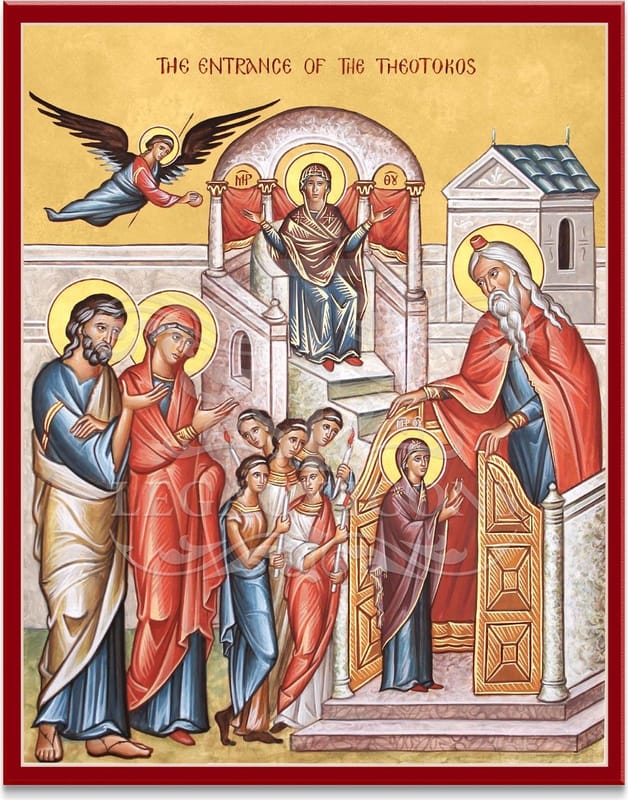
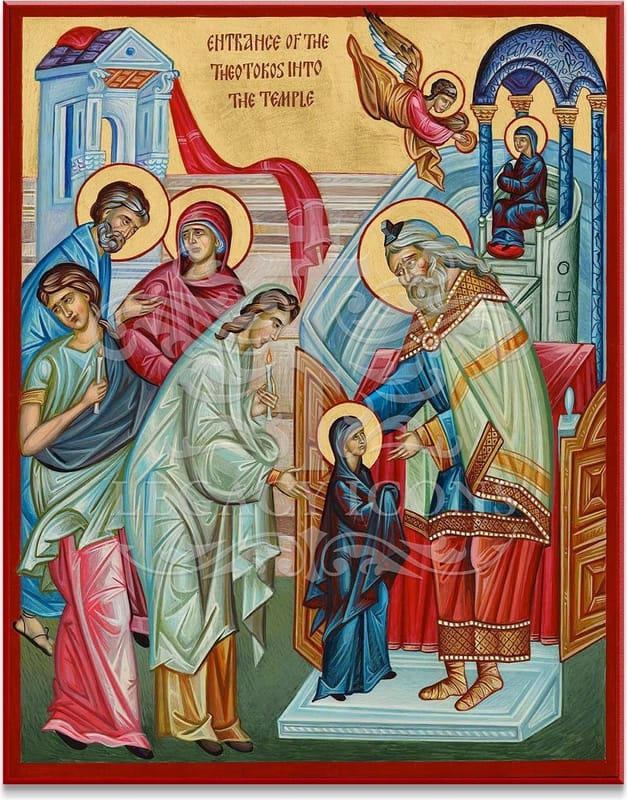
Depictions & Icons
How the Church has written this feast — festal icons across the centuries.
Overview
The Entry of the Theotokos into the Temple is one of the Great Feasts of the Orthodox liturgical year, celebrated on November 21. It commemorates the presentation of the child Mary in the Temple at Jerusalem by her parents, the Righteous Joachim and Anna, who by tradition had vowed to dedicate their long-awaited daughter to the service of God. According to the account, Mary was received at the Temple by the priest Zechariah and dwelt there in preparation for her role as the living temple of God.
The feast is dedicated to the Theotokos and falls within the Nativity Fast. It is preceded by a forefeast on November 20 and concludes with its apodosis (leave-taking) on November 25. In many places it opens the singing of the Nativity katavasiae ("Christ is born"), directing the faithful toward the coming Nativity feast.
The narrative underlying the feast is drawn chiefly from the Protoevangelion of James, a non-canonical text dated before 200 AD. The Church understands the event as a threshold in the history of salvation: the young Mary entering the sanctuary as the one who will herself become the dwelling place of the Divine child to be born of her.
Timeline
before 200 AD — Protoevangelion of James
The earliest documented source for the account of Mary's presentation, dating the narrative underlying the feast.
543 — New Church of the Theotokos built
Emperor Justinian I constructs the New Church of the Theotokos (the Nea Church) near the ruined Temple site in Jerusalem, an origin point of the observance.
614 — Church destroyed
The New Church is destroyed by the Sasanian Persians under Khosrow II following the Siege of Jerusalem.
715-730 — Homilies of Germanos I
Germanos I, Patriarch of Constantinople, authors two homilies for the feast, an early mark of liturgical recognition.
730 — First celebration in Constantinople
According to Theodore Balsamon in the twelfth century, the Entrance is celebrated for the first time in Constantinople.
c. 806 — Established as an official feast
Patriarch Tarasios introduces the Entrance as an official feast, possibly following the end of the first wave of Iconoclasm.
9th century — Hymns of George of Nicomedia
George of Nicomedia composes three sermons and hymns for the feast; a codex at Saint Andrew's Skete on Mount Athos gives the first clear designation of November 21.
11th century — Menologion of Basil II
The feast receives formal calendar designation as the Entry of the All-Holy Theotokos, the earliest documented calendar mention.
1372 — Introduced in the West
The feast is introduced to the Papal Chapel in Avignon, where it is known as the Presentation of the Virgin Mary.
History
The narrative of the feast derives from the Protoevangelion of James, an apocryphal text dated before 200 AD. According to this account, Mary's parents Joachim and Anna, having vowed to dedicate their child to God if their childlessness ended, brought their daughter to the Temple at the age of three in thanksgiving for the gift of their daughter. The account relates that Mary remained in the Temple until her twelfth year, when Joseph became her guardian.
As a liturgical observance, the feast was not among the most ancient of the Christian year. Fourth-century Palestinian traditions mention that Empress Helen built a church honoring the event, though no concrete evidence supports the claim. Church Fathers including Gregory of Nyssa, Jerome, and John of Damascus mention the Entrance, but it is not attested as a festival of the Church until the eighth or ninth century. Gregory of Nyssa in the fourth century is cited as mentioning the feast.
The observance is closely tied to the dedication of the New Church of the Theotokos (the Nea Church, or Basilica of Saint Mary the New) constructed in 543 by the Byzantine Emperor Justinian I near the ruined Temple site in Jerusalem. That structure was destroyed by the Sasanian Persians under Khosrow II following the Siege of Jerusalem in 614.
The feast became formally established in Constantinople during the eighth century. Germanos I, Patriarch of Constantinople (715–730), authored two homilies for the feast, an early mark of liturgical recognition; according to Theodore Balsamon in the twelfth century, the Entrance was celebrated for the first time in Constantinople in 730. Patriarch Tarasios introduced it as an official feast around 806, possibly following the end of the first wave of Iconoclasm, and, with Germanus, delivered sermons on the feast in the eighth century. In the ninth century, George of Nicomedia composed three sermons and hymns for it.
From Constantinople the feast spread more widely. By the ninth century it was celebrated in Southern Italian monasteries. It received formal calendar designation in the eleventh-century Menologion of Basil II under the title "Εἴσοδος τῆς Παναγίας Θεοτόκου" (Entry of the All-Holy Theotokos), the earliest documented calendar mention. The date of November 21 was fixed in the East: a ninth-century codex at Saint Andrew's Skete on Mount Athos provides the first clear designation of November 21, while Palestinian calendars mention the date only from the tenth century. In the West the feast developed differently and along a later course, being introduced to the Papal Chapel in Avignon in 1372, where it is also known as the Presentation of the Virgin Mary.
Meaning
The feast celebrates Mary's presentation at the Temple as God's blessing for the human race, the preaching of salvation, and the promise of the coming of Christ. In dedicating their daughter to God, Joachim and Anna offered her as a first-fruit to the One who had granted her to them, and the Church honors in her the multidimensional purity of the Theotokos and her significance as a model for Christian life.
The central theological content of the feast is the transformation the Church perceives in Mary's entry: she who is presented at the Temple becomes herself the living sanctuary and temple of the Divine child who was to be born in her. In this the feast is read as marking the end of the physical temple in Jerusalem as the dwelling place of God, signifying a transition in sacred worship from a place to a person.
Orthodox tradition surrounds the event with signs of divine election. The Temple is remembered as having fifteen high steps leading to the sanctuary, accessible only to priests, which the three-year-old Mary is said to have ascended independently and swiftly by divine strength; the High Priest, inspired from above, then led her into the Holy of Holies, a space ordinarily entered only once a year by the High Priest alone. This unprecedented action is remembered as amazing all who witnessed it.
The feast also holds up Mary as an example of ascetic and contemplative life. After her parents' departure she is said to have remained among the consecrated virgins, growing up in a community of pious virgins, diligently reading Holy Scripture, occupying herself with handicrafts, and praying constantly. Homilies on the feast accordingly discuss her monasticism and her example of asceticism and contemplative prayer within the life of the Temple.
Iconography
The festal image depicts the young Mary at the Temple. Tradition surrounds her entry with a procession of virgins who escorted her with lighted candles in their hands while singing sacred songs, and with the fifteen high steps leading to the sanctuary that the three-year-old ascended by divine strength. At the summit the High Priest receives her and leads her into the Holy of Holies, the space entered ordinarily only once a year by the High Priest alone.
Hymnography
Hymnody for the feast was shaped by early Constantinopolitan authors. Germanos I, Patriarch of Constantinople, composed two homilies for the feast in the eighth century, and in the ninth century George of Nicomedia composed three sermons together with hymns for it, marking the feast's establishment in the liturgical services.
In many places the feast marks the point at which the Nativity katavasiae, beginning "Christ is born," are first sung, so that its hymnography begins to turn the services toward the approaching feast of the Nativity.
Fasting in Practice
The feast falls within the Nativity Fast. The Church's practice on this day is to lessen the fasting rules somewhat, so that fish, wine, and oil may be eaten in observance of the Great Feast.
Customs & Traditions
In many places the feast opens the singing of the Nativity katavasiae ("Christ is born"), pointing the faithful toward the coming Nativity fast and feast.
Ideas for Celebrating This Feast
Ways to keep the Entry of the Theotokos into the Temple with children.
- Read the story of young Mary brought to the Temple from a children's book such as The Story of Mary, the Mother of God.
- Learn the feast's troparion and unpack its words so children grasp Mary as the fulfillment of God's plan.
- Echo the maidens who escorted Mary with lamps: have children carry simple lanterns around the house while one holds a Theotokos icon and the family sings a hymn to her.
- Make a "temple of the Holy Spirit" craft — trace each child's outline, let them decorate it, and tuck a small paper icon of Christ inside, linking Mary's entry to our own bodies as temples.
- Add a standing Akathist to the Theotokos to family prayers — a fitting devotion near American Thanksgiving.
- Dress the icon corner with the Entrance icon, flowers, and candles, and gather there for the reading and hymn.
Ideas gathered and adapted from Orthodox family resources — Orthodox Motherhood. These are optional, inviting ideas, not liturgical requirements.
Scripture
- Exodus — Vespers Old Testament reading, on the divine glory filling the temple.
- 1 Kings — Vespers Old Testament reading, on the divine glory filling the temple.
- Ezekiel — Vespers Old Testament reading, on the divine glory filling the temple.
- Luke 1:39-49, 56 — Matins Gospel, including the Magnificat.
- Hebrews 9:1-7 — Divine Liturgy Epistle, on the tabernacle of the old covenant.
- Luke 10:38-42; 11:27-28 — Divine Liturgy Gospel, emphasizing those who hear the word of God and keep it.
Fasting is described here at the season-summary level and differs by jurisdiction and person — please consult your parish priest about how to keep the fasts.