
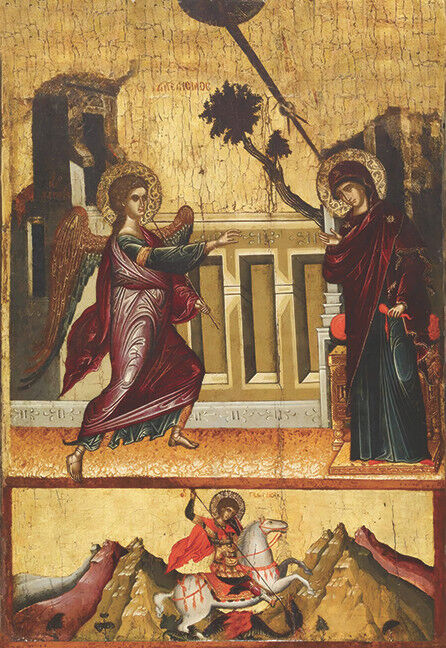
Annunciation of the Theotokos
Also known as: Annunciation of the Virgin Mary, Annunciation to the Mother of God
Mar 25· Fixed date
The archangel Gabriel's announcement to the Virgin Mary that she would conceive and bear the Son of God, and her free assent, "Be it unto me according to thy word." It falls nine months before the Nativity.
Depictions & Icons
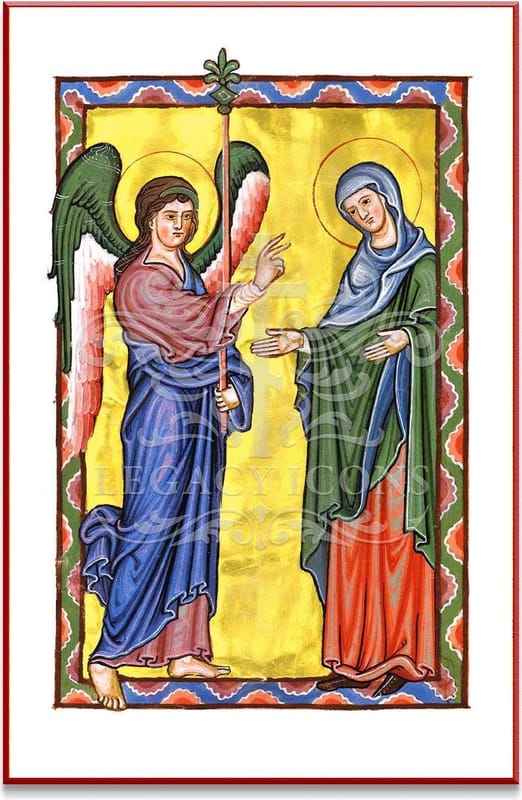
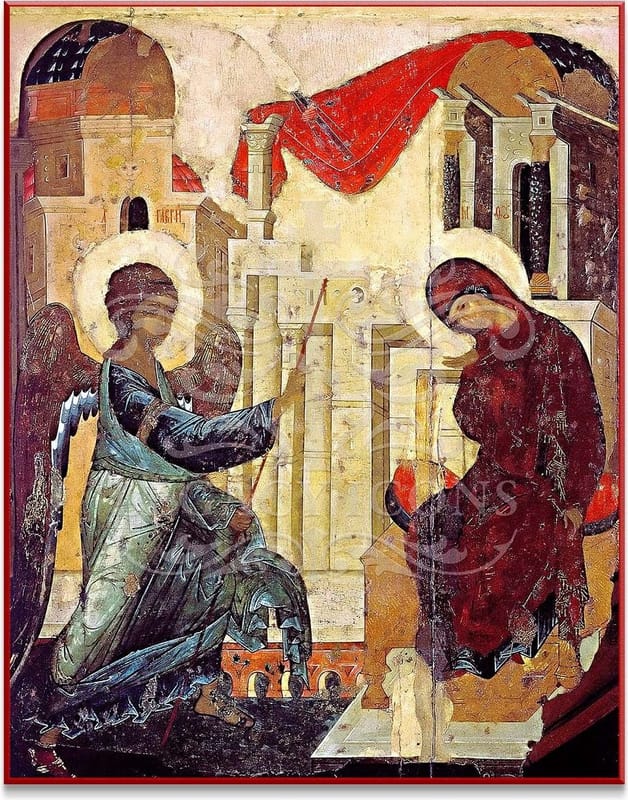
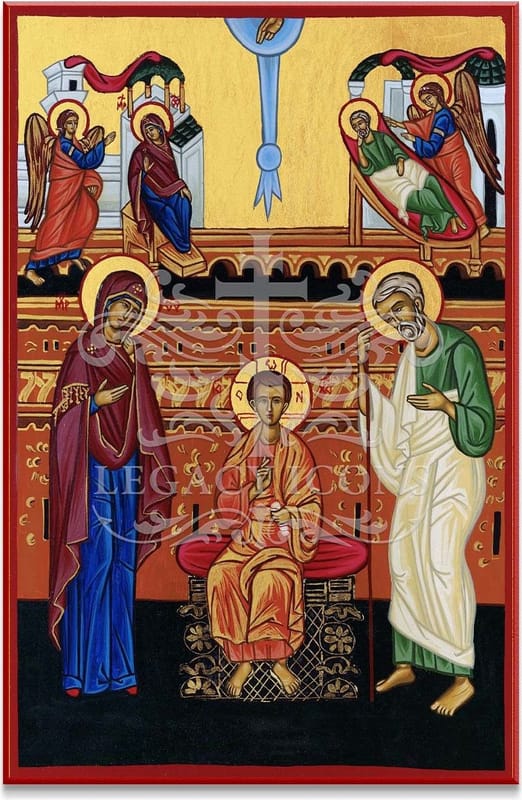
How the Church has written this feast — festal icons across the centuries.
Overview
The Annunciation of the Theotokos commemorates the archangel Gabriel's announcement to the Virgin Mary in Nazareth that she would conceive and bear the Son of God, and her free assent, "Behold the handmaid of the Lord; be it unto me according to thy word." The account is drawn from the Gospel of Luke (1:26–38), where Gabriel comes to Mary during the sixth month of Elizabeth's pregnancy with John the Forerunner. The Church understands Mary's consent as the moment initiating the Incarnation of Christ.
The feast is observed on March 25, a date set exactly nine months before the Nativity of the Lord (December 25). It stands among the Twelve Great Feasts of the Orthodox liturgical year and is counted among the feasts of the Lord as well as of the Theotokos. Its forefeast is kept on March 24 and its leavetaking (apodosis) on March 26, which is also the Synaxis of the Archangel Gabriel; because the feast falls within Great Lent, it has no ordinary afterfeast period.
Falling in Lent, the Annunciation is a festal interruption of the fast. The Divine Liturgy is served even on a Lenten weekday—uniquely permitted for this feast—and fish is allowed at the table in honor of the Incarnation, so that the joy of the feast is kept despite the season of preparation.
Timeline
c. 431 — Probable origin around the Council of Ephesus
Sources place the feast's origin shortly before or after the Council of Ephesus; it was not known at the Synod of Laodicea in 372, though St. Proclus of Constantinople (d. 446) may have referred to it.
d. 496 — First official Latin record
The feast appears in the Sacramentary of Pope Gelasius, and later in the Sacramentary attributed to St. Gregory (d. 604).
525 — March 25 set as the new year
Dionysius Exiguus, introducing the Anno Domini system, set the new year at March 25, holding that grace began with the Incarnation on that date.
656 — Tenth Synod of Toledo
A canon describes the Annunciation as already celebrated throughout the Church—among the earliest certain written records of the feast.
692 — Council in Trullo
While forbidding festivals during Lent, the council made an explicit exception for Sundays and for the Annunciation, fixing its place within the Lenten discipline.
History
The feast probably originated shortly before or after the Council of Ephesus (c. 431). It was not yet known at the Synod of Laodicea in 372, though St. Proclus of Constantinople (d. 446) may have referred to it in his homilies. In the Latin Church it first appears in official records in the Sacramentary of Pope Gelasius (d. 496) and later in the Sacramentary attributed to St. Gregory (d. 604). An early artistic witness survives in Rome: the Catacomb of Priscilla contains one of the oldest known depictions of the Annunciation, dated by sources variously to the second and to the fourth century.
By the seventh century the feast is spoken of as universally observed. The Tenth Synod of Toledo (656) describes it as already celebrated throughout the Church, and its canon is among the earliest certain written records of the feast. The Council in Trullo (the Quinisext Council of Constantinople, 692) forbade the celebration of festivals during Lent but made an explicit exception for Sundays and for the Annunciation—an exception that fixed the feast's distinctive place within the Lenten discipline.
The choice of March 25 was reinforced by patristic reckoning that joined the date to the whole economy of salvation. Church Fathers held that the coming of the Lord and His death should coincide with the creation and fall of Adam, and ancient sources assigned March 25 both to the creation of Adam and to the Crucifixion; this theological numerology underlay the patristic selection of the date. Later, when Dionysius Exiguus introduced the Anno Domini calendar system in 525, he set the beginning of the new year at March 25, holding that grace had begun with the Incarnation on that day.
The feast retained cosmic and civic significance in various lands. In Lebanon, March 25 remains an official national holiday, and in Greece the date coincides with the commemoration of Greek Independence. Across Orthodox cultures the universal feast acquired localized expressions and customs while keeping its fixed place on the calendar.
Meaning
The Annunciation is understood as the beginning of salvation and the revelation of the eternal mystery of God's plan for the redemption of humanity through the Incarnation. In the words the Church applies to the feast, it is "the beginning of our salvation, and the revelation of the eternal mystery." What is announced to Mary is that Christ is conceived of the Holy Spirit and of the Virgin, as confessed in the Nicene-Constantinopolitan Creed.
Central to the feast's theology is the free consent of the Virgin. Her willing acceptance is treated not as passive but as genuine cooperation in the work of salvation; St. Philaret of Moscow taught that "the word of the creature brought the Creator down into the world," underscoring Mary's active participation in salvation history. Through her assent she is called the workshop—or the very site—of salvation.
The Fathers read the event against the whole of Scripture. They interpret the reference to "her seed" in Genesis 3:15 as prophetically pointing to Christ, so that the Annunciation fulfills God's ancient promise for humanity's redemption. They also draw the parallel between Mary and Eve, exploring how the Virgin's obedient acceptance reverses the consequences of ancestral sin—the point at which divine purpose intersects with human consent.
Iconography
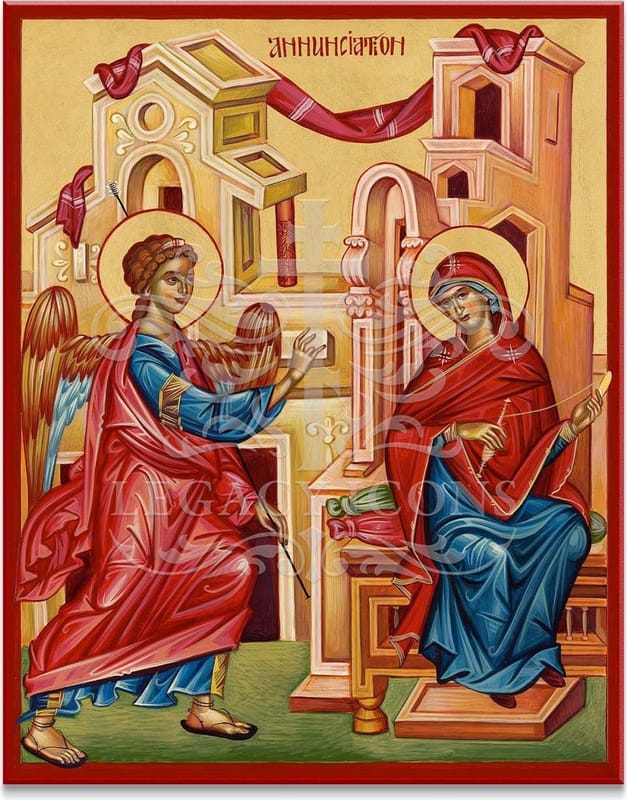
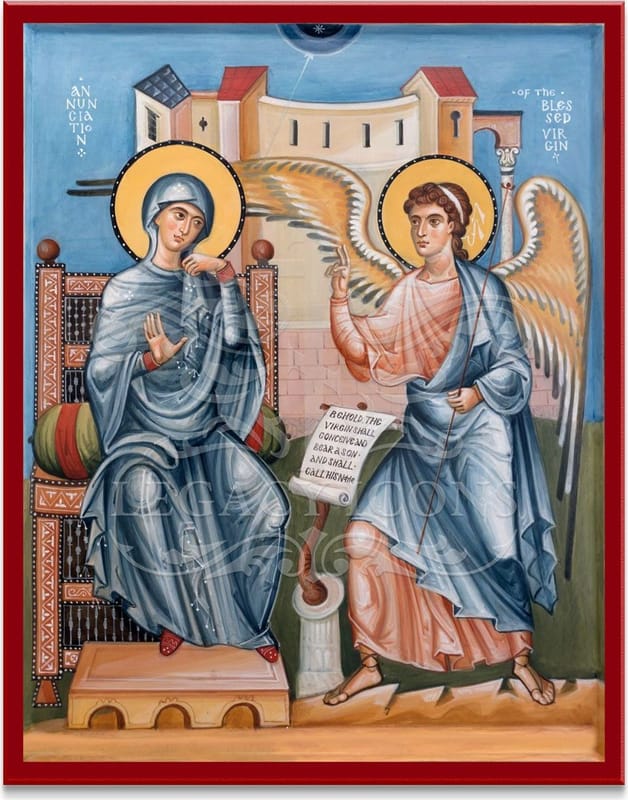
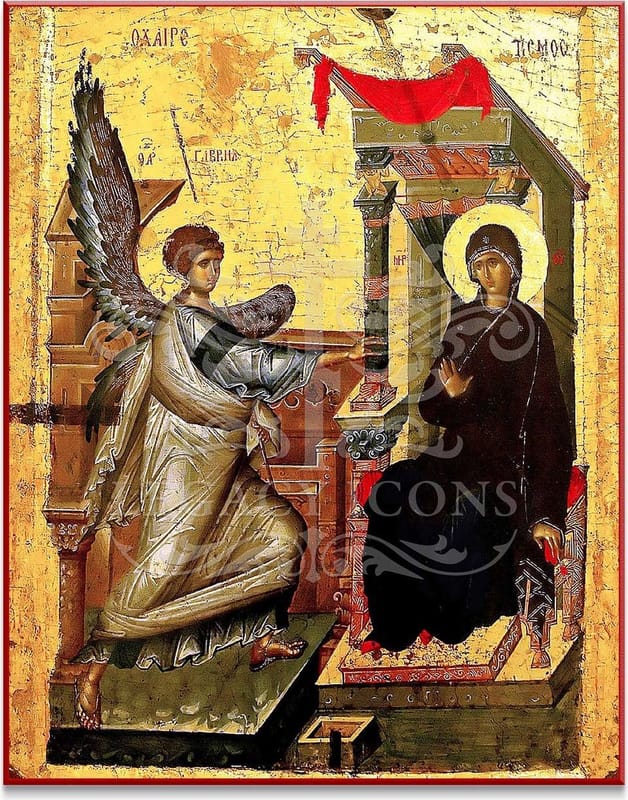
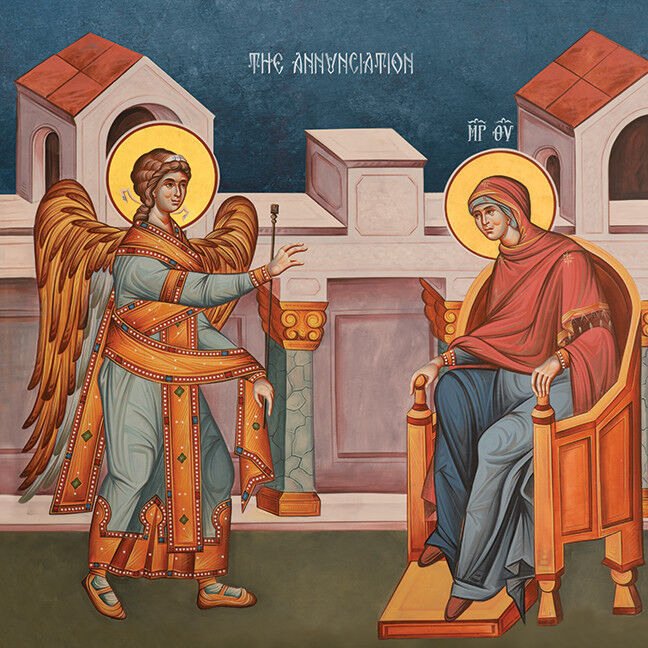
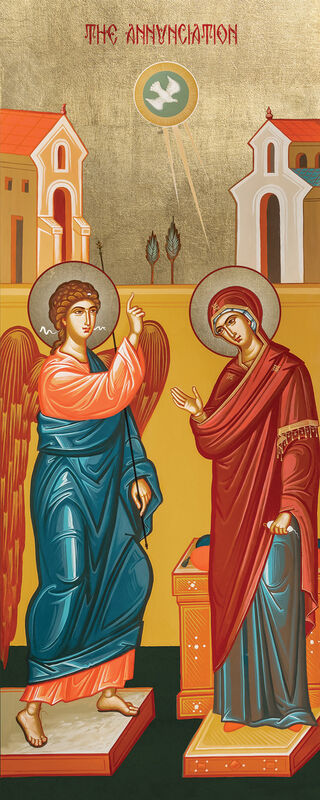
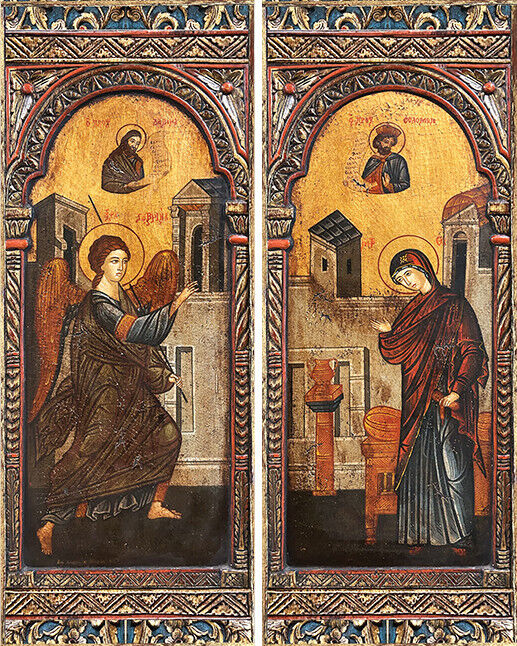
The festal icon depicts Gabriel announcing the glad tidings to Mary. The archangel is shown with a staff, signifying his role as messenger, while Mary is portrayed standing or seated—often holding yarn or a scroll—with her head bowed to indicate her consent. A ray of light descending from heaven symbolizes the work of the Holy Spirit; in some well-known icons this ray includes a white dove. Traditional depictions concentrate on the moment of the divine announcement and Mary's acceptance of her role as Theotokos.
Hymnography
The Orthodox services for the feast include appointed epistle and gospel readings together with proper hymnographic compositions. The Akathist Hymn to the Theotokos is associated with the feast and its season, its themes centered on the salutation of Gabriel and the mystery of the Incarnation.
Fasting in Practice
The Annunciation falls during Great Lent, and the feast relaxes the fast: fish is permitted on the day in honor of the Incarnation—one of only a small number of Lenten occasions when fish is allowed (sources note Palm Sunday as the other principal exception). The Divine Liturgy is served even on a Lenten weekday, which is unique to this feast; depending on the day, the Liturgy of St. John Chrysostom or St. Basil is celebrated. When the feast coincides with Great and Holy Friday, the Liturgy of St. John Chrysostom is still served—the only non-paschal occasion when this occurs—and the fasting rule is adjusted accordingly. When the Annunciation falls on Pascha itself (Kyriopascha), it is celebrated jointly with the Resurrection.
Customs & Traditions
Fish is blessed for the table even during Lent, and where the feast falls the joy of the Incarnation is kept despite the fast.
In Greece, on the island of Tinos, many make a pilgrimage to the Church of Evangelistria, which houses a miraculous healing icon discovered in 1823; crowds fill the docks and city streets on March 25 and again on August 15.
Various Orthodox cultures maintain distinctive Annunciation customs, including Bulgarian traditions, reflecting local expressions of the universal feast.
Ideas for Celebrating This Feast
Ways families honor the Annunciation to the Theotokos, in the heart of Great Lent.
- Bring fresh flowers to leave before the icon of the Theotokos at church, and place flowers in your home icon corner in her honor.
- Do a little needlework, sewing, or weaving together — tradition holds Mary was spinning thread for the Temple veil when Gabriel appeared.
- Color or paint an Annunciation icon and talk about its details — Mary's spindle, her raised hand of acceptance.
- Plant a small "Mary garden" of flowers linked to the Theotokos, or press spring flowers for a simple craft.
- Bake a Lenten-friendly bread for the festal table — fish, wine, and oil are traditionally allowed on this feast even in Lent.
- Explain to children why the feast falls on March 25 — exactly nine months before Christmas.
- Read a picture book about the Theotokos (e.g. The Story of Mary the Mother of God) and sing the troparion of the feast.
Ideas gathered and adapted from Orthodox family resources — Ascetic Life of Motherhood. These are optional, inviting ideas, not liturgical requirements.
Scripture
- Luke 1:26-38 — Gabriel's announcement to Mary and her assent; the Gospel foundation of the feast.
- Genesis 3:15 — The Fathers read the reference to "her seed" as prophetically pointing to Christ.
Fasting is described here at the season-summary level and differs by jurisdiction and person — please consult your parish priest about how to keep the fasts.