
Great and Holy Saturday
Also known as: Holy Saturday, Great Saturday, The Blessed Sabbath
P−1· Movable · Paschal cycle
The Church keeps the Sabbath of Christ's rest in the tomb and proclaims His descent into Hades to free the souls held there, on the eve of the Resurrection.
Depictions & Icons
How the Church has written this feast — festal icons across the centuries.
Overview
Great and Holy Saturday, also called the Great Sabbath, is the day of the Church's calendar on which Christ's body rested in the tomb after the Crucifixion and on which the Church proclaims His descent into Hades to free the souls held there. It falls on the eve of Pascha, the day before the Resurrection, and in the anchor calendar is dated to the day immediately preceding Pascha.
Liturgically the day joins two theological realities: Christ's physical rest in the tomb and His spiritual descent into Hades. Orthodox tradition teaches that while His body lay in the tomb, He performed in spirit what is called the Harrowing of Hades, preaching to and liberating those held captive there.
The principal service of the day is the Vesperal Divine Liturgy of Saint Basil the Great, at which the vestments and hangings of the church are changed from dark to bright colors. In many places the reading of the whole Book of Acts precedes the midnight Paschal service, as the faithful keep watch for the Resurrection.
History
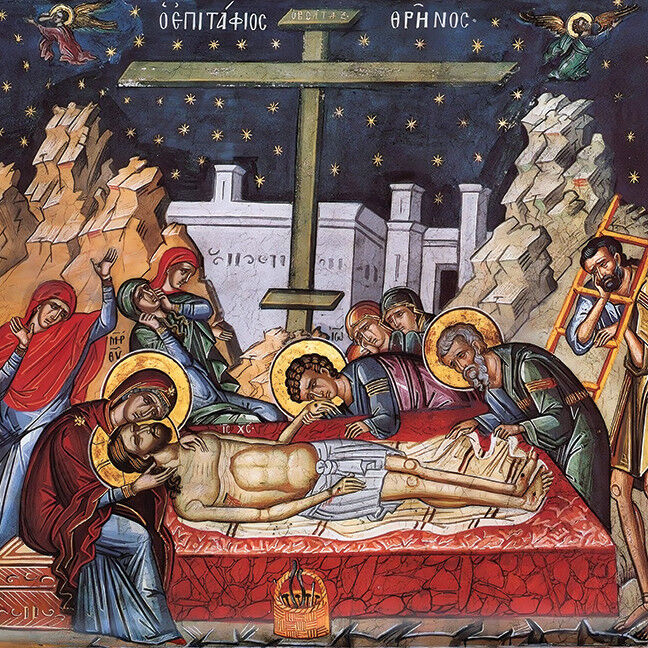
Great and Holy Saturday developed as the Church's observance of the day between the Crucifixion and the Resurrection, keeping the Sabbath of Christ's rest in the tomb. In parish practice the Matins of Holy Saturday is frequently anticipated on Friday evening and is structured as a funeral service for Christ, centered on the Epitaphios, an icon in the form of an embroidered cloth bearing the image of the dead Christ prepared for burial.
The Matins service incorporates verses of Psalm 118 interspersed with hymns of lamentation known as enkomia, though the predominant mood is one of watchful expectation rather than mourning. Near the conclusion of Matins, during the Great Doxology, the Epitaphios is carried in procession, in many communities through the surrounding streets, while the Trisagion is sung in funeral style and church bells toll in funeral rhythm, mirroring Orthodox funeral practice.
On Saturday, at what tradition reckons as the tenth hour of the day, the Vesperal Divine Liturgy of Saint Basil the Great is celebrated. Described as the longest Divine Liturgy of the entire year and known as the First Resurrection Service, it features fifteen Old Testament readings recounting salvation history, many connected to Passover, baptism, or resurrection. A distinctive liturgical transition occurs before the Epistle: the vestments, altar cloths, and hangings change from dark colors to white, marking the shift from mourning toward the anticipation of the Resurrection.
In this liturgy the traditional Trisagion is replaced by the baptismal hymn drawn from those who have been baptized into Christ having put on Christ, the Epistle reading is Romans 6:3–11 on death and resurrection in baptism, and the Gospel is Matthew 28:1–20, encompassing the full Resurrection account. The faithful continue fasting throughout Holy Saturday, and the Paschal greeting is not exchanged until after midnight during the Paschal Vigil, since the announcement of the Resurrection to earthly believers belongs to that moment.
Meaning
The theological heart of Great and Holy Saturday is Christ's descent into Hades, the event Orthodox tradition calls the Harrowing of Hades. Tradition holds that while His body rested in the tomb, Christ performed in spirit His descent to the realm of the dead, preaching salvation to those held captive throughout history and raising them up to Paradise, having liberated those who had been held.
Through this descent the Church proclaims Christ's triumph over death itself. The imagery of the day speaks of the shattered gates and broken chains of Hell, and the hymnography describes Christ slaying hell with the splendor of His Godhead and raising the dead from the depths, so that the powers of Heaven cried out. The Kontakion of the day portrays this as the most blessed Sabbath on which Christ has fallen asleep to rise on the third day, presenting the Immortal One laid in a tomb as a mortal man while the myrrh-bearing women prepare to anoint Him.
Orthodox theology positions the descent into Hades as inseparable from an understanding of the Resurrection and of humanity's redemption. The traditional icon of the event, called the Anastasis or Resurrection, depicts Christ rescuing Adam and Eve from Hades, surrounded by the righteous of the Old Testament. In it Christ grasps Adam and Eve by their wrists rather than their hands, expressing the teaching that humanity could not raise itself out of the fall but that its deliverance came about only by the work of God.
Iconography
The icon associated with Great and Holy Saturday is the Anastasis, a title that means Resurrection, which depicts what Orthodox Christians hold to be the spiritual reality accomplished by Christ's death and resurrection. It shows the Harrowing of Hades: Christ rescuing Adam and Eve from Hades, surrounded by the righteous figures of the Old Testament. Christ is shown grasping Adam and Eve by their wrists rather than their hands, expressing the teaching that humanity could not pull itself out of the fall, and that its deliverance came about only by the work of God.
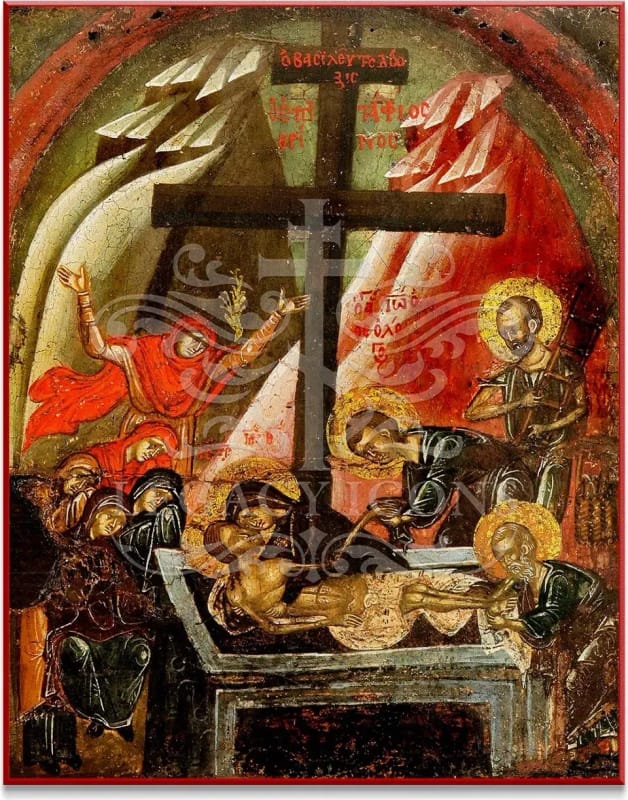
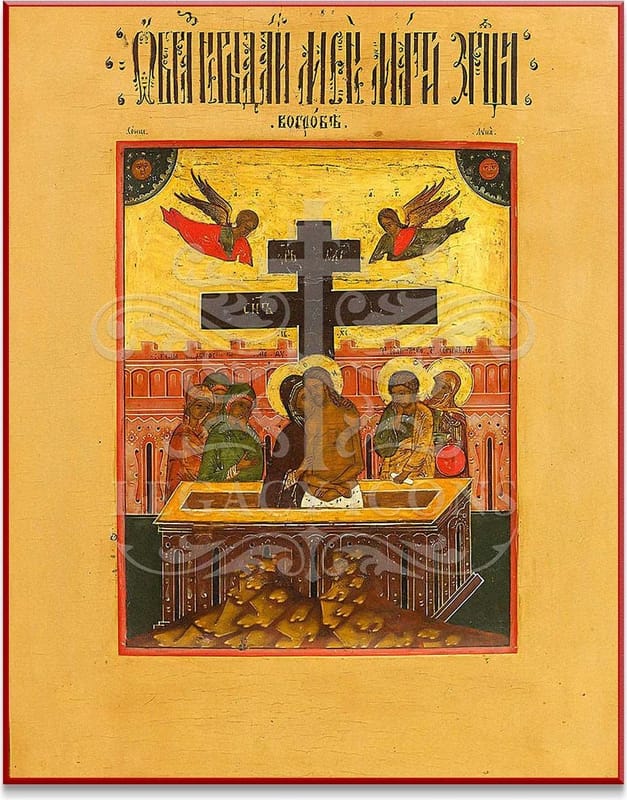
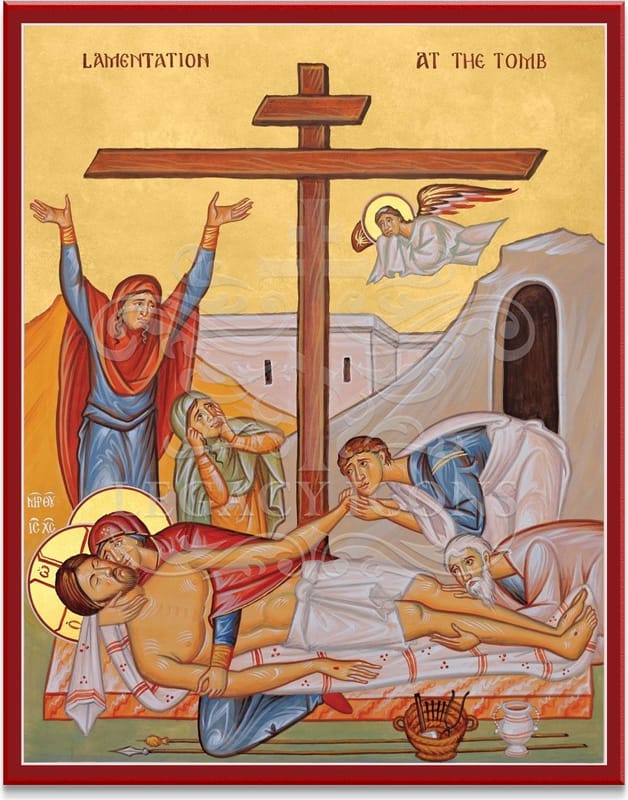
The other central image of the day is the Epitaphios, a liturgical cloth icon depicting Christ's dead body after its removal from the cross. It typically consists of a large, embroidered and often richly adorned cloth bearing the image of the dead Christ, frequently accompanied by figures such as Mary, John the Evangelist, Joseph of Arimathea, and Mary Magdalene. The cloth commonly has a burgundy border edged in gold, often with the troparion of Holy Saturday embroidered in gold letters around its edge. In later Byzantine practice this burial scene was sometimes painted in church apses below images of Christ Pantocrator, illustrating the concept of Christ enthroned above and in the tomb below.
Hymnography
The hymnography of Great and Holy Saturday holds together the day's twofold theme of burial and victory. The troparion recalls the noble Joseph, who took down Christ's most pure body from the tree, wrapped it in fine linen, anointed it with spices, and placed it in a new tomb. A second troparion turns to Christ's triumph, describing how in descending to death He slew hell with the splendor of His Godhead and raised the dead from the depths, at which all the powers of Heaven cried out. The Kontakion names the day as the most blessed Sabbath on which Christ has fallen asleep to rise on the third day.
At Matins the service includes the Epitaphios lamentation, in which worshippers hold lighted candles and sing the enkomia, or lamentations, before the Epitaphios cloth as though at Christ's tomb, alternating with verses of Psalm 118. In the Vesperal Liturgy the Trisagion is replaced by the baptismal hymn sung over those baptized into Christ, and Psalm 81 (82) replaces the customary Alleluia while the deacons perform a ritual censing.
Fasting in Practice
The faithful continue fasting throughout Great and Holy Saturday. The Paschal greeting is not exchanged until after midnight during the Paschal Vigil, since the announcement of the Resurrection to earthly believers belongs to that moment rather than before it. Fasting disciplines vary by tradition and typikon, and questions of practice are best resolved with one's own priest.
Customs & Traditions
The Vesperal Divine Liturgy of Saint Basil the Great is served, at which the vestments, altar cloths, and hangings are changed from dark colors to white before the Epistle reading.
In many places the whole Book of Acts is read before the midnight Paschal service.
At Matins the Epitaphios is carried in procession, in many communities through the surrounding streets, accompanied by the Trisagion sung in funeral style; in Greek tradition an elaborate carved canopy called a kouvouklion may shelter the cloth, representing Christ's tomb.
Greek tradition: the priest in bright vestments strews laurel and bay leaves and flower petals throughout the church, symbolizing the shattered gates and broken chains of Hell.
Greek and Arabic custom: congregational noise-making — stamping, banging pews, and clanging pots — represents Christ breaking the chains of Hell.
In Palestine and the Levant the day is called sabt an-nur (Saturday of Light), commemorated through the Holy Fire ceremony at the Church of the Holy Sepulchre.
Scripture
- Romans 6:3-11 — Epistle of the Vesperal Liturgy, on death and resurrection in baptism.
- Matthew 28:1-20 — Gospel of the Vesperal Liturgy, the full Resurrection account.
- 1 Peter 3:18-19 — Scriptural support for Christ's proclamation to the spirits.
- Ephesians 4:8-9 — Scriptural support for Christ's descent into the lower regions.
- Psalm 118 — Sung interspersed with the enkomia (lamentations) at Matins.
The Harrowing of Hades
The Harrowing of Hades is Christ's descent into the realm of the dead between His crucifixion and resurrection, which Eastern Orthodox tradition treats as central to the history of salvation. Its scriptural support is found in passages including 1 Peter 3:18–19 and Ephesians 4:8–9, which describe Christ's proclamation to the spirits and His descent into the lower regions.
In the Orthodox Church the Harrowing of Hades is commemorated annually on Great and Holy Saturday during the Vesperal Divine Liturgy of Saint Basil. The liturgical transformation of the service — the shift of the clergy from somber colors to white vestments and the strewing of laurel leaves symbolizing the broken gates of Hell — expresses this victory over death, and the annual commemoration places the event at the heart of Orthodox paschal theology.
Fasting is described here at the season-summary level and differs by jurisdiction and person — please consult your parish priest about how to keep the fasts.